Meaningful Street Art About Water Drawings of Dead Trees
INSTALLATIONS
Seven Contemplations
Albright-Knox Northland
September 26, 2022 - January ten, 2021
Curated by: Aaron Ott
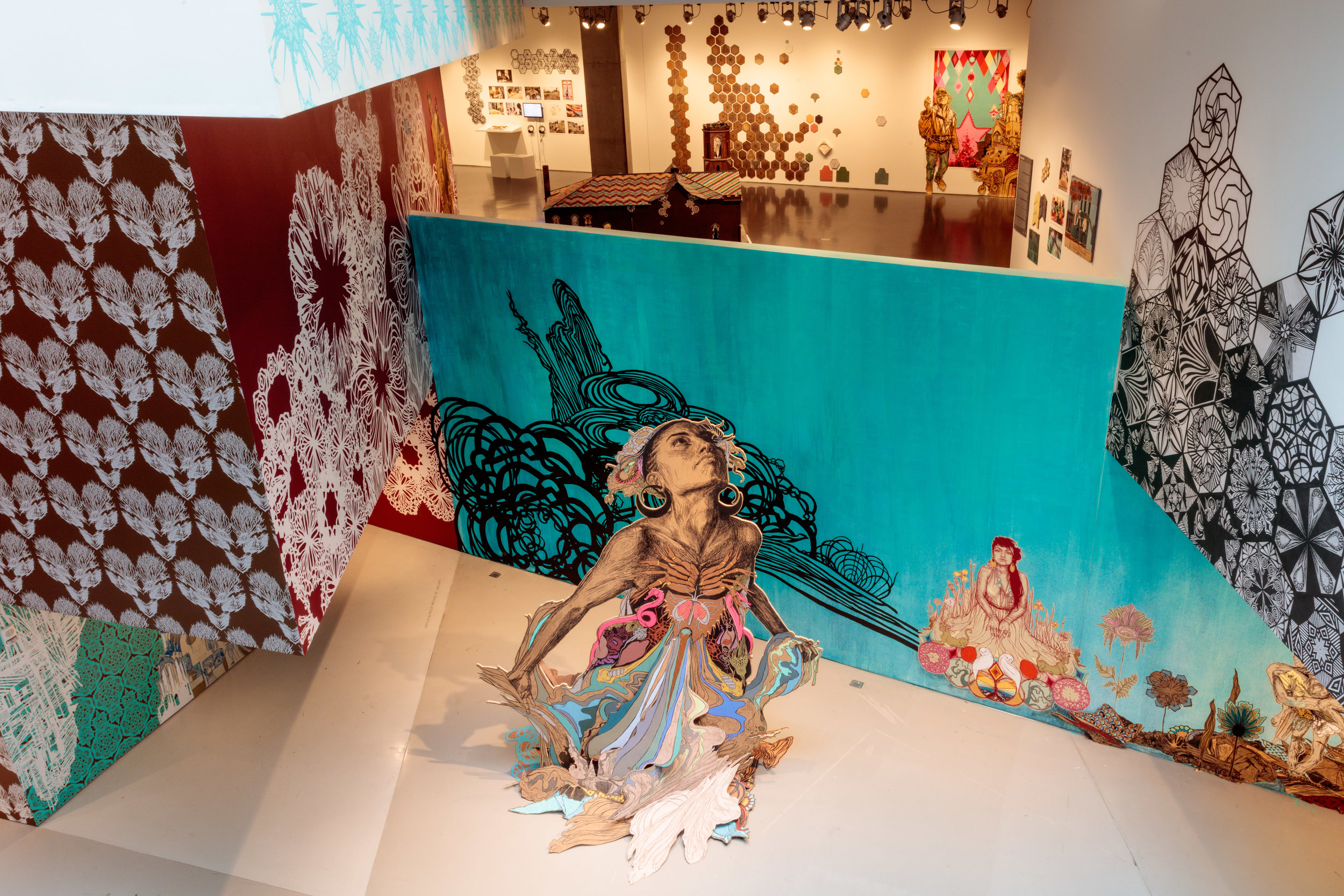
Seven Contemplations is an installation of seven monumental works that craft a meditative journey for the viewer. Curry responds to the cavernous architecture of the viii,000 foursquare foot Albright-Knox Northland with immersive works that cultivate a feeling of awe by looking outward to the immensity of the cosmos, and in to our interior worlds. Drawing from her own contemplative practice, Curry pairs focal points in each installation with a guided, fixed-gaze meditation prompt. Touching on themes including beloved, loss, grief, suffering and forgiveness, the prompts explore the power of sitting with hard emotions, and the possibility for growth and healing we tin access through self-exploration and contemplation.
The installations featured in Seven Contemplations include iconic works from Curry's career, Thalassa, Dawn and Gemma and Memento Mori, alongside newer works including the sculpture and sound installation Medea, Creation and the stop-motility animation Cicada.
Read the Meditation Prompts
Sentinel the Artist Talk: "Creativity, Healing from Trauma, and Collective Liberation" with Prentis Hemphill and Caledonia Back-scratch.
Cicada
Deitch Projects, New York, NY
Nov 14, 2022 - February 1, 2020
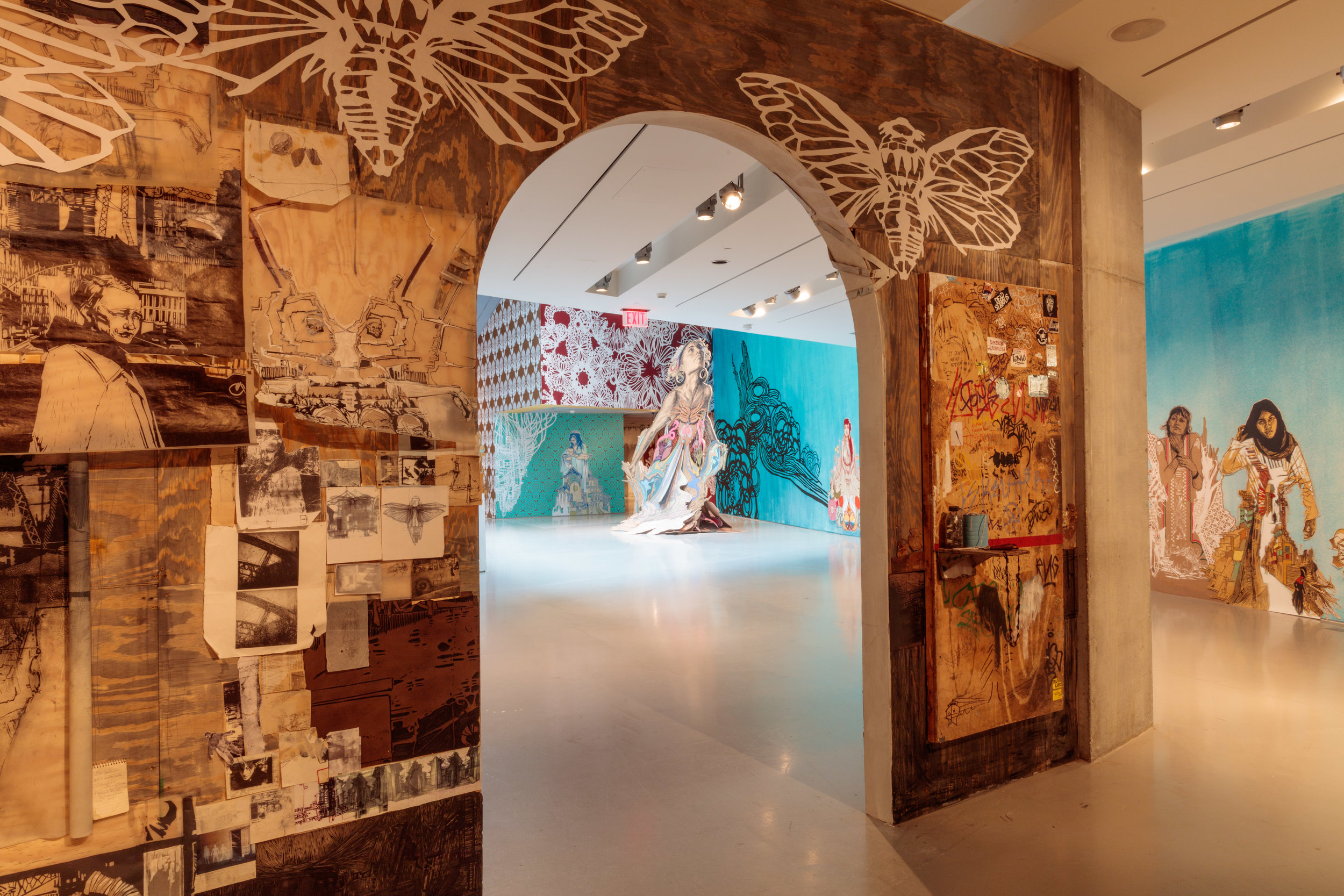
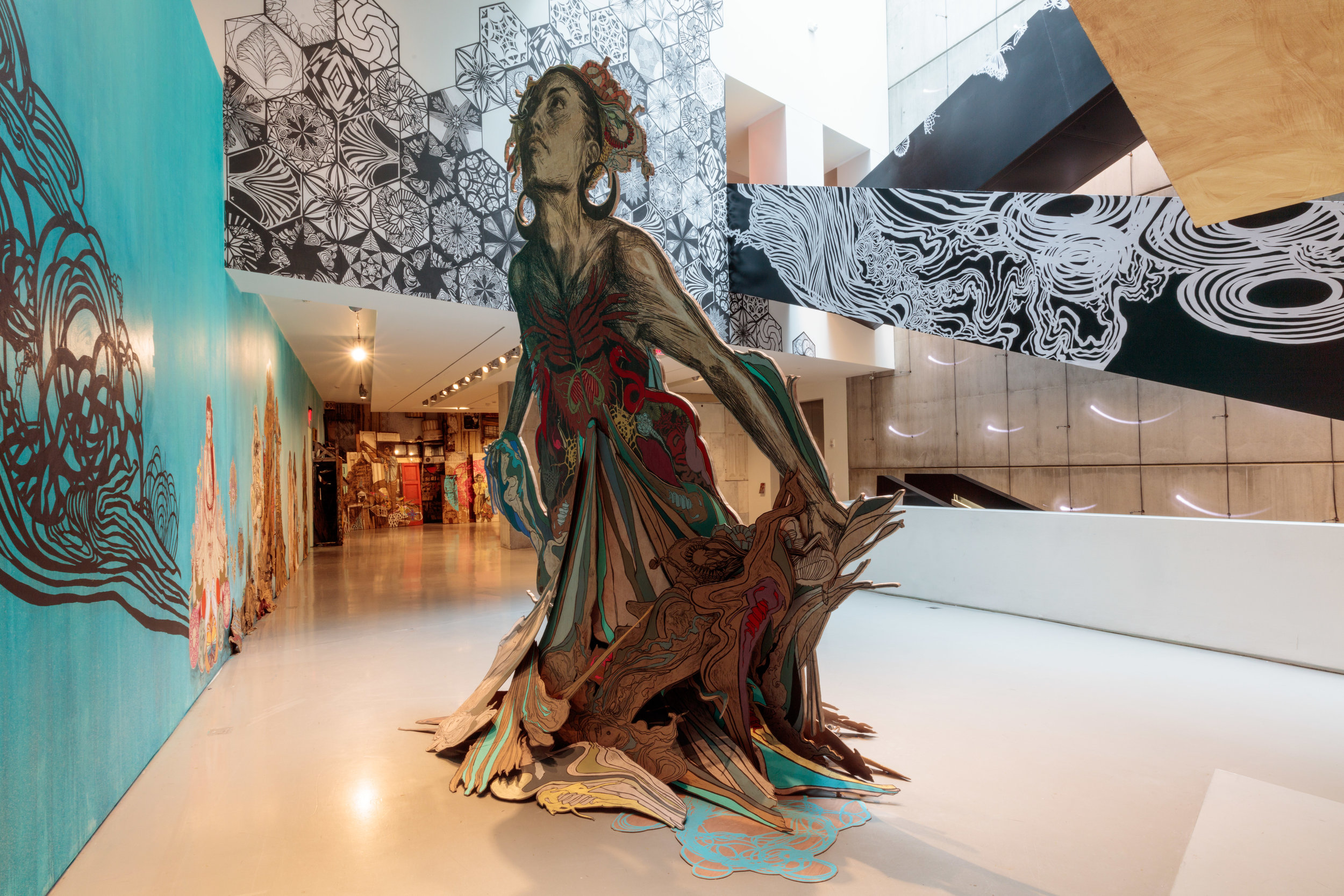
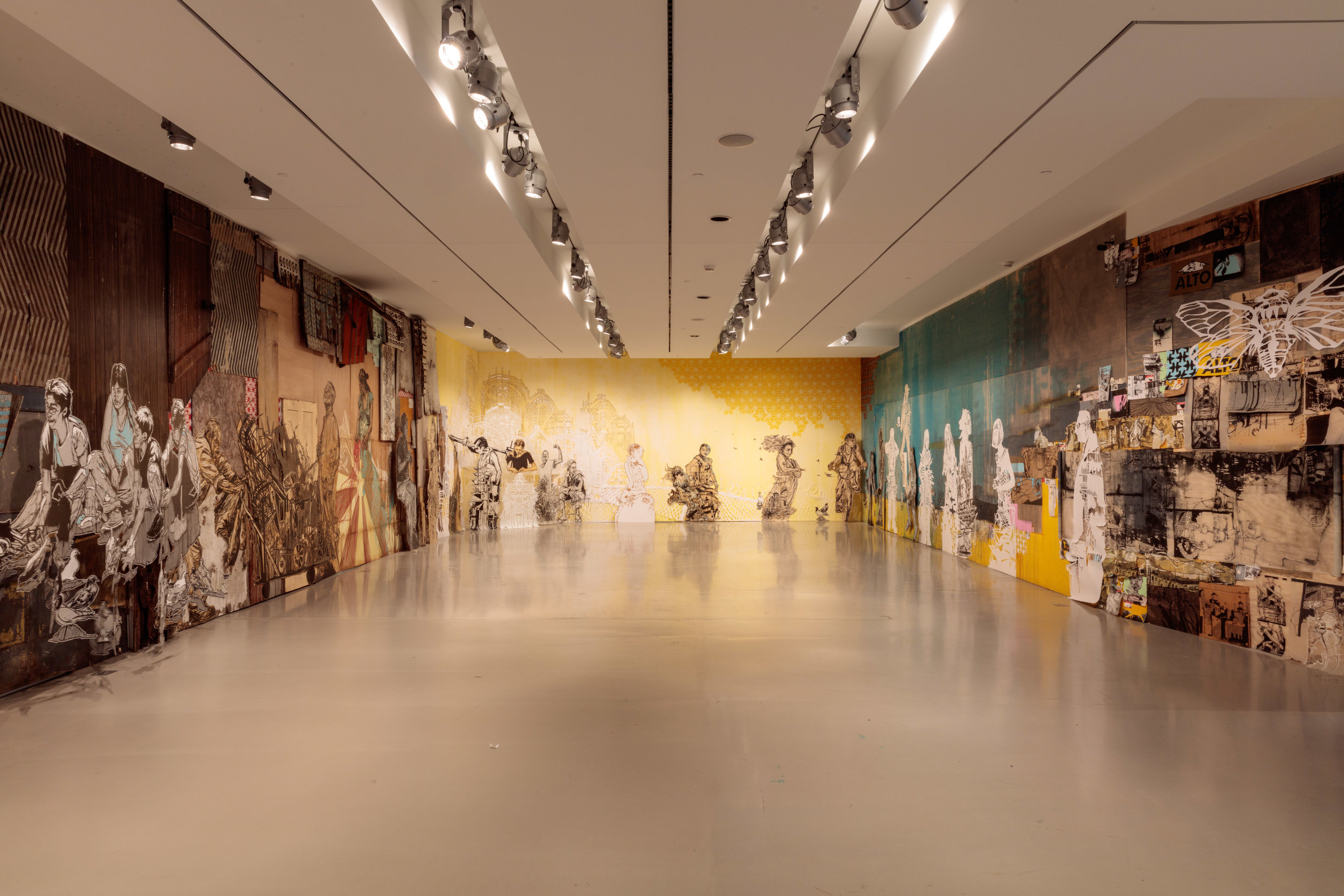
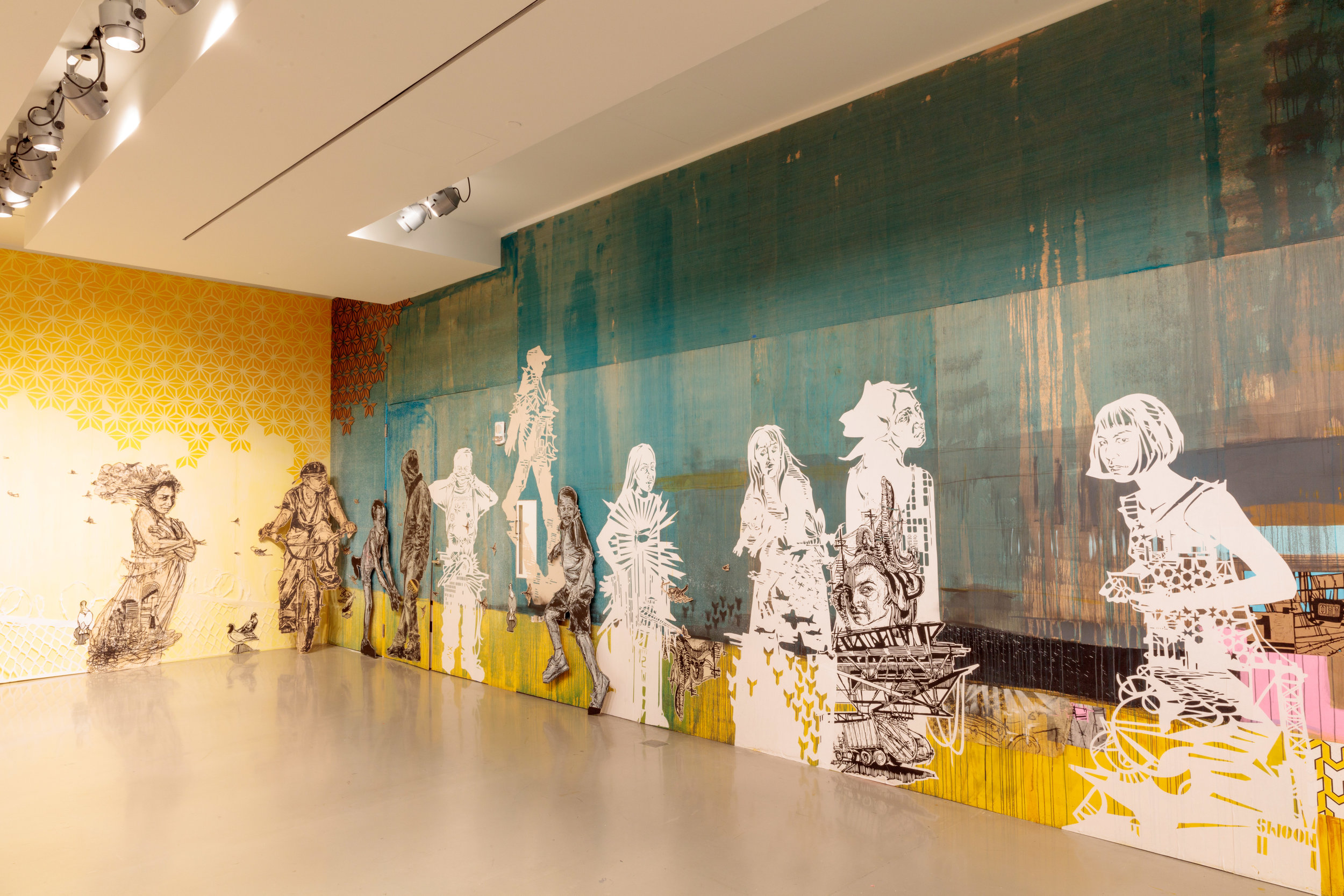
Cicada the exhibition is a site-specific installation that features the premiere screening of Back-scratch's kickoff cease-motion animation of the aforementioned proper name, alongside minimalist pen and charcoal drawings of her close friends, and a re-staging of the puppets and other elements from the film. The cardinal theme of the exhibition metaphorically connects the quiet, often gradual procedure of personal growth to the physical transformations of the cicada cached underground.
Cicada the blitheness is a continuation of themes Curry began exploring in the installation Medea in 2017. Seeking to sympathize the touch of intergenerational trauma and habit in her family, she began a profound inwards journey with psychedelic assisted therapy. In these sessions, she began to enter a regressive state from a very early period in her babyhood, where she would speak in a infant voice. She started to bring along toys similar to ones she had as a child as props, to help process the memories where her psyche had become stuck. Raggedy Ann was originally i of these therapeutic props. Subsequently several sessions with the doll, Raggedy Ann told Curry "I'grand old at present. I tin go." This doll is the first prop from her therapy sessions that she began to incorporate into the picture.
Two other central elements of the film — the house splitting open and the Tarantula Mother — build on motifs first used in Medea. In her dwelling studio, she created immersive environments for these characters using scaled-down versions of the techniques she has developed over the past 2 decades in gallery installations. The deep work Curry was doing in her therapy sessions began to extend into her artistic process. Curry wondered what the characters and props she relied on to help her in speaking while voiceless might limited in the lite of day.
Over the course of filming, the animation procedure became a physical metaphor for the dissociation she sought to understand through her therapy sessions. She worked intuitively, without a storyboard, assuasive each frame to dictate the next. To create a curt prune required hours of disjointed labor, constantly stopping and starting with only subtle shifts between. At a frame rate of 8 frames per second, the animations had a flickering quality that gestured to the gaps in data just under the surface as if they were the memories that remained lost. In this way, the unique power of stop-motion animation to capture and express the dissociative quality of Curry'due south inner experience mobilized the artistic process equally an extension of her inner journey.
The formidable force of mythology was another approach Curry incorporated to give vocalism to the darkest corners of the human psyche. The goddess Hectate presides over birth and death and can see frontwards and backward in time. Medea, the sorceress best known for killing her children, was a priestess and devotee. Hectate appears in the blitheness equally a kaleidoscopic spinning bicycle, growing, irresolute and turning. In the myth of Persephone, it is the witch Hectate who allows Demeter to find her lost daughter in the depths of the underworld. Demeter, the embodiment of the nurturing female parent and protectress, appears to envelop and heal the house split apart.
For Curry, the blitheness process was a way to locate demons within herself, await them in the middle and interact with them in order to diminish their subversive force. The central message in the film Cicada is the healing bulletin contained in Hectate's wheel: that the regenerative power held in these archetypal tales is not locked away in the by, simply is available to accompany and assist us if we allow it.
Cicada is Curry's third solo exhibition at the Deitch Projects, which was the premiere of the curt motion picture of the aforementioned name. Cicada the animation has been exhibited in Vii Contemplations at the Albright-Knox Foundation (2020), and is now part of their permanent collection. Information technology was screened at Wholeness in Mind at Turner Carroll Gallery (2021) and Superchief Gallery NFT (2021).
Sentry Cicada Mini-Doc by Frederic King



Haven
Skissernas Museum, Lund, Sweden
January 28, 2022 - Nov 21, 2018
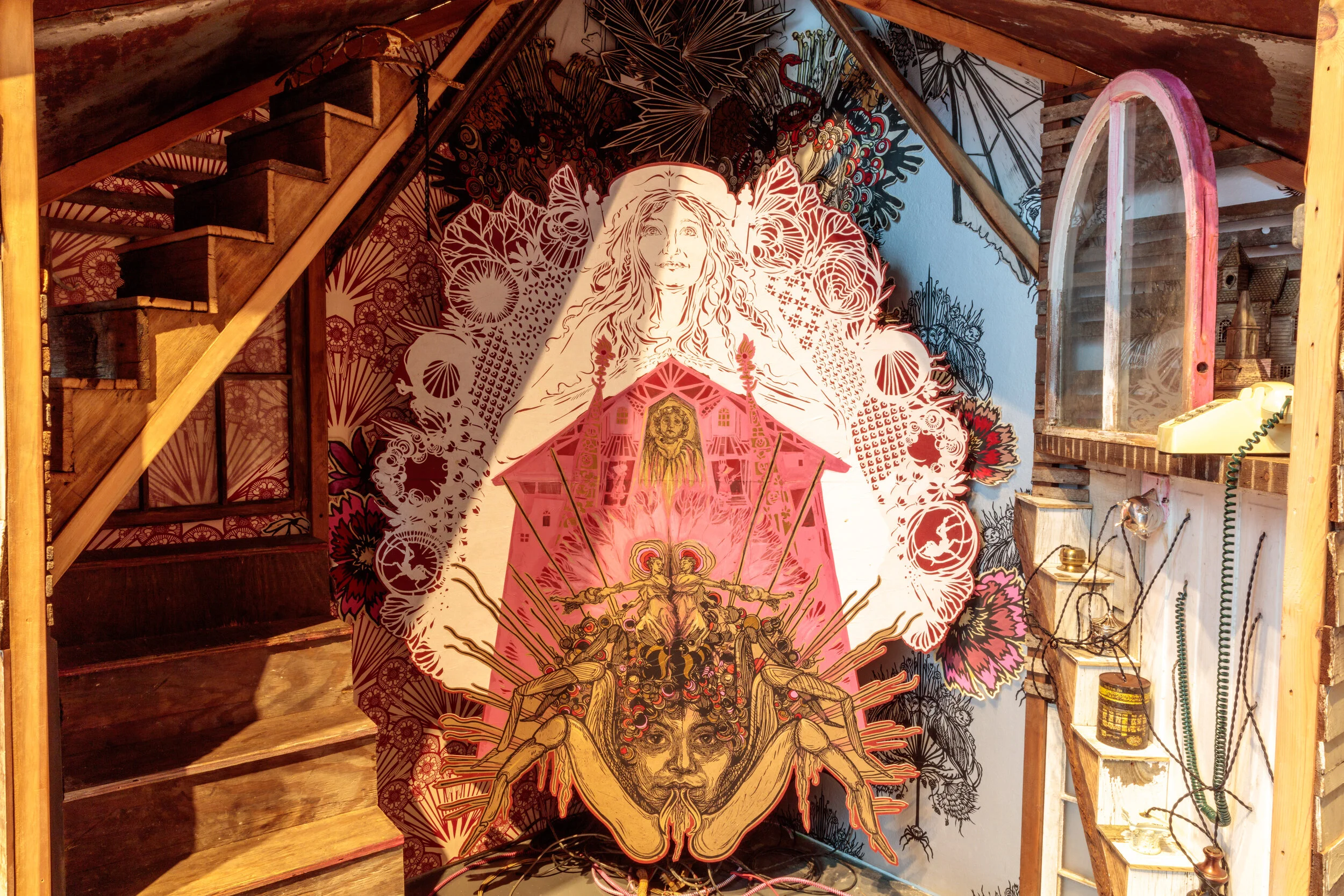
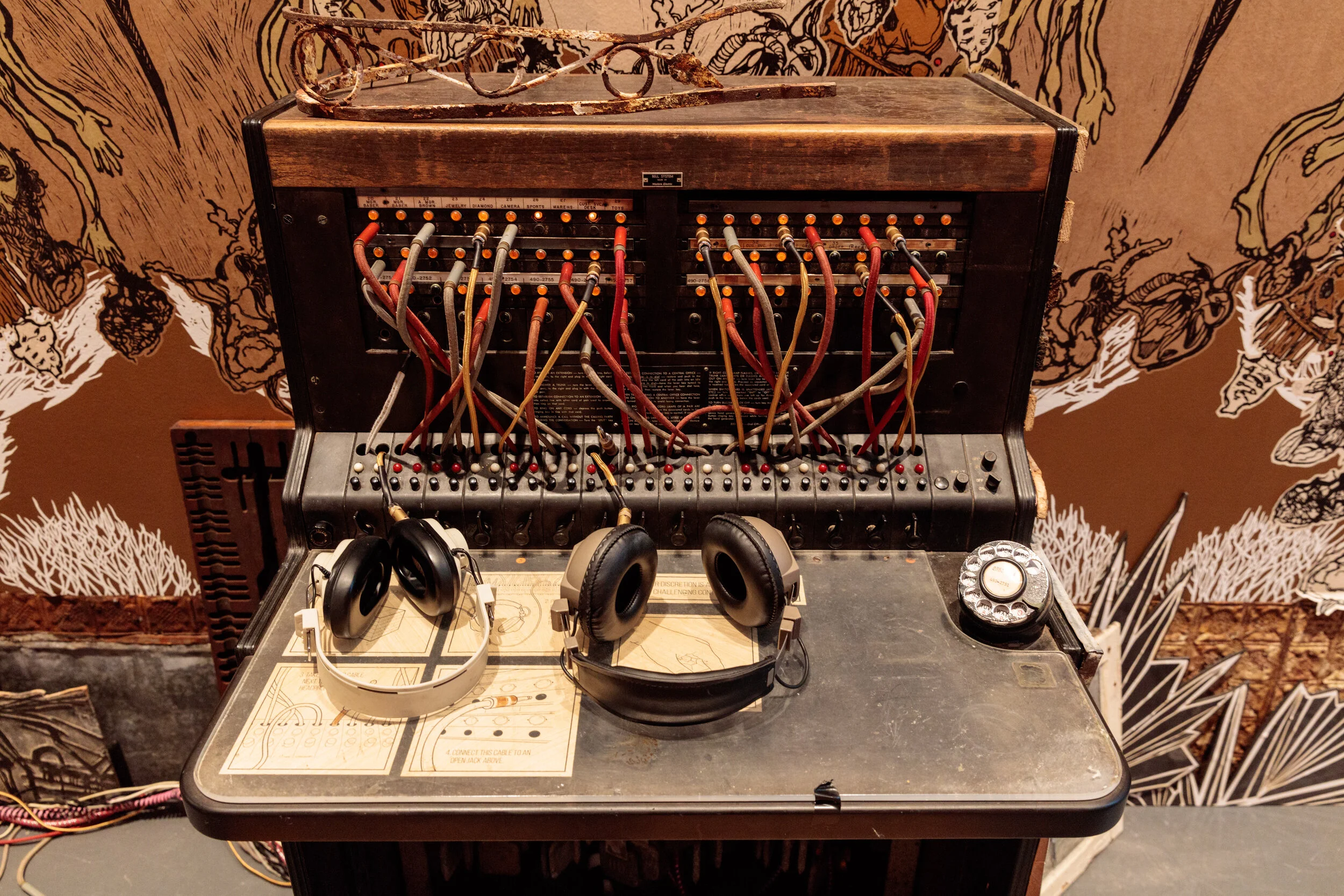
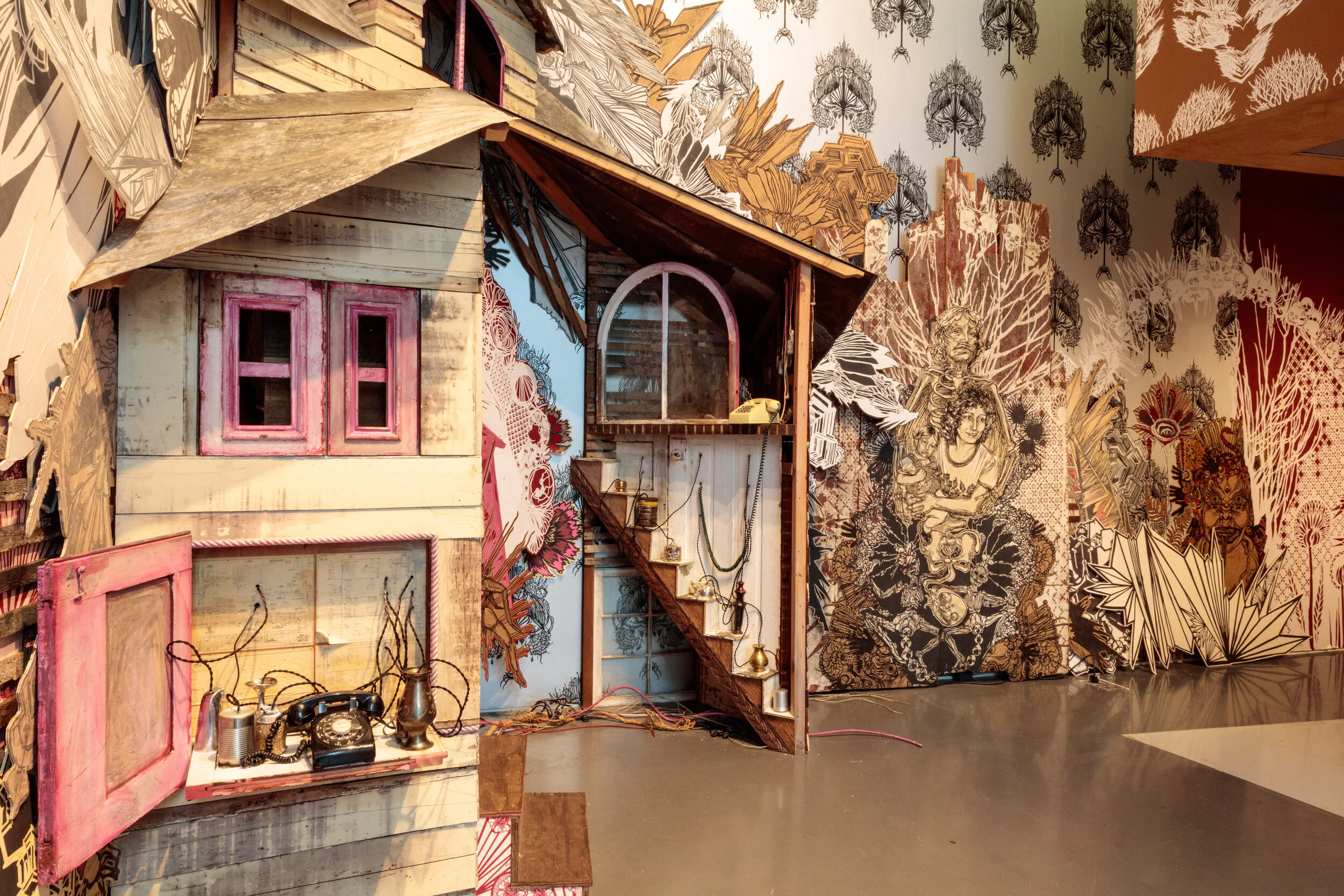
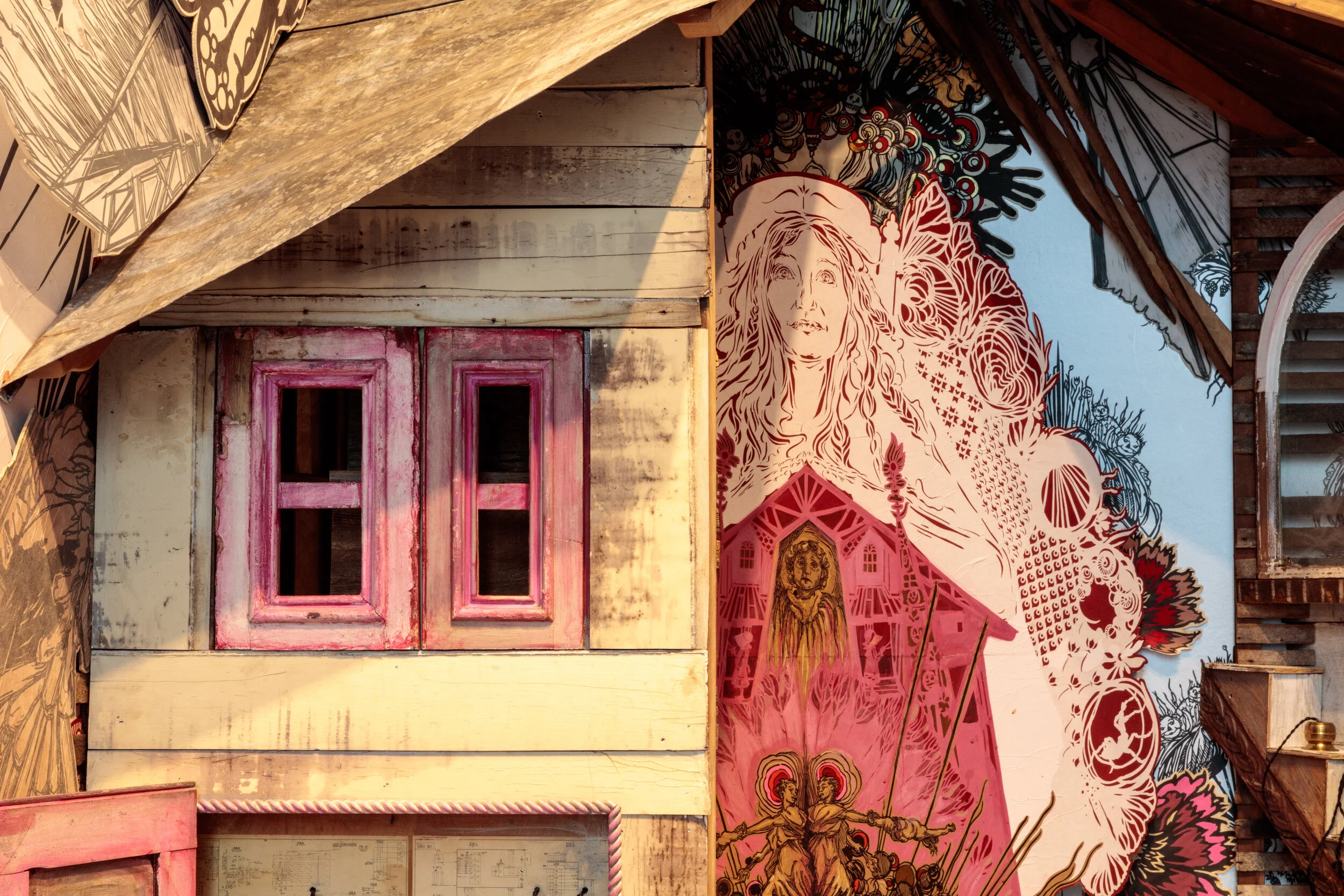
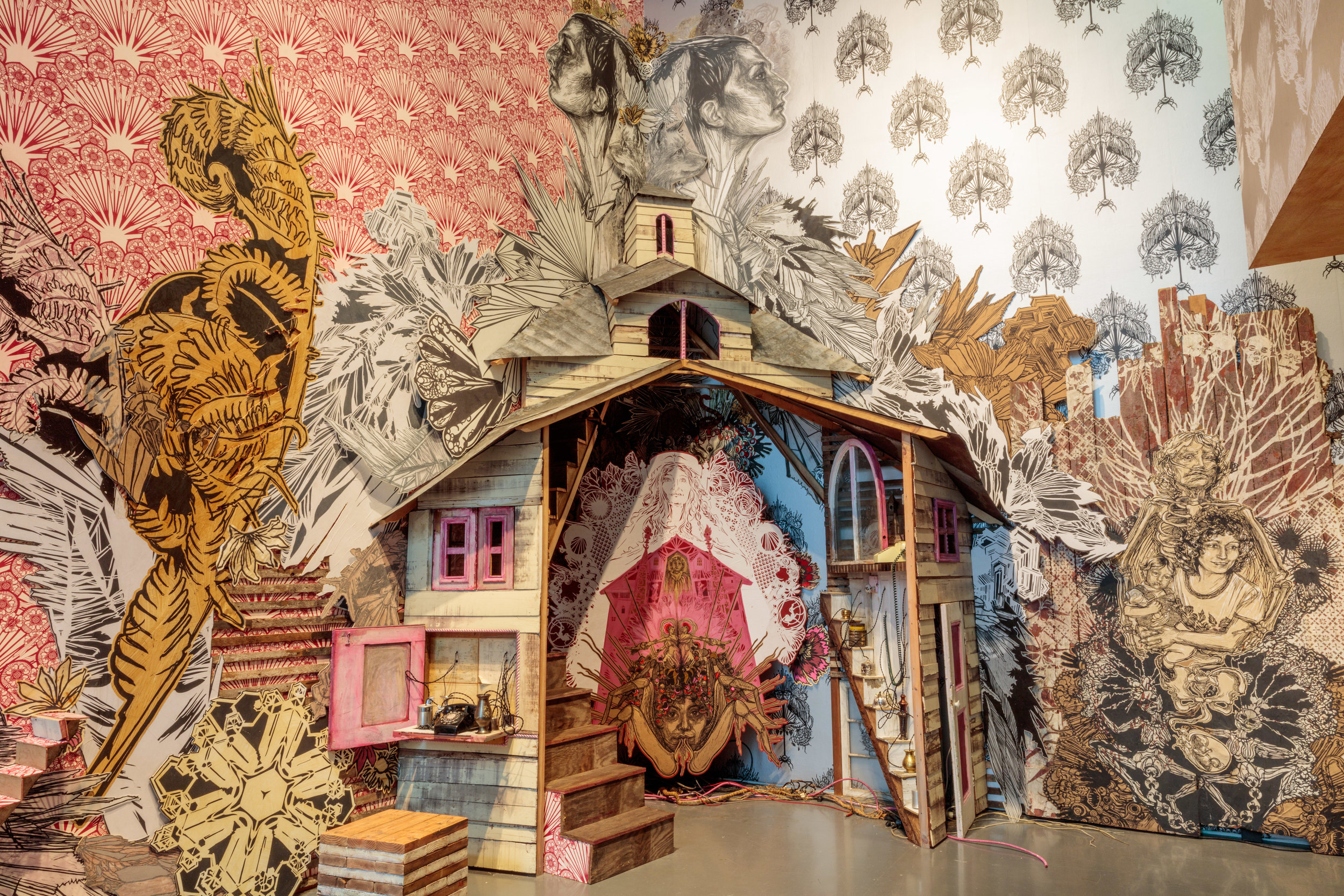
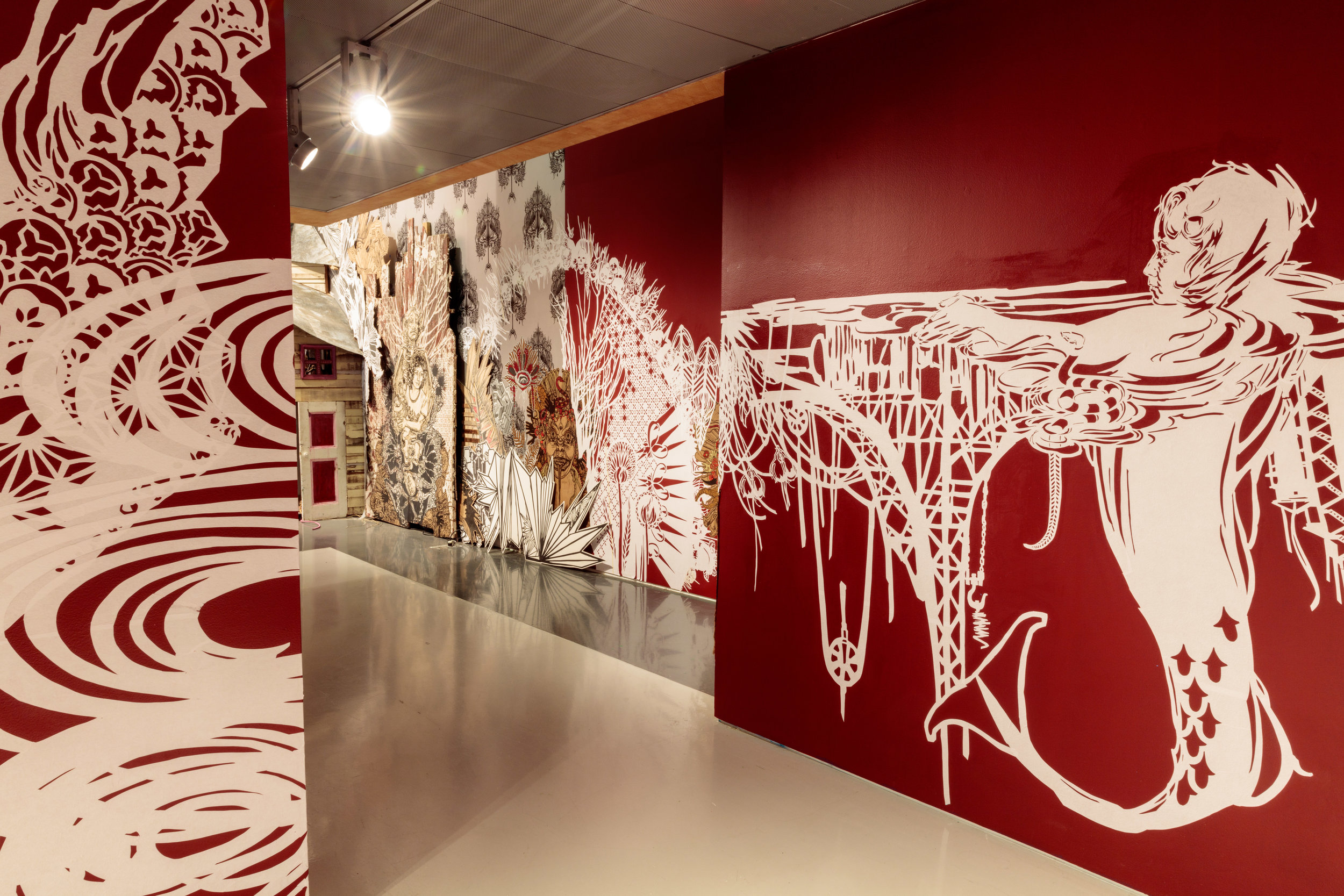
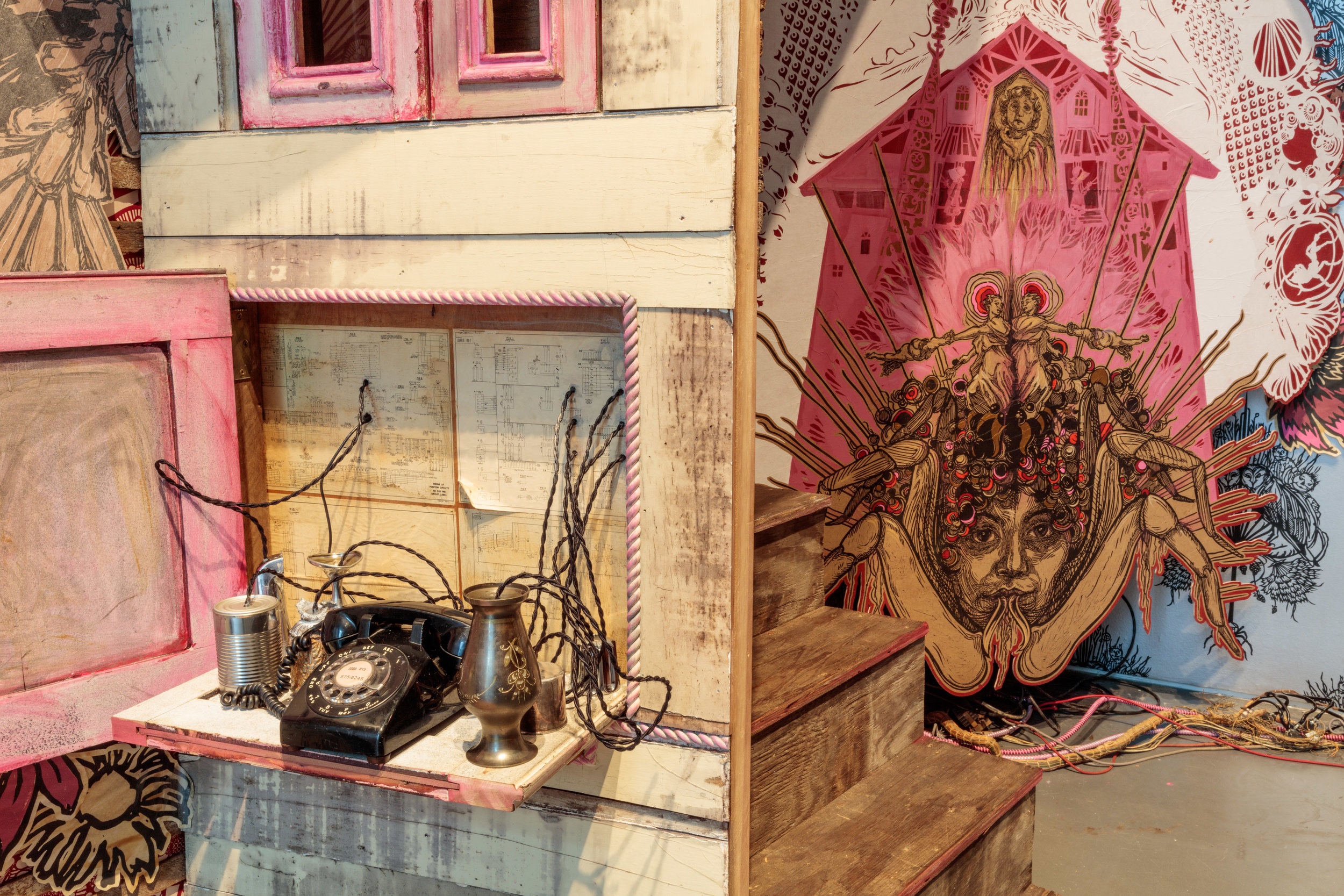
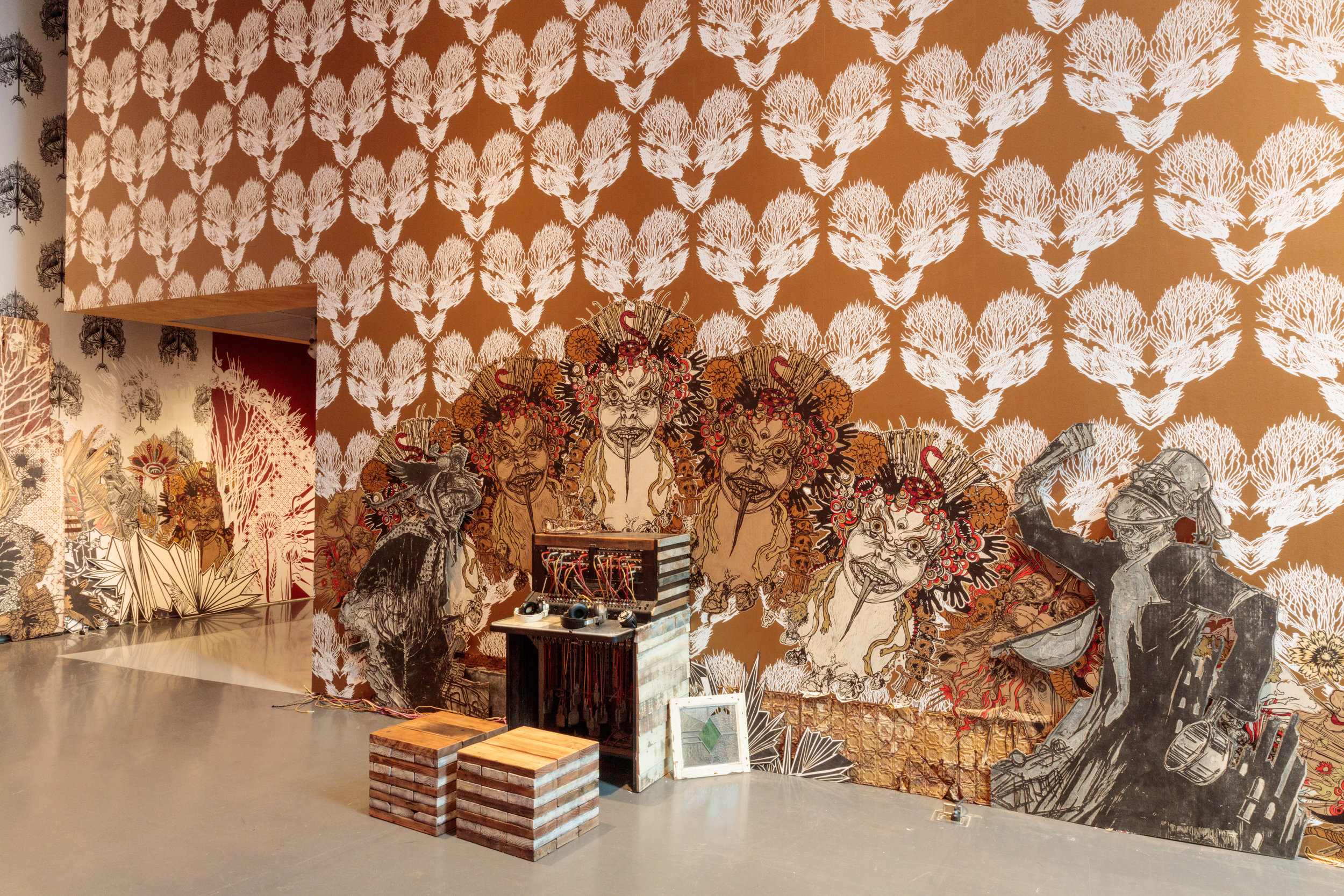
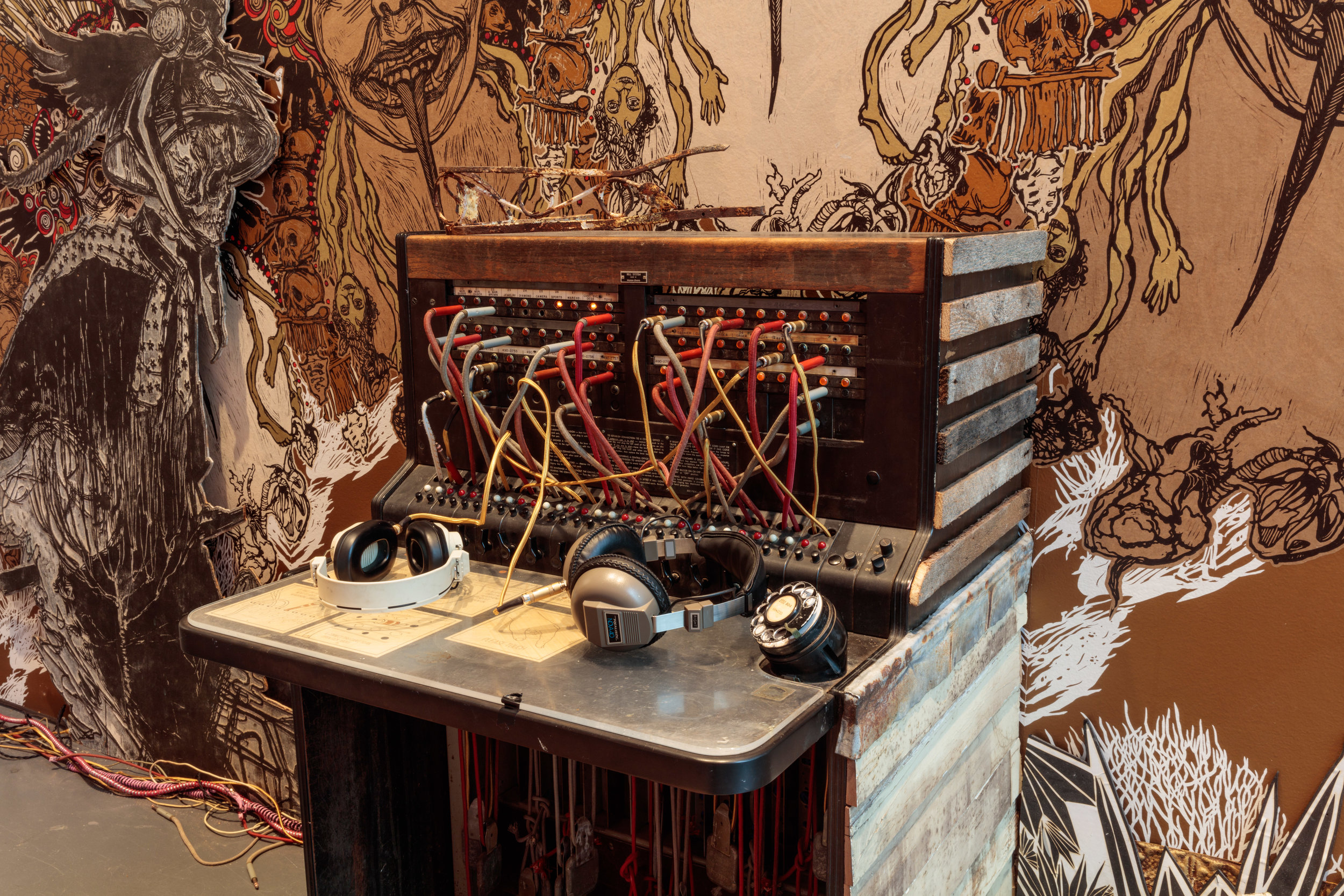
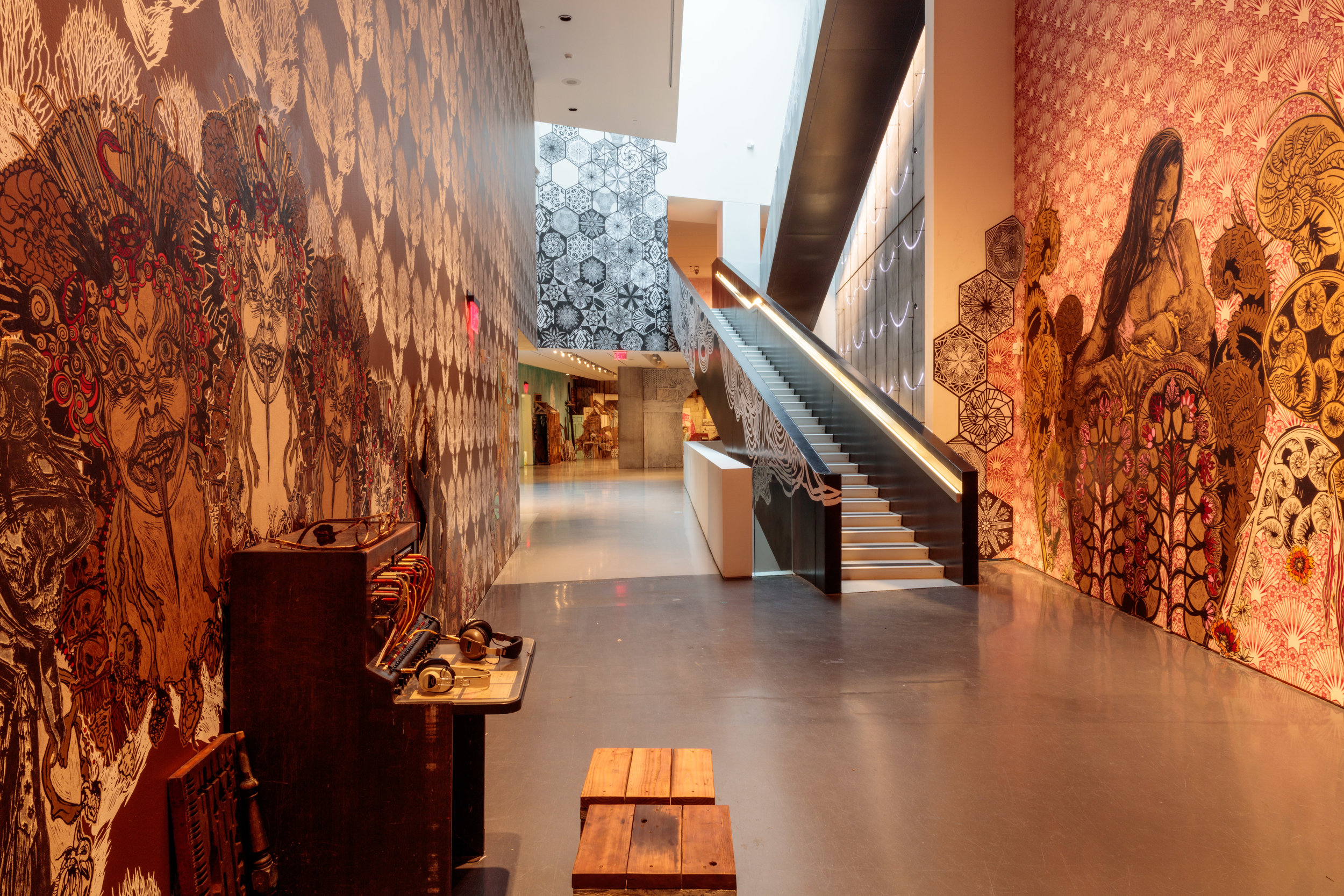
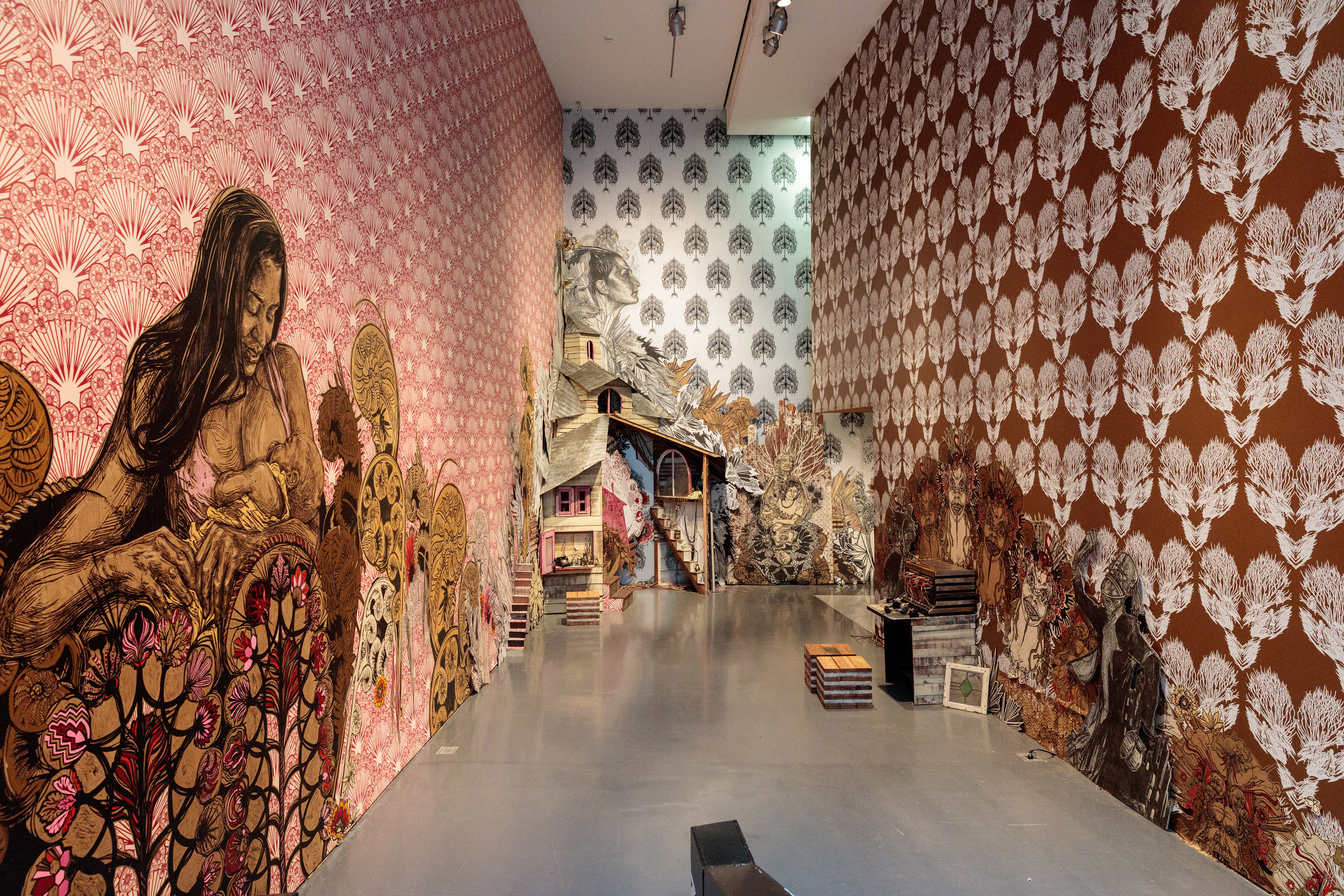
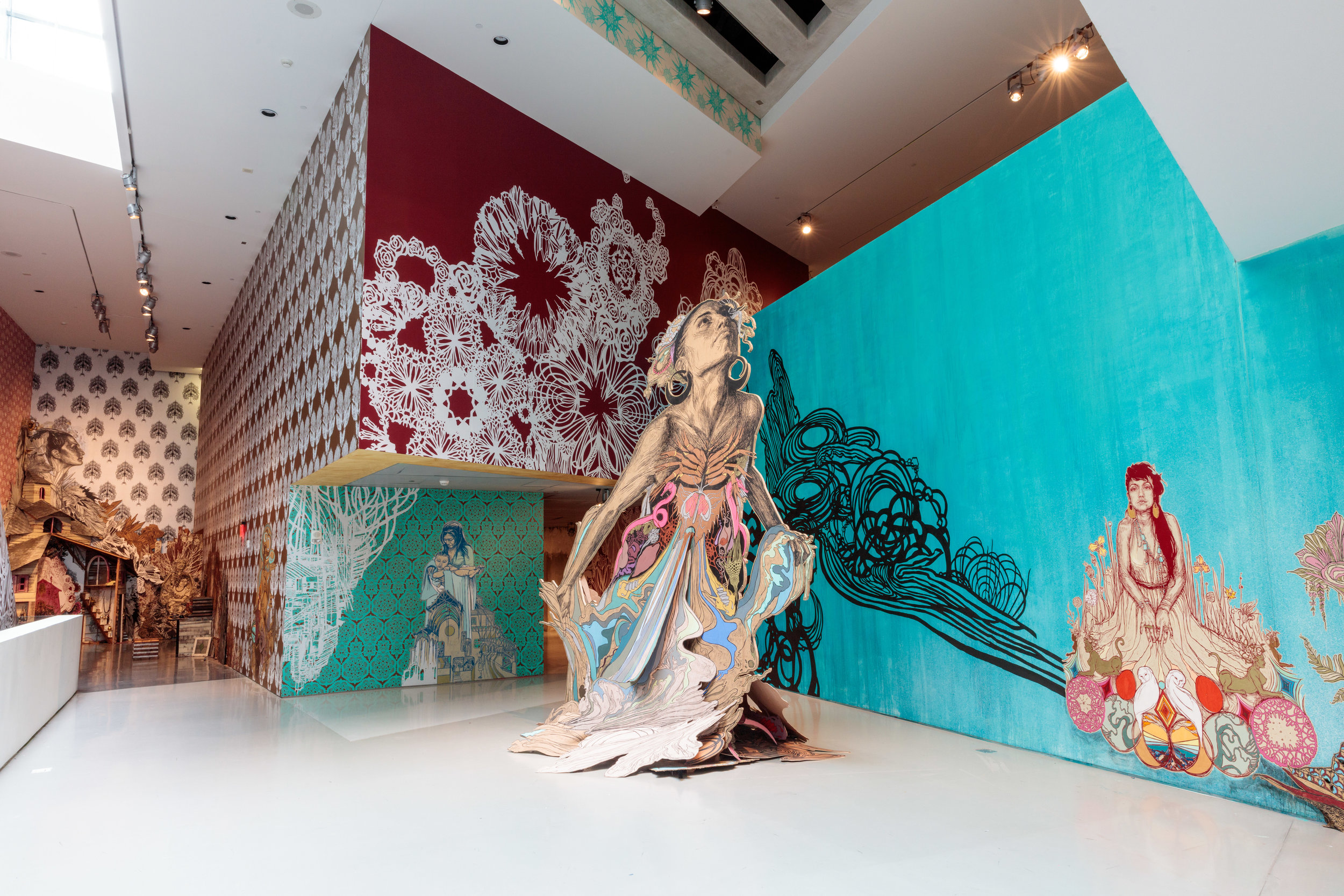
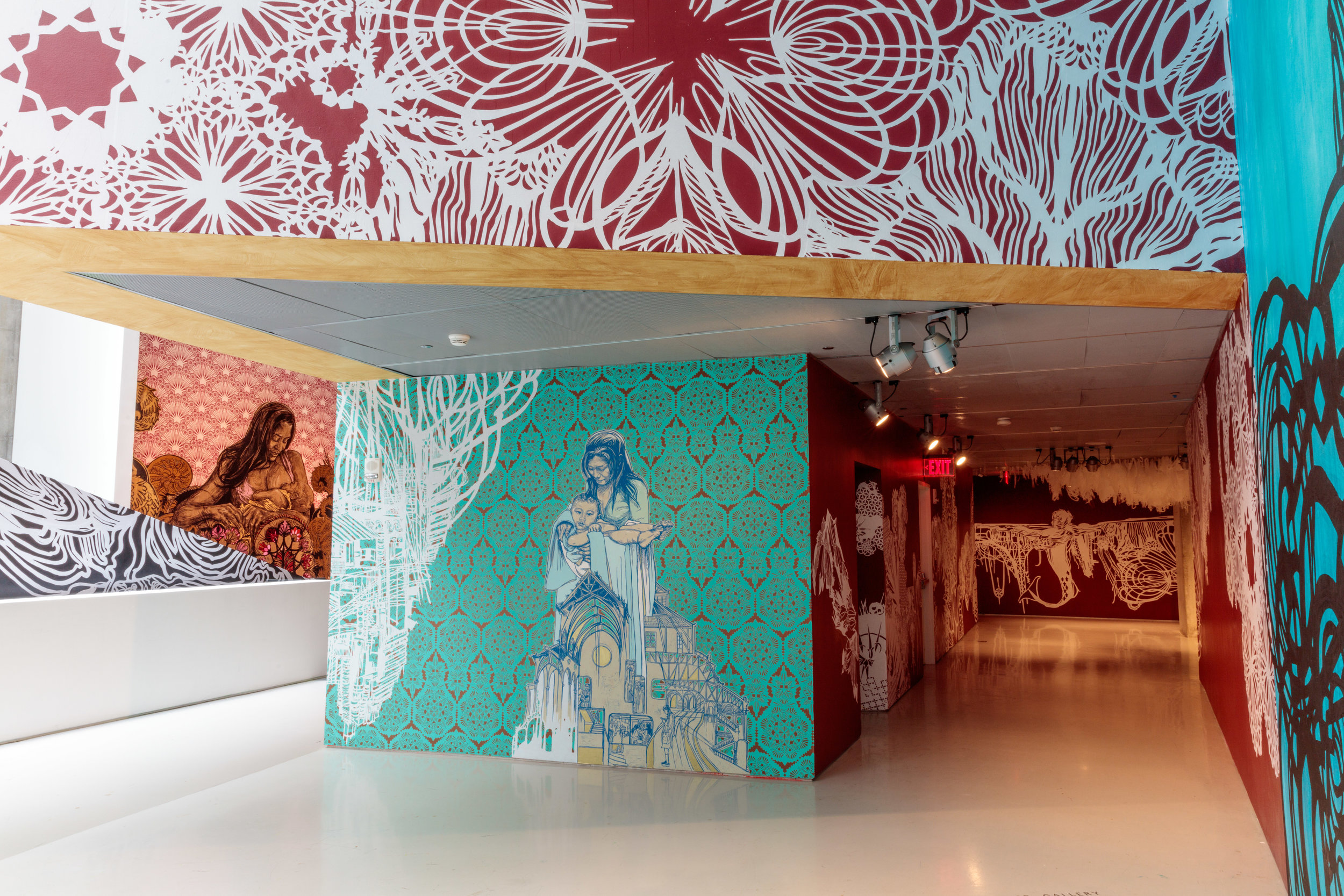
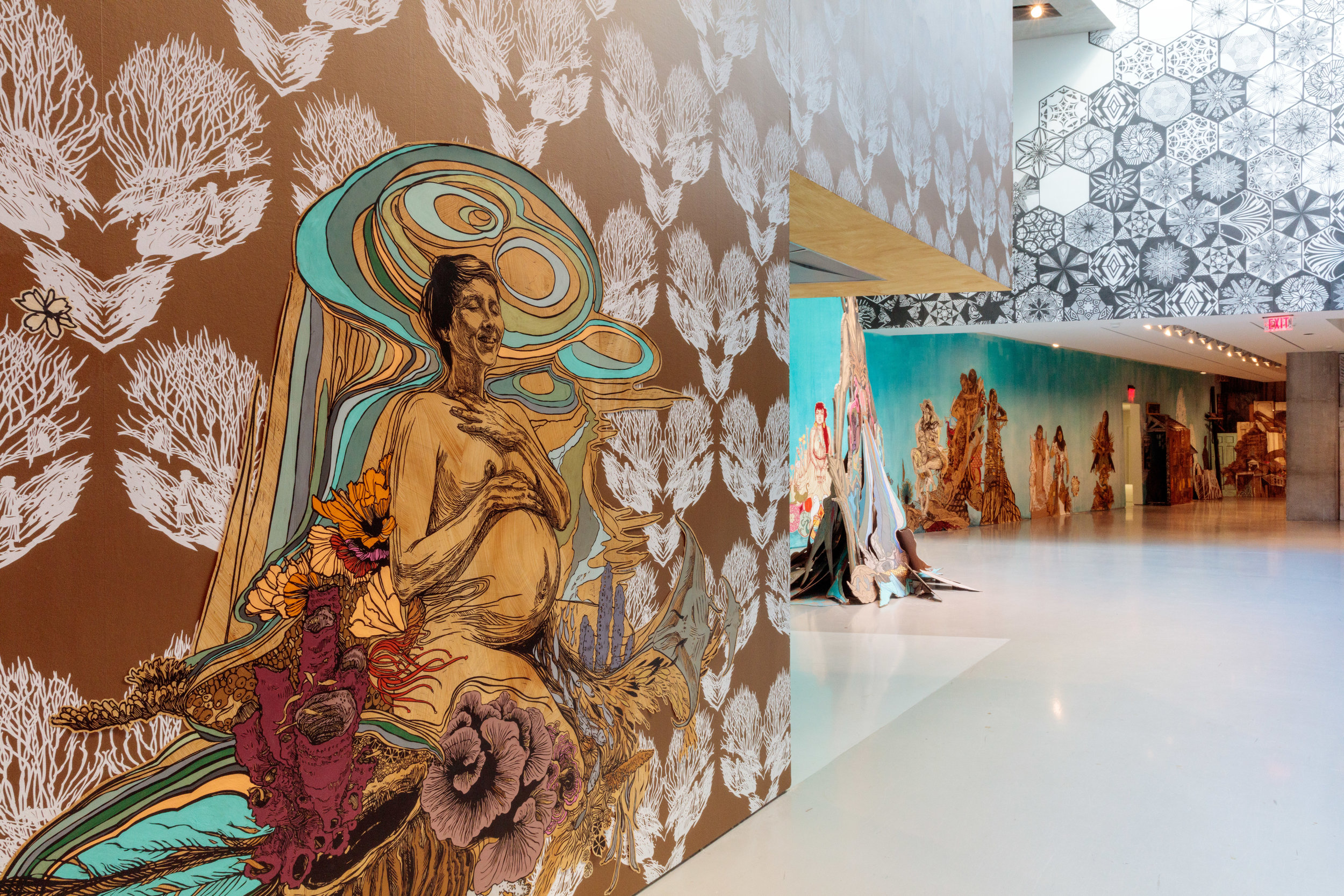
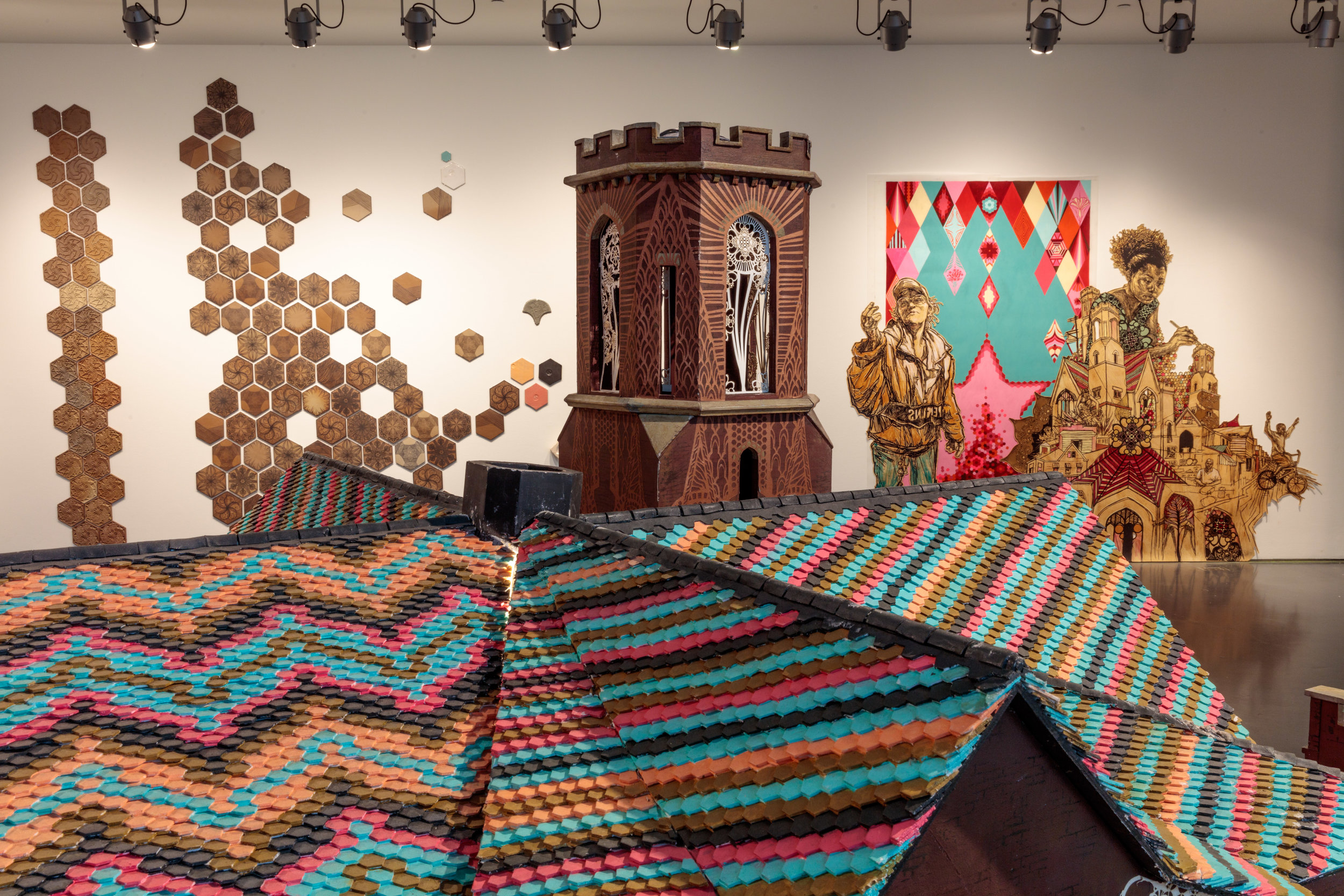
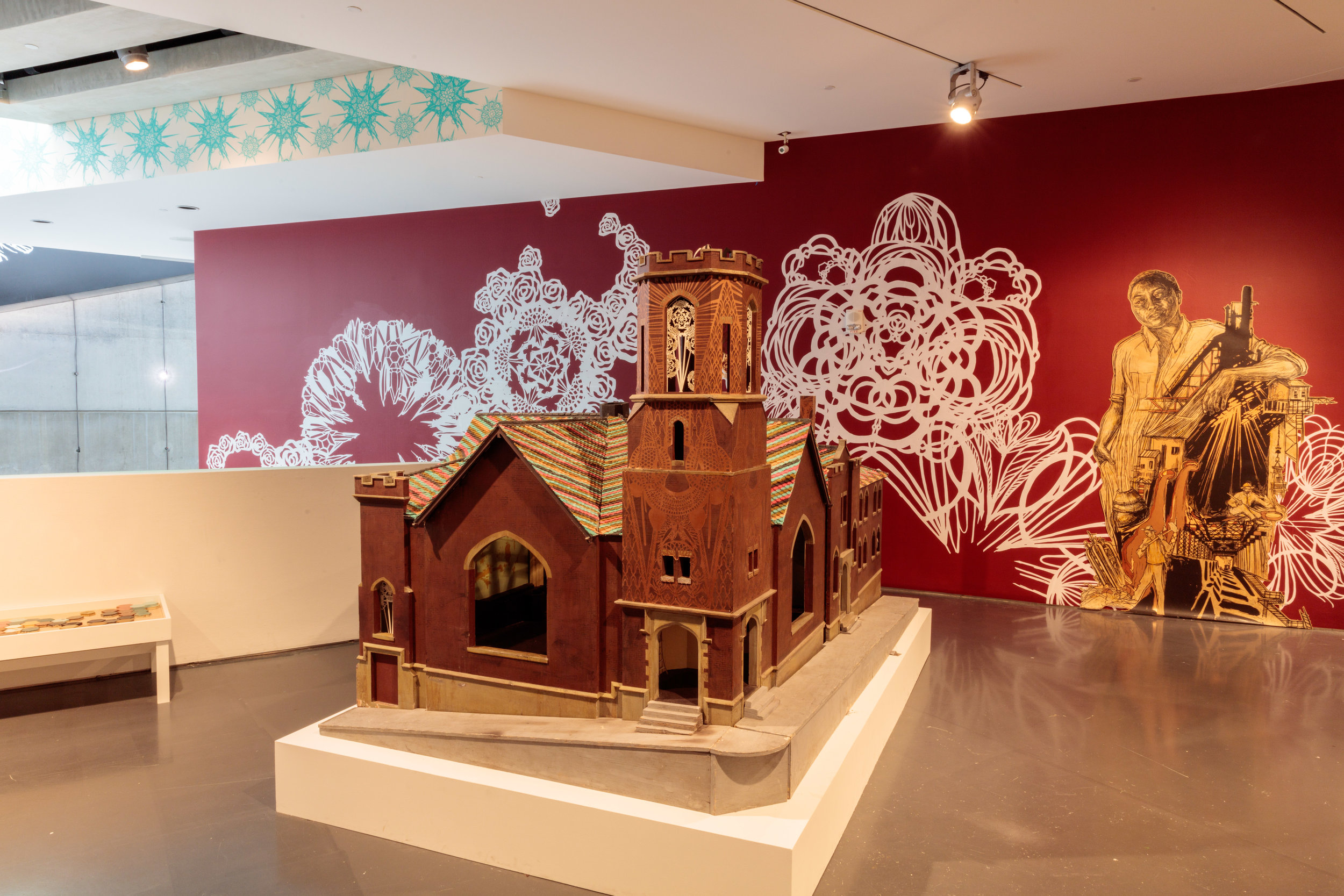
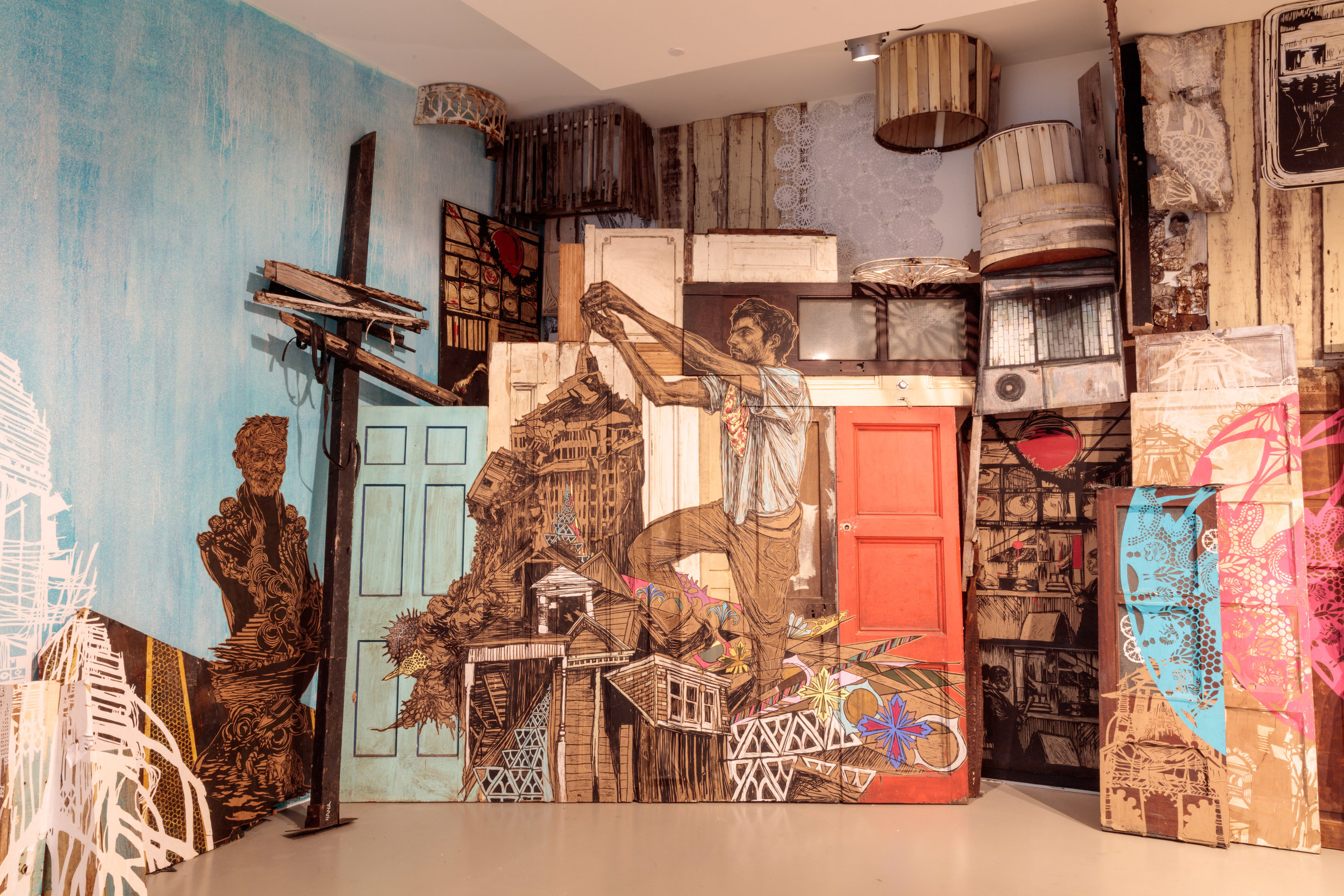
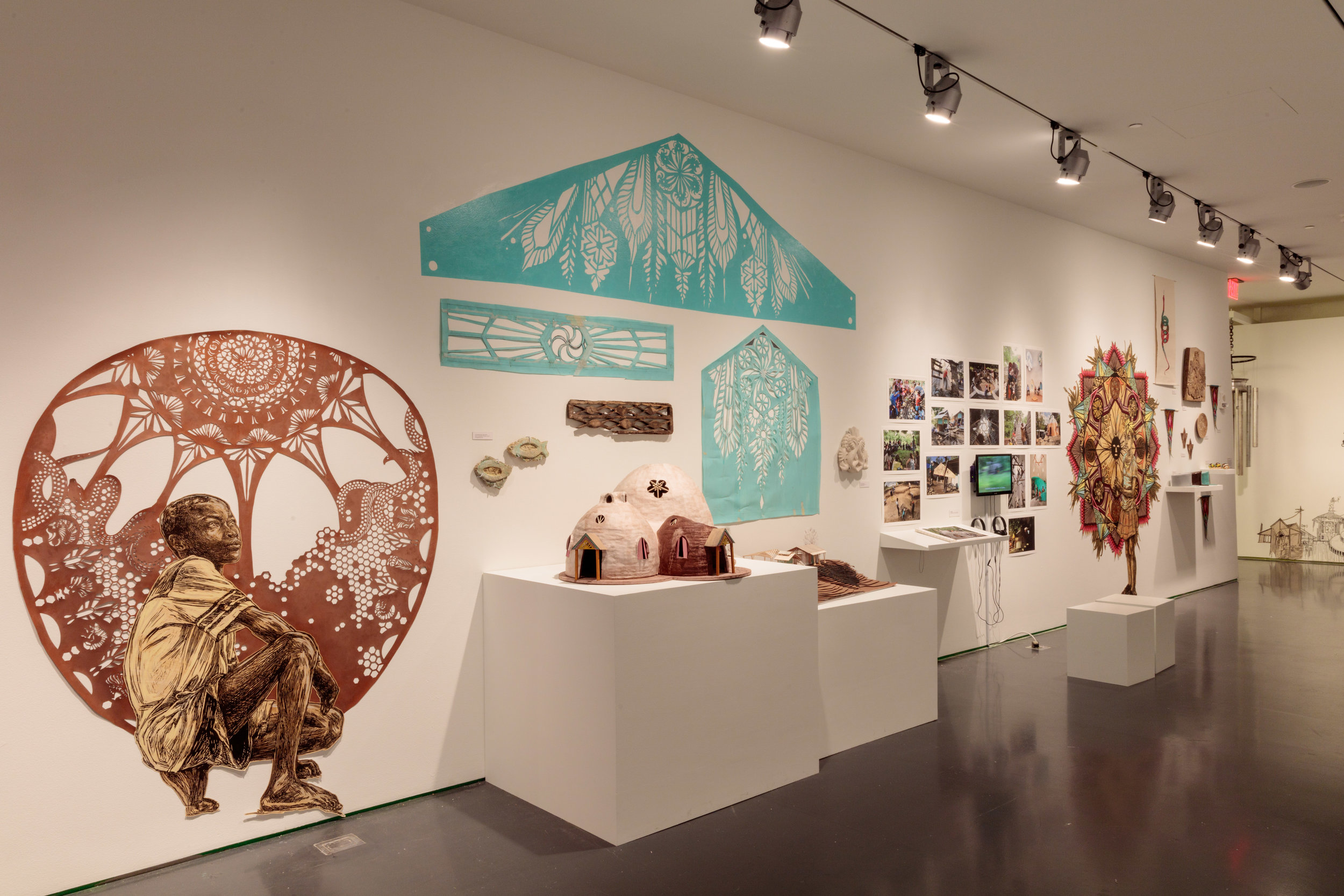
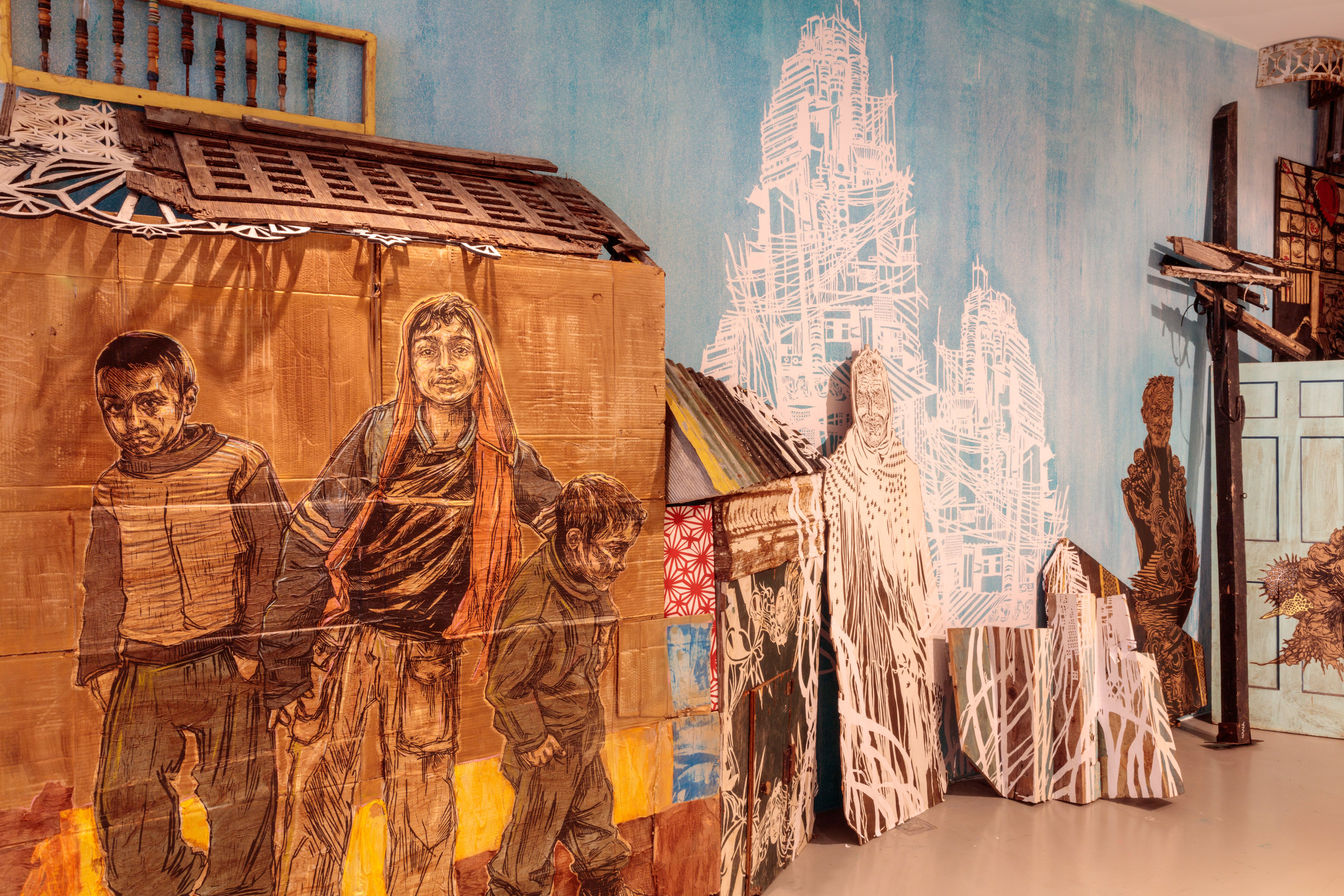
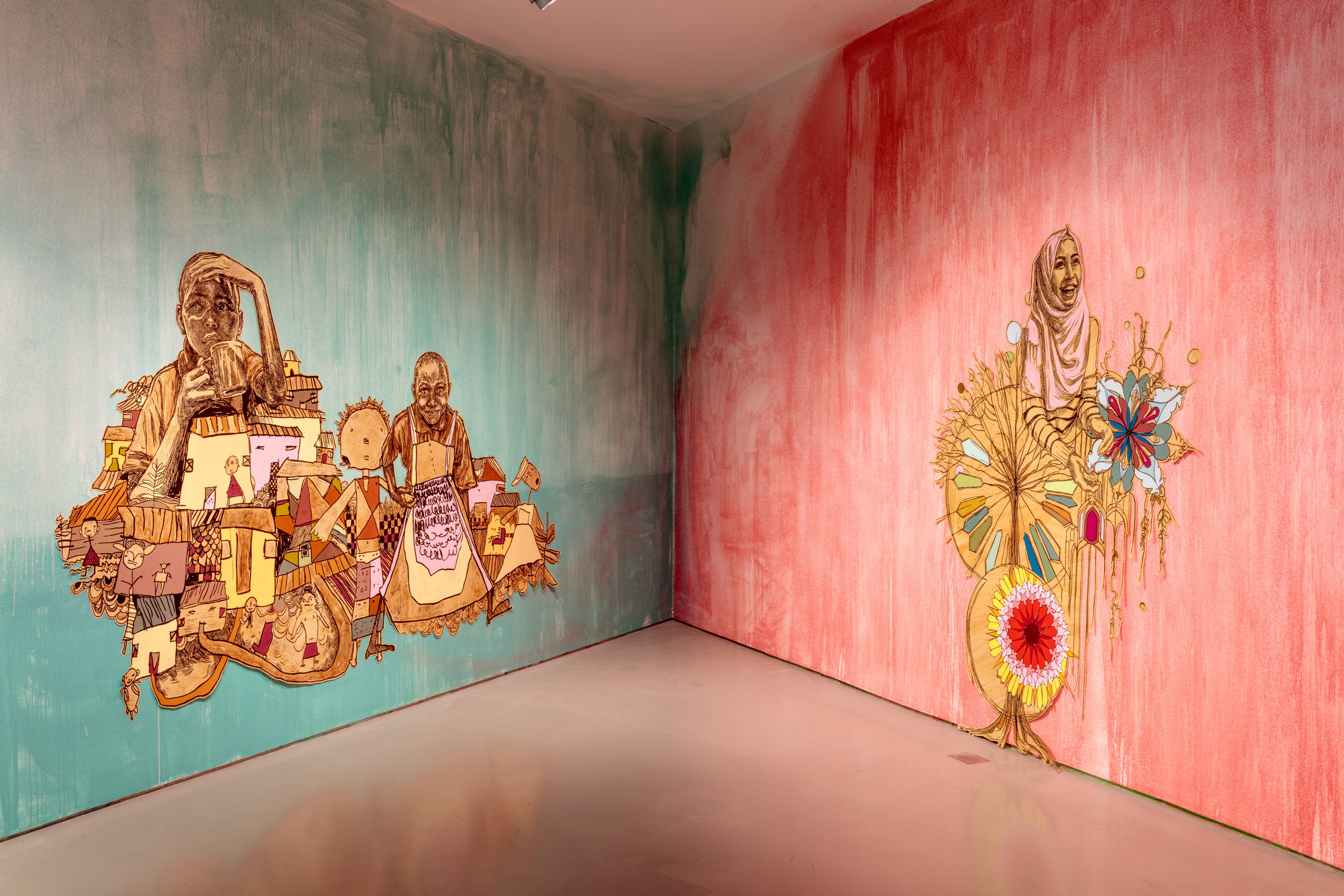
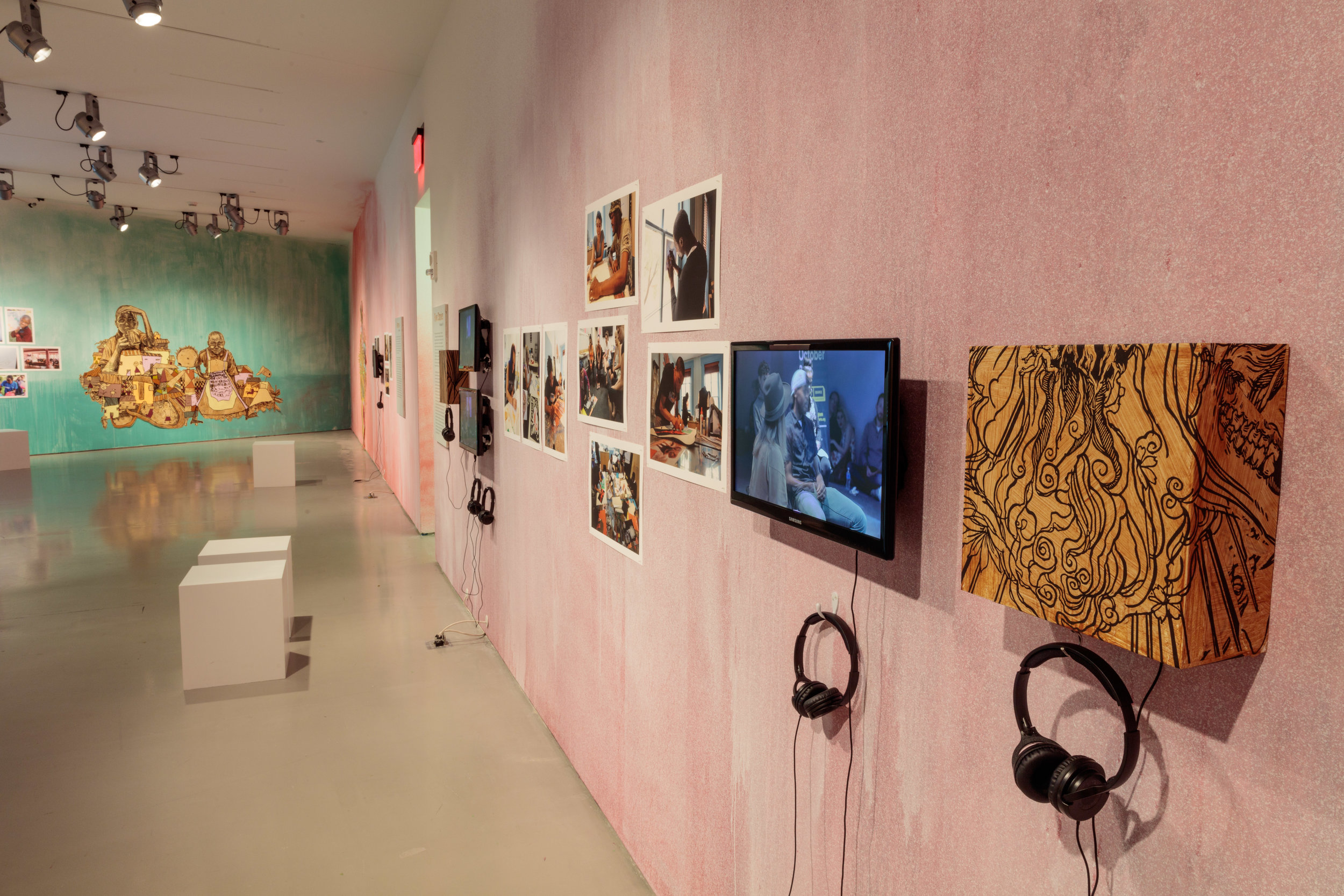
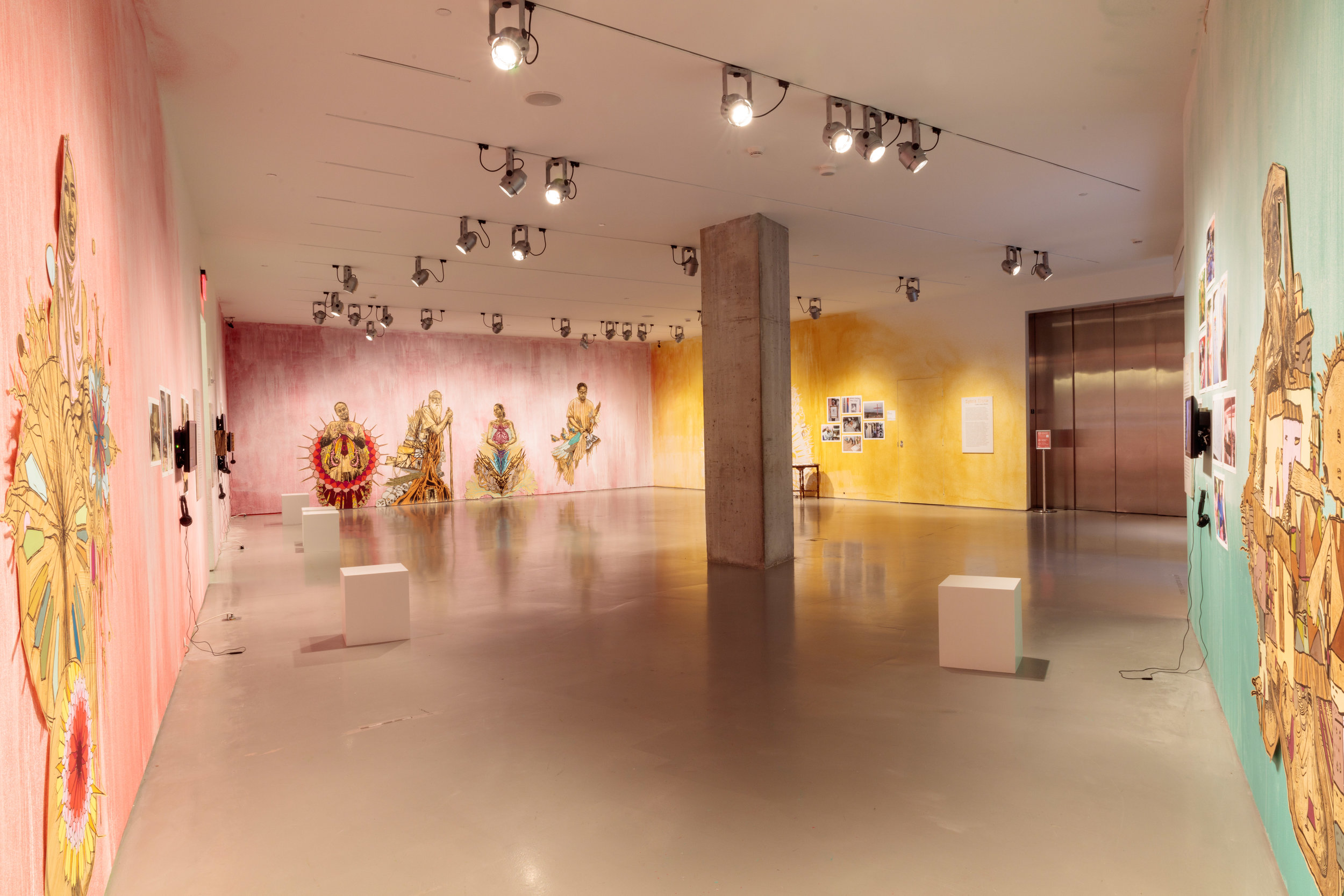
Haven is a site-specific mural and exhibition that explores the experience of finding community as an outsider through a two-year storytelling collaboration with refugees in Malmö, Sweden and The Million Person Project. Sweden has opened its borders to the virtually refugees per capita of any other country. Generally considered an exception amongst western countries to hardline politics confronting people seeking asylum, at the peak of the civil war in Syria, with over vi.6 million people displaced, the scale of the crisis began to shift public sentiment. With the goal of encouraging public dialogue betwixt new neighbors, Curry examines her capacity as an creative person to act as a span, creating meaningful connections and chat between refugees and Swedish nationals.
Curry focuses on two encounters from these collaborations: Maram, a young Syrian adult female, and Daniel, a young man from Transitional islamic state of afghanistan. A ii-story-tall portrait of Maram laughing is the centerpiece of the exhibition, installed in the Skissernas Museum'due south courtyard, capturing the sense of promise that Maram feels as she settles into her new life. The exhibition extends into the stairwell and Birgit Rausing Gallery, responding to the gallery's architectural elements with screen-printed pattern wallpaper overlaid with Curry's iconic portraits, capturing the feeling of safety, comfort and abode.
Haven Creative person Interview with Caledonia Curry.




Radical Seafaring
Parrish Art Museum, Watermill, NY
May 8–July 24, 2016
Curated by Andrea Grover
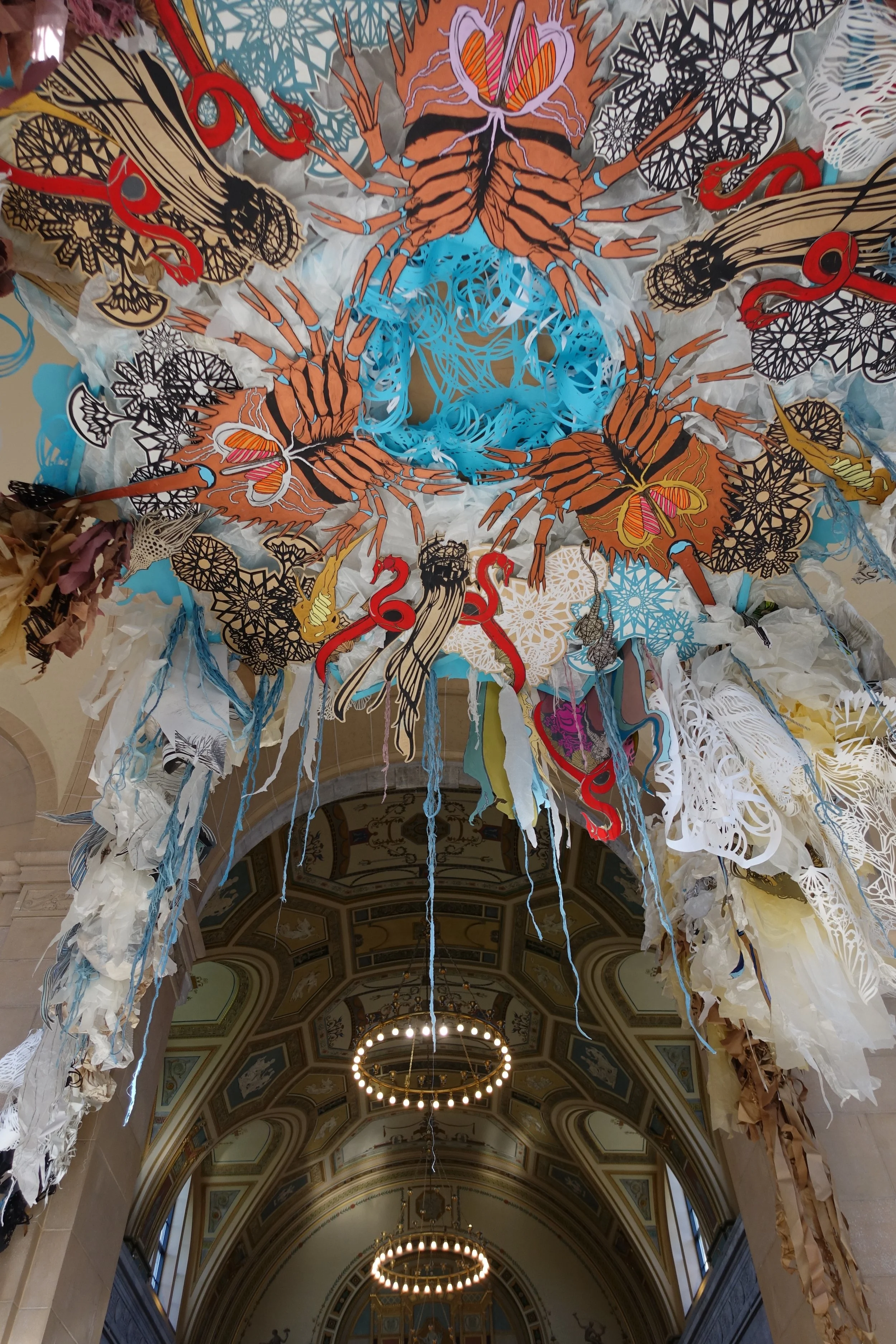
Radical Seafaring is a multidisciplinary group exhibition of twenty-five contemporary artists working in waterways in the United States and Europe. It features works that range from artist-made vessels, to documentation of creative expeditions, to speculative designs for alternative communities on the h2o. Directed by Andrea Grover, Century Arts Foundation Curator of Special Projects, the exhibition argues that the increasing number of artworks created on the h2o in the final decade is budgeted the critical mass of a movement like Land art, only at sea.
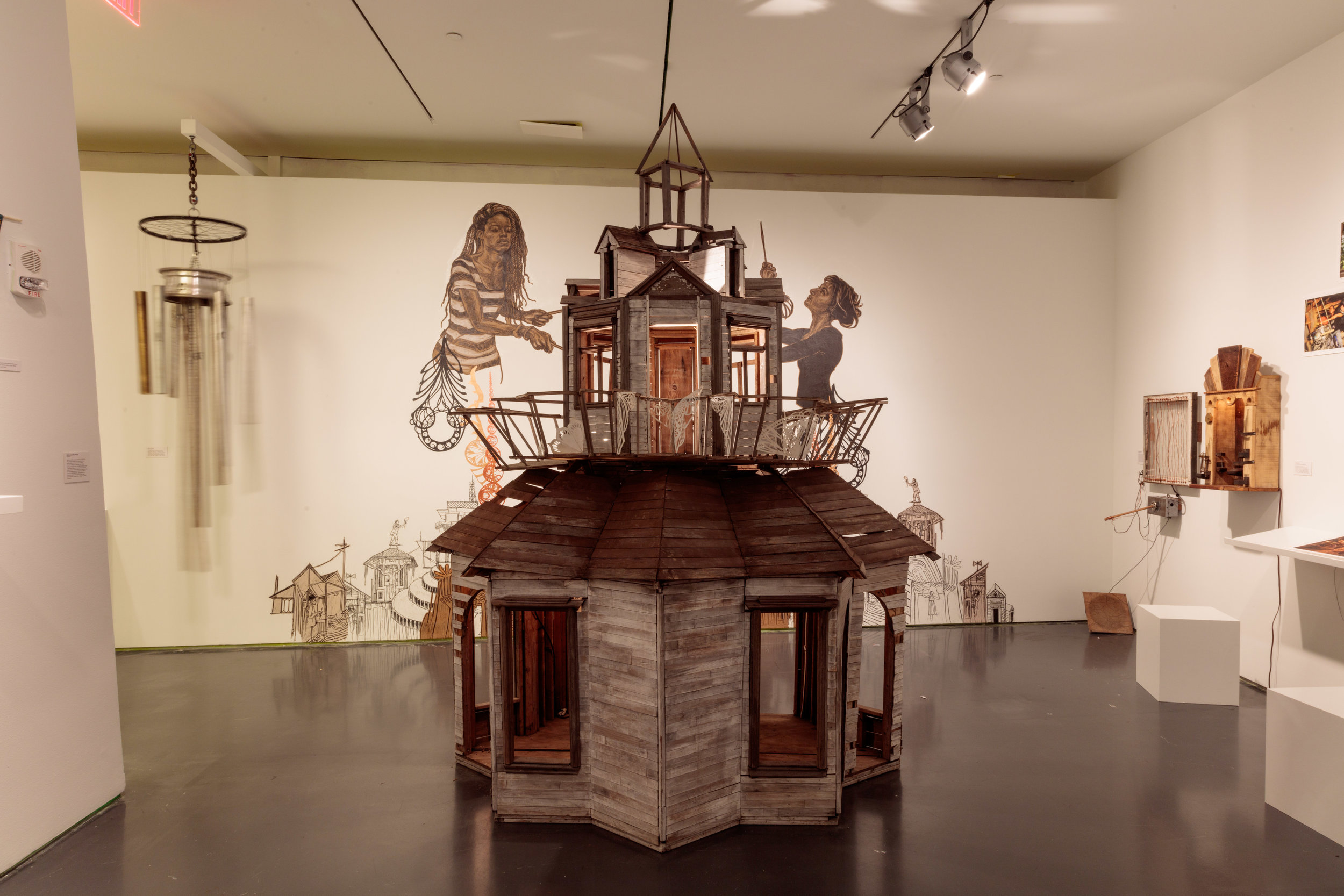
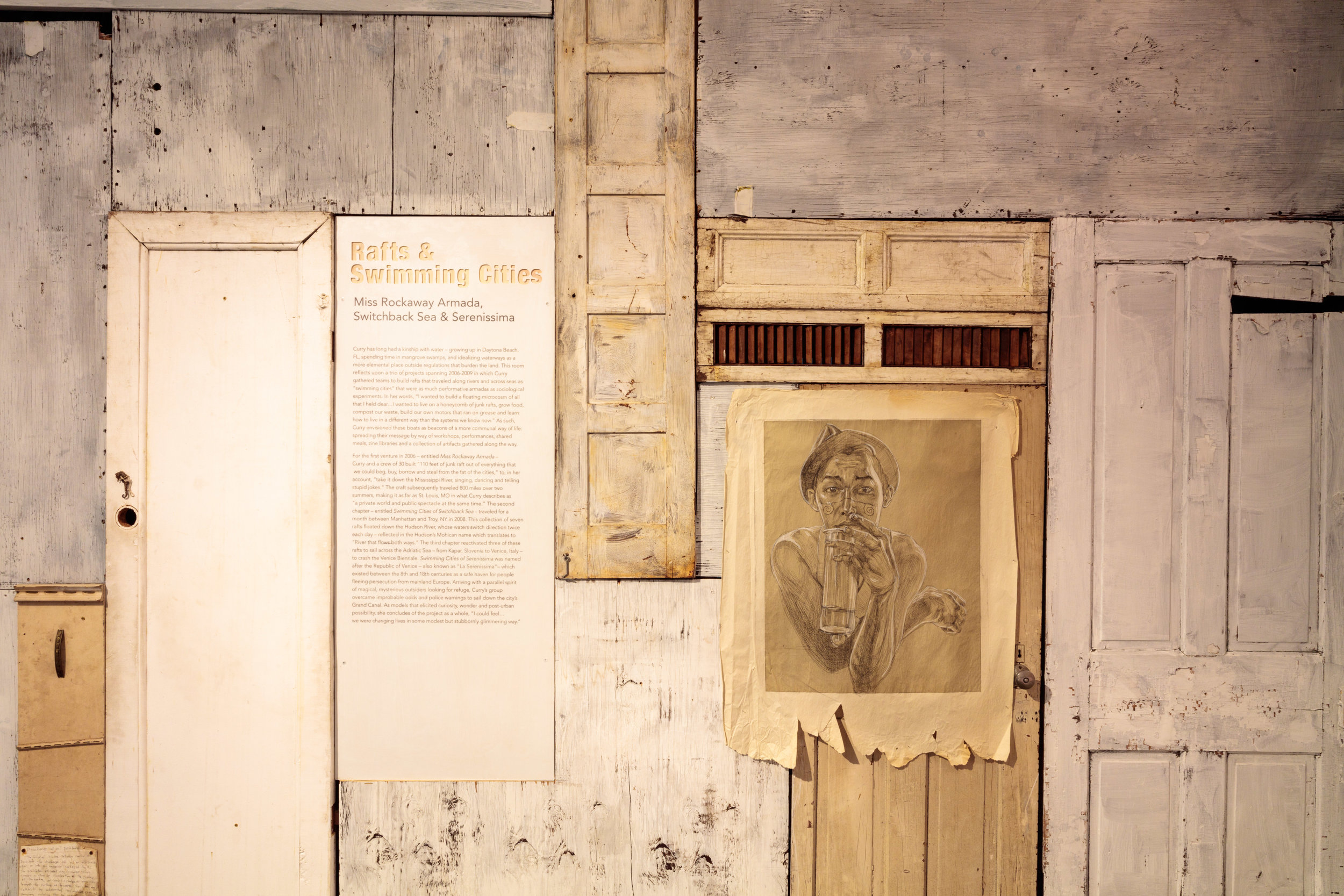
The exhibition begins with conceptual and operation art of the 1960s and 70s and extends to recent phenomenological inquiry and site-specific works that involve relocating the studio, the laboratory, or the operation infinite to the water. The exhibition places Swoon's multi-twelvemonth river projects, including Swimming Cities of Switchback Sea (2008) and Swimming Cities of Serenissima (2009) into this larger context of water every bit a site for speculating new forms of collective living. Hickory, the floating vessel Swoon built to navigate from Koper, Slovenia to the Venetian lagoon to crash the 2009 Venice Biennale, is installed inside the museum, as a cornerstone to the exhibition. Along with the other artists featured in Radical Seafaring, Swoon's work figures prominently in a universal, however contemporary, research: how practise we live in a natural world from which we are discrete non only physically but emotionally and intellectually. Her contributions apply directly engagement strategies that remove this distance and reignite a sensual, heuristic, and watchful agreement of the water.
The exhibition is divided into four themes: Exploration (the quest for new experiences, the ineffable, and living in an exhilarated land), Liberation (self-reliance, freedom from terrestrial social contracts, the want to shape one'southward world, and Utopian impulses), Fieldwork (hands-on, methodological intelligence gathering about the environment, such equally an artist laboratory at sea), and Speculation (waterways as a tabula rasa on which other realities can be congenital).
The phenomenological works in Radical Seafaring represent a new grade of expression that is especially powerful and timely as climatologists anticipate the effects of rising ocean levels, changes in weather condition patterns, and the impact on coastal zones—especially when one considers that half the world'southward population lives within 200 miles of a bounding main declension.
The notion of the creative person'south studio in the world, rather than separated from information technology, descends from art movements since the 1960s, including land, environmental, and conceptual fine art. Its forebears include Gordon Matta-Clark, Dennis Oppenheim, and Robert Smithson. The artists in Radical Seafaring are a continuation of these interdisciplinary, collaborative, and site-specific approaches. By narrowing this vast area of inquiry to projects on the water, Radical Seafaring provides focus and clarity to widespread creative strategies that embrace the earth outside.
Artists
Bas Jan Ader, Ant Farm, Atelier Van Lieshout, Scott Bluedorn, George Brecht, Bruce Loftier Quality Foundation, Chris Burden, The Center for Land Use Interpretation, Steve Badgett and Chris Taylor, Michael Combs, Mark Dion, R. Buckminster Fuller, Cesar Harada, Constance Hockaday, Courtney Thousand. Leonard, Mare Liberum, Marie Lorenz, Mary Mattingly, Vik Muniz, Dennis Oppenheim, The PLAY, Pedro Reyes, Knuckles Riley, Robert Smithson, Simon Starling, and Swoon
Exhibition Catalogue
Printing
Jane L. Levere, "Review: Exhibition at Parrish Museum Celebrates Rule-Breaking," The New York Times, June half dozen, 2016.
Allison Meier, "Navigating the Recent Moving ridge of Renegade Seafaring in Art," Hyperallergic, July 1, 2016.
The Lite After
Library Street Collective, Detroit, MI.
October eight - November 26, 2016
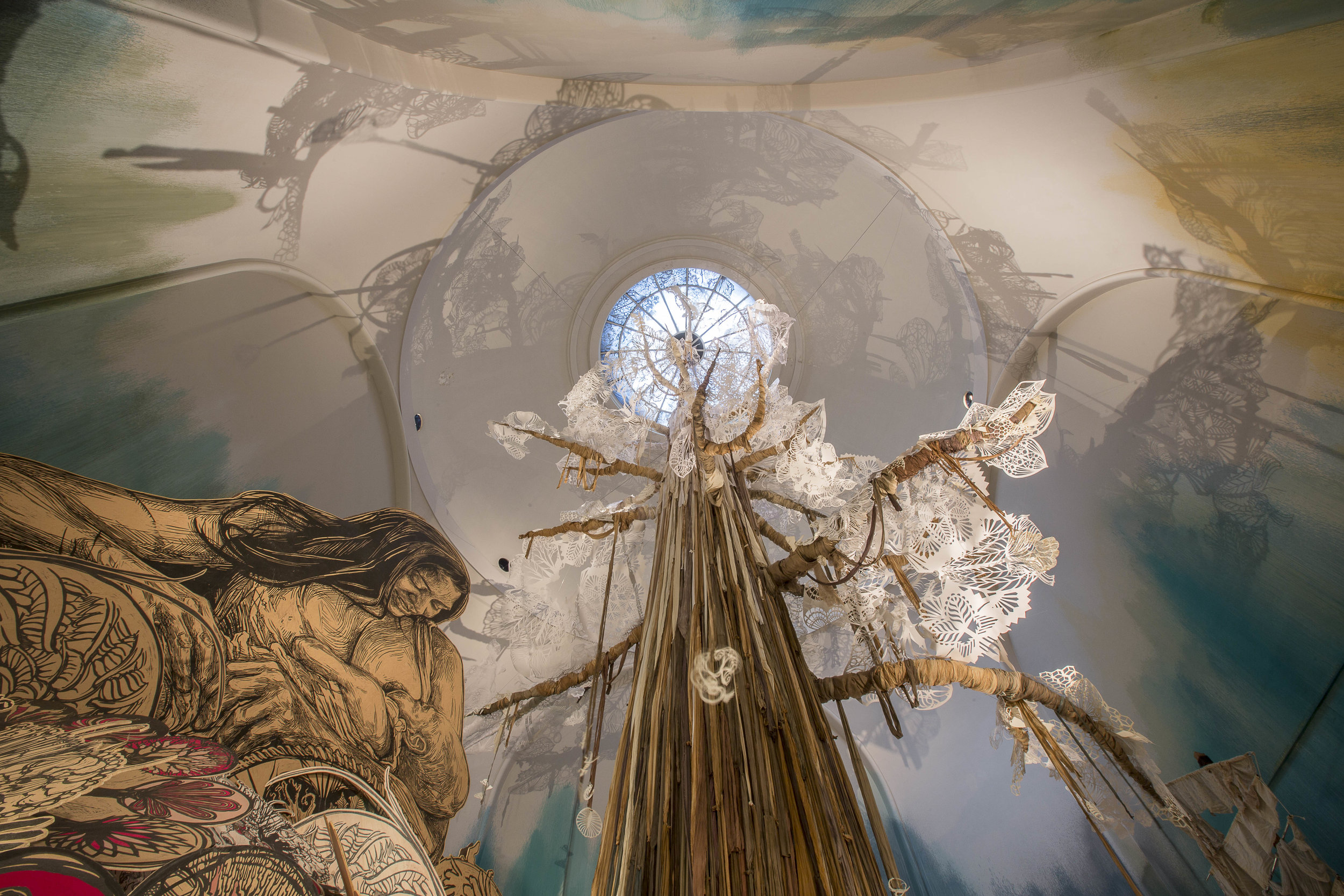
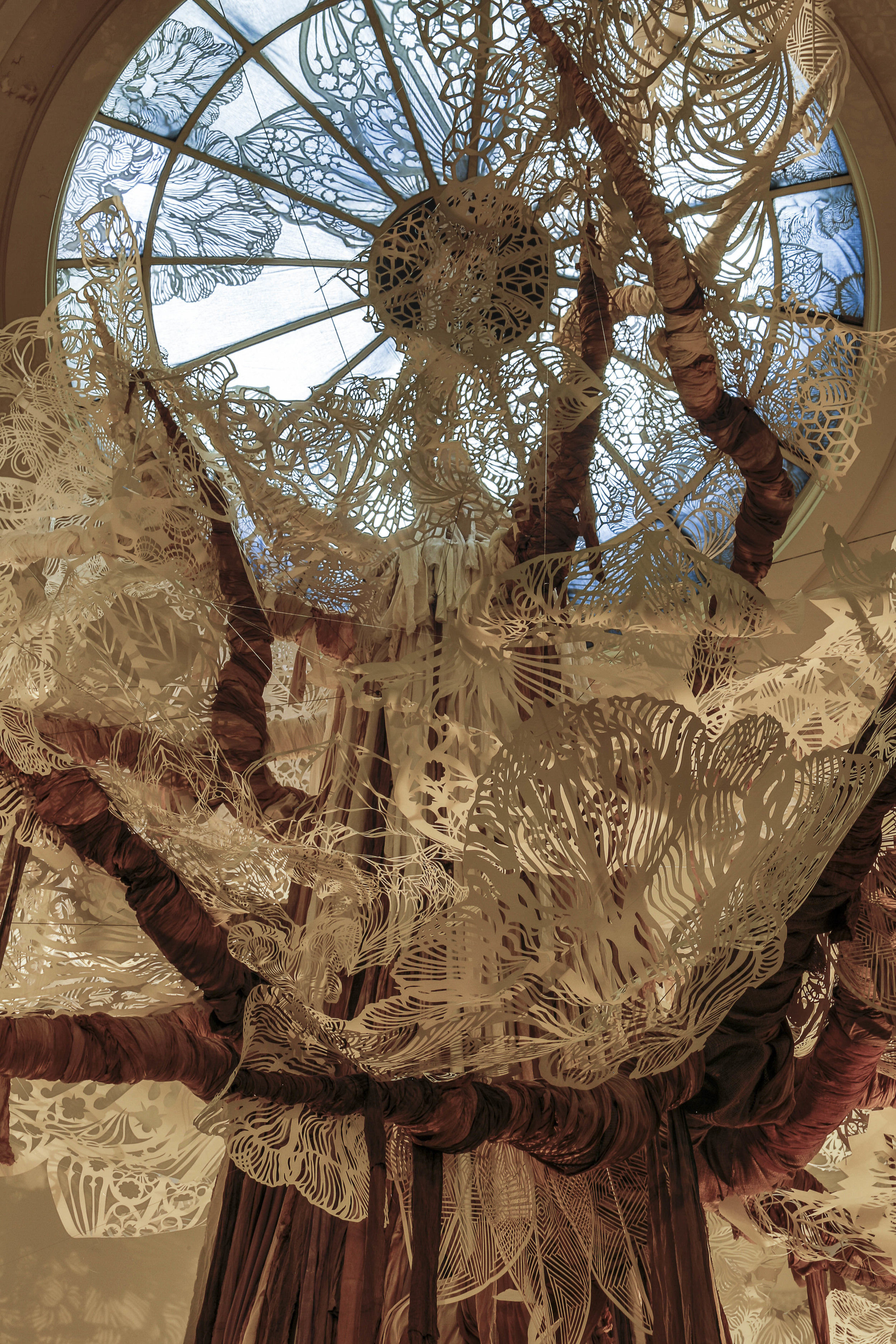
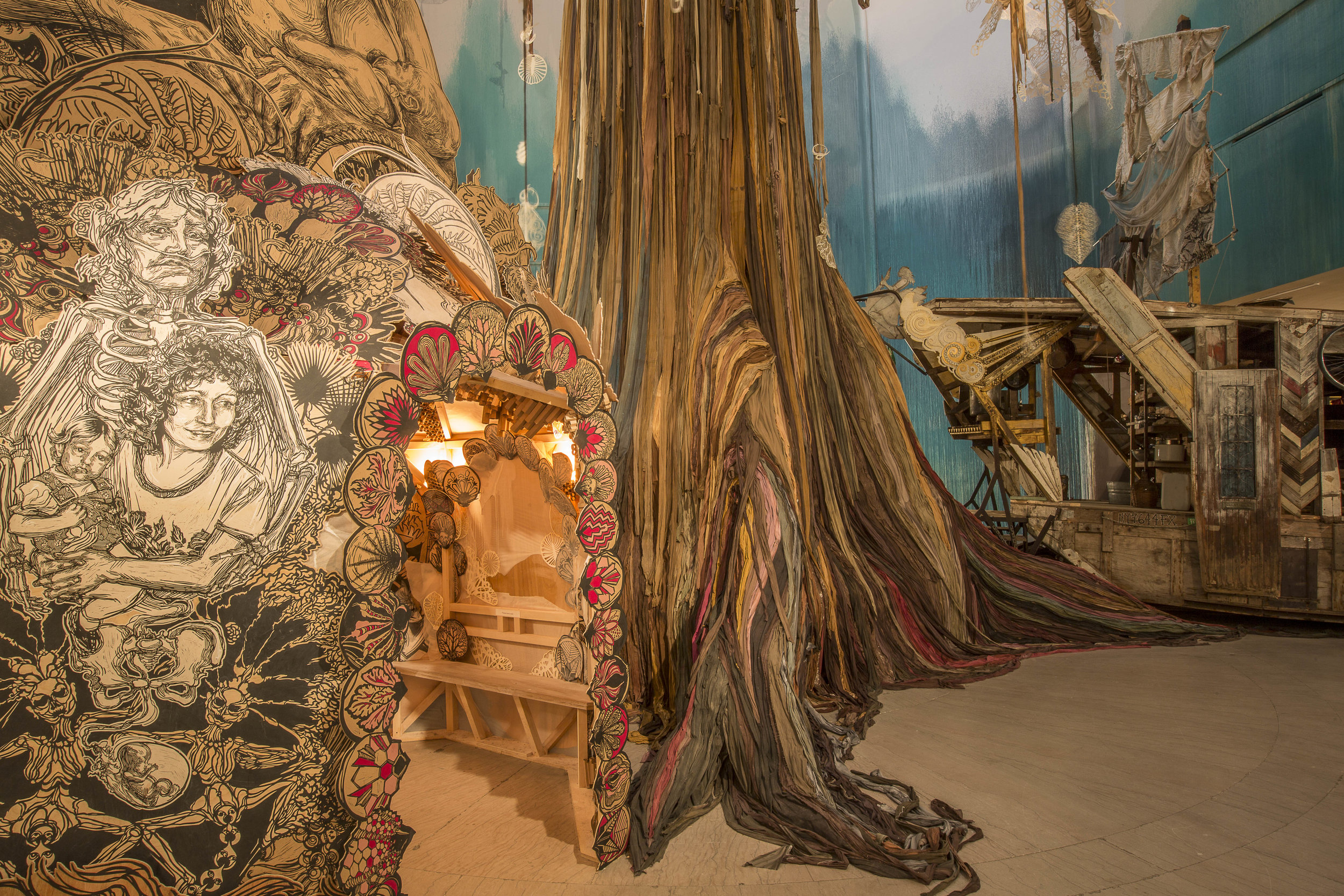
The Lite Later on is an immersive installation exploring the transition betwixt life and death. Back-scratch draws from her own empathetic death experience at the time of her mother's passing, as well every bit the anecdotes of others who have lived through profound experiences where they themselves, or their loved ones, were close to dying. A virtually-death experience is a perceptual event that sometimes occurs when a person has succumbed to death and been resuscitated; an "compassionate death experience" is an experience whereby loved ones, caregivers, or even bystanders share in an feel of the dying person'south transition.
Death is a little understood borderland. Through advances in technology and resuscitation medicine, our ability to bring people back from death, after longer periods of fourth dimension, has shed light on these experiences and brought them into our collective consciousness. The experiencer's start hand accounts have expanded the body of decease enquiry, equally well as our own ability to imagine decease and dying. Collectively these experiences, equally they become more mutual, are creating new worlds and consciousness.
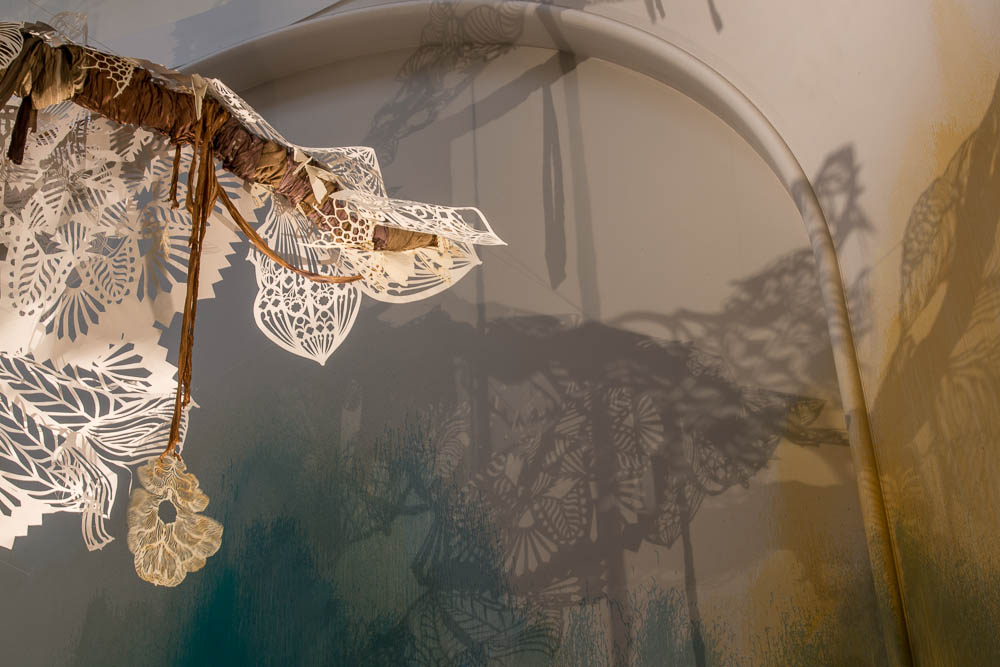
Swoon responds to the compages of the Library Street Collective galleries — two rooms connected by a narrow tunnel — to capture the sensory phenomena of near-decease and empathetic death experience. The installation begins in the "vortex," featuring halos of intricately cutting paper framing block printed figures. Afterward passing through a narrow hall with clusters of suspended papercut patterns, the second gallery opens into the "meadow," a bright yellow room with familiar faces encircled within a lush landscape. The delicacy and effulgence of the installation captures the overwhelming sense of transcendent joy and the all encompassing love that has been described in many people's experiences of dying.
Curry describes the origin of The Light Afterwards in her own words:
"When my female parent passed away in 2013, I was comatose at the time. I awoke inside a dream to see falling snow. The snow started to open up into blossoms of light as it passed through my trunk, and it carried with it my mother'southward voice. I woke up knowing that my mother had passed abroad, simply I felt a niggling crazy for believing such a thing was possible. My sister called soon after to ostend that my mom had indeed passed. In the years following this intensely foreign and profound experience, I discovered through inquiry that it was a rare but extant miracle called the 'empathetic death experience.'"
Press
Andrew Salomone, "Street Artist Swoon Brings a Spiritual Installation to Detroit," VICE, Oct 17, 2016.
Kristin Sancken, "Swoon Installation Breathes Life, and Death, Into Deserted Detroit Architecture," artnet News, October eighteen, 2016.
Sarah Rose Sharp, "Glimpses of the Afterlife in Swoon'southward New Installation," Hyperallergic, November 3, 2016.
Priscilla Frank, "Artist Simulates What Information technology's Similar To Have A Shared-Death Experience," Huffington Post, October eleven, 2016.

City Lights
Millennium Iconoclast Museum of Art, Brussels, Belgium
March 24 - Baronial 28, 2016
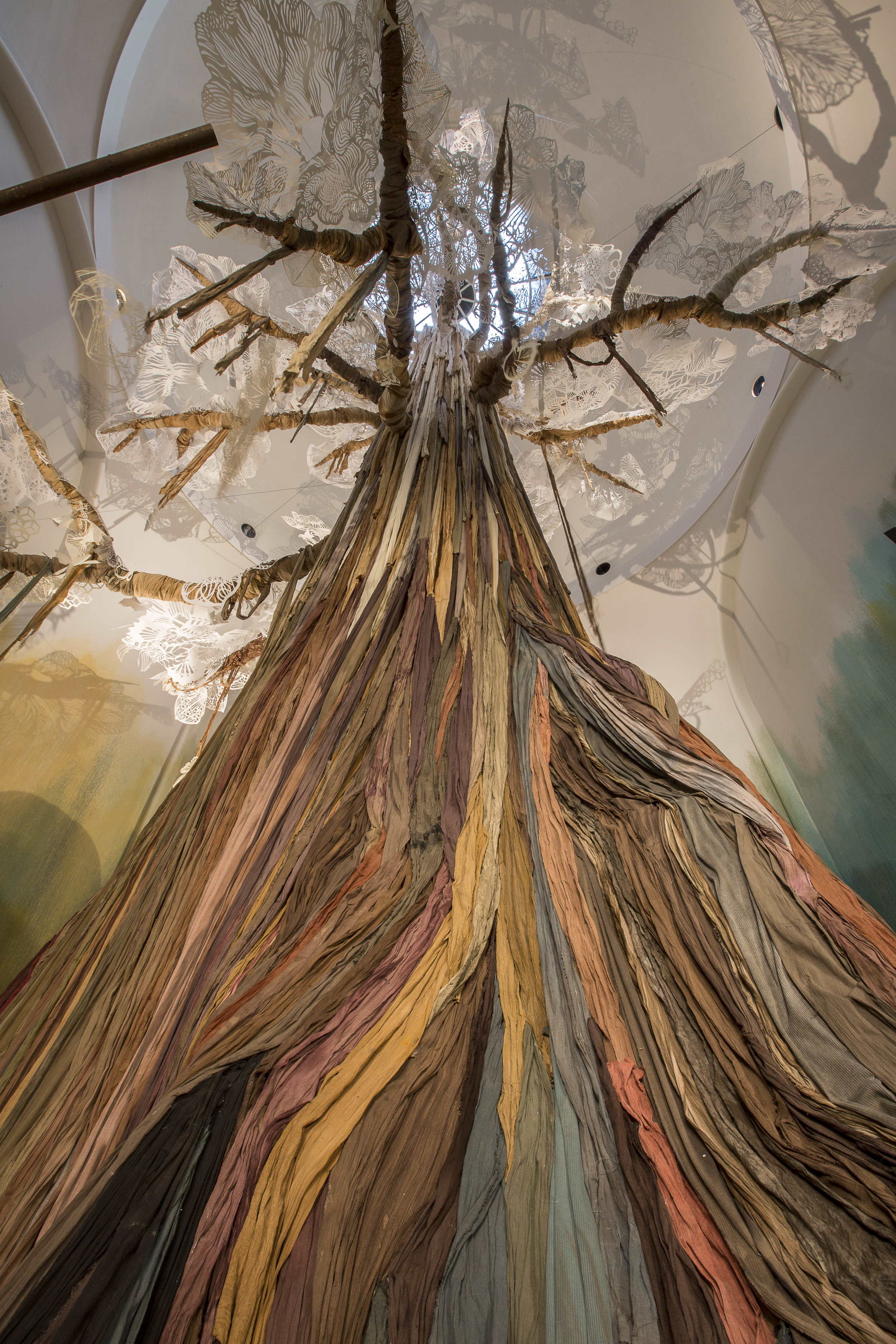
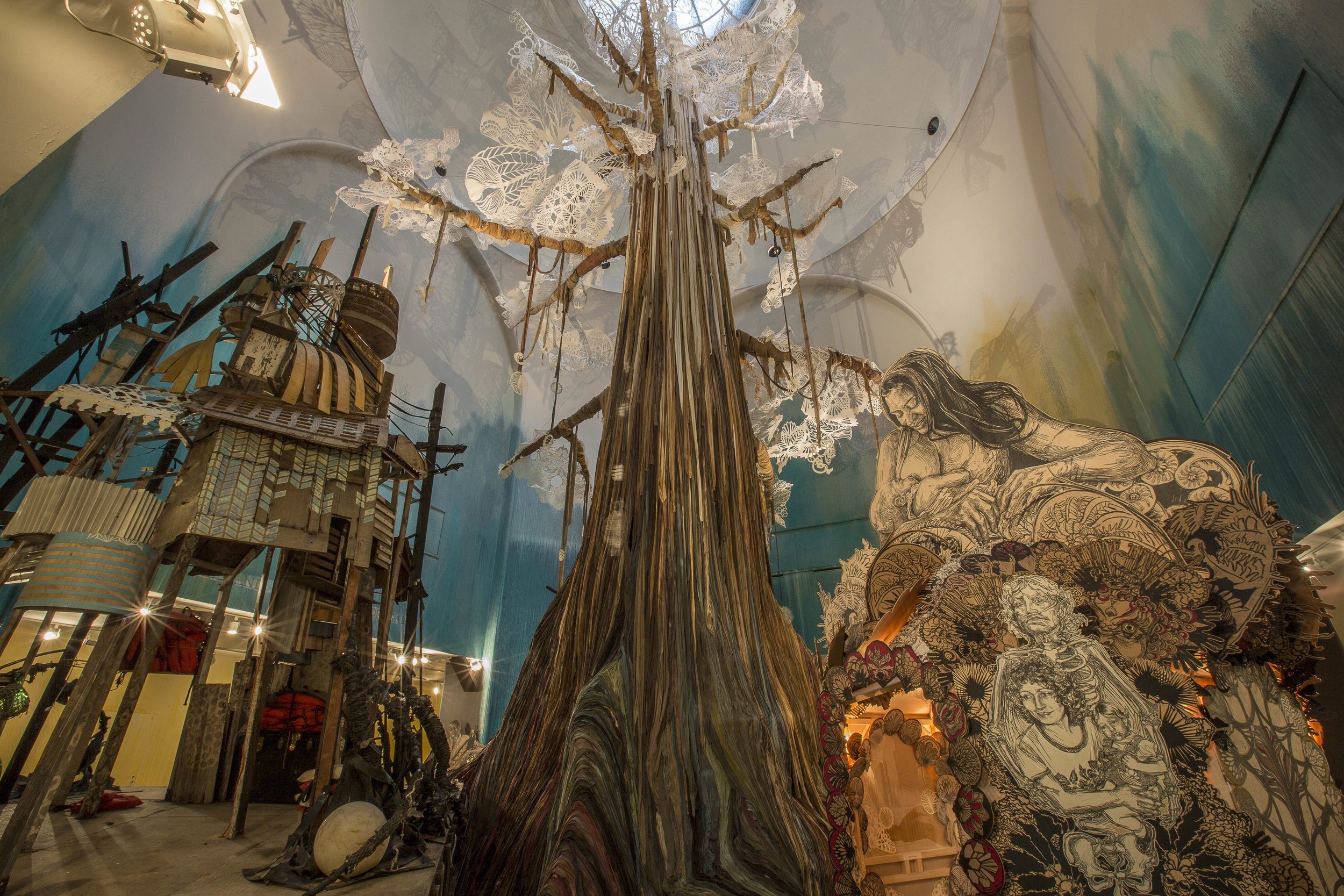
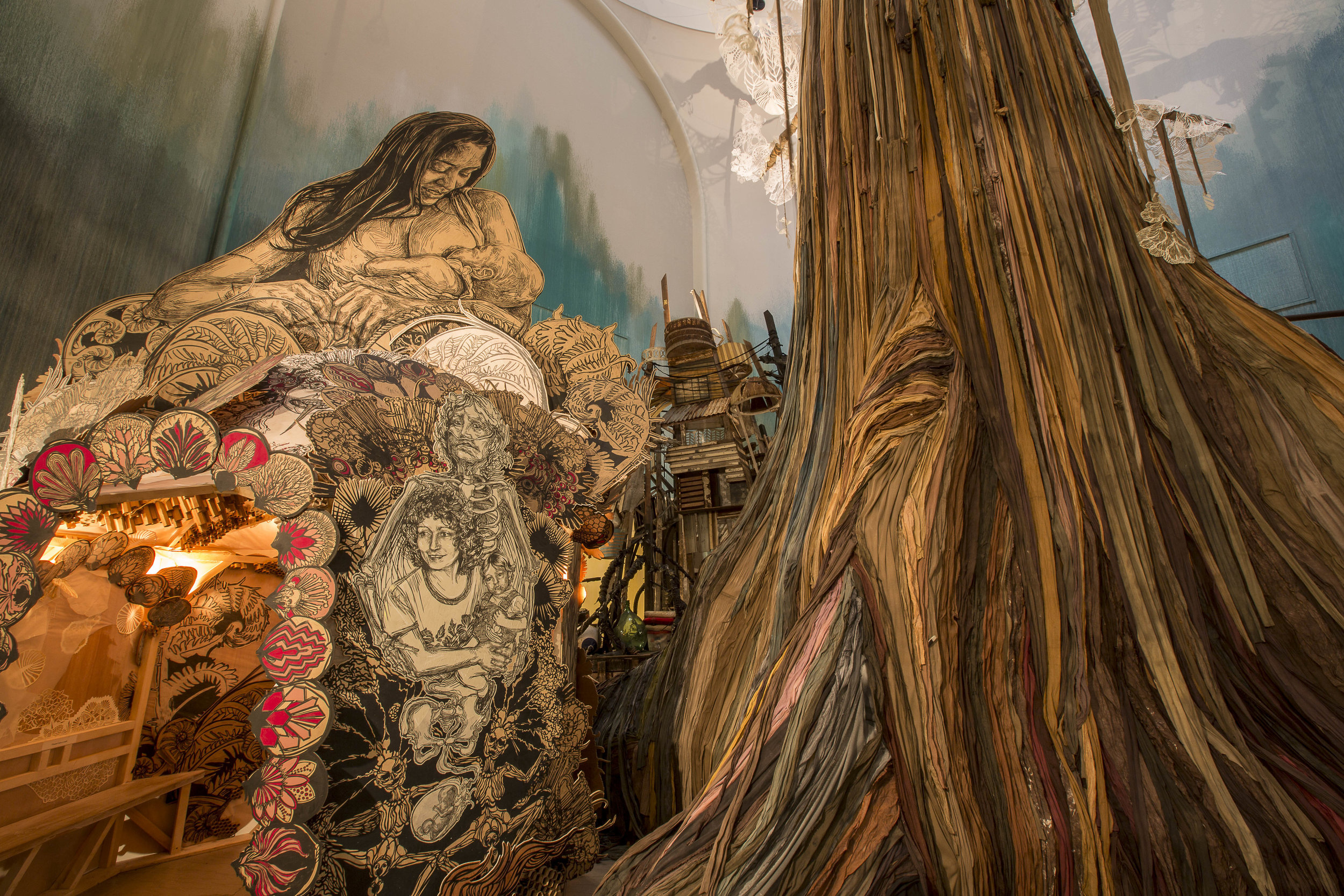
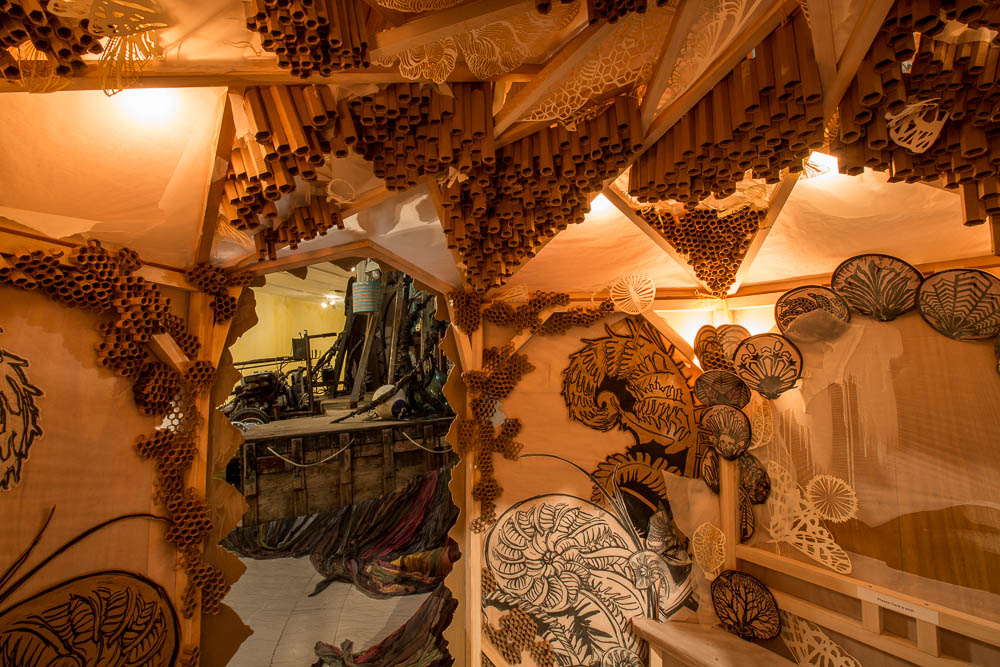
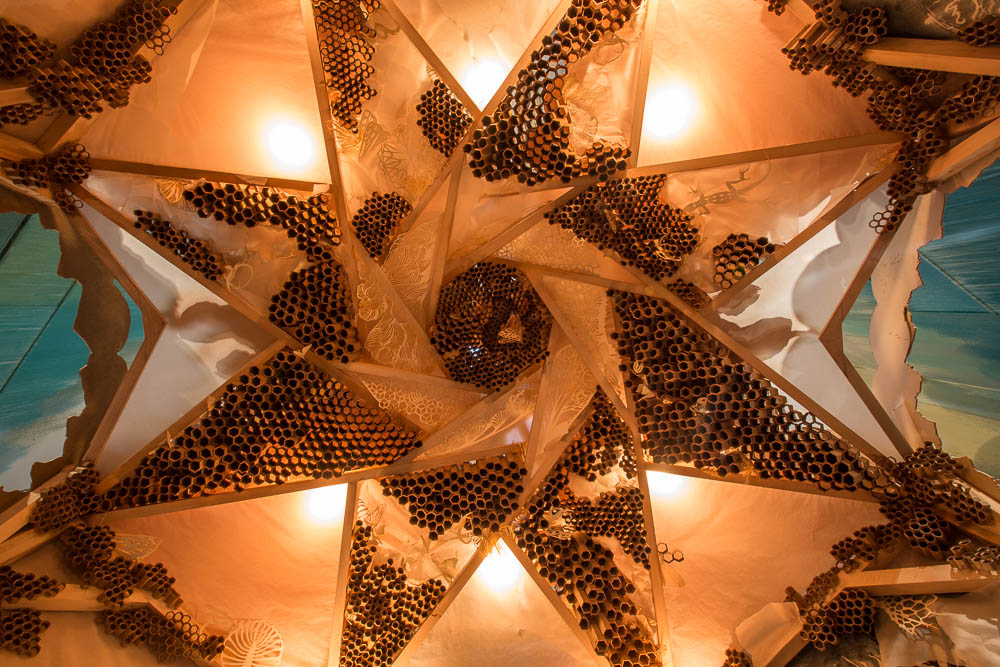
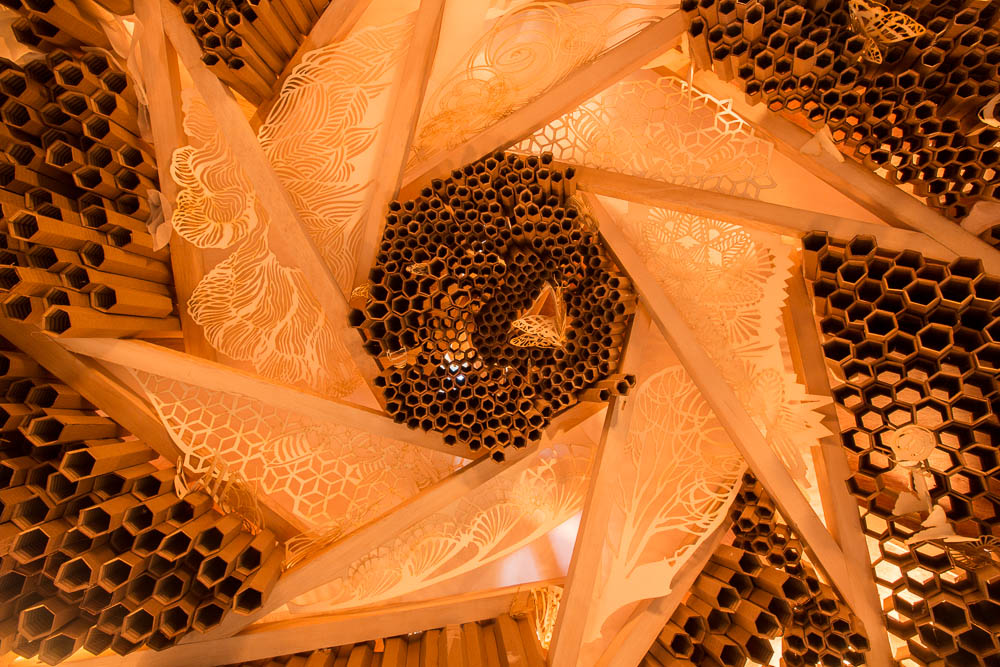
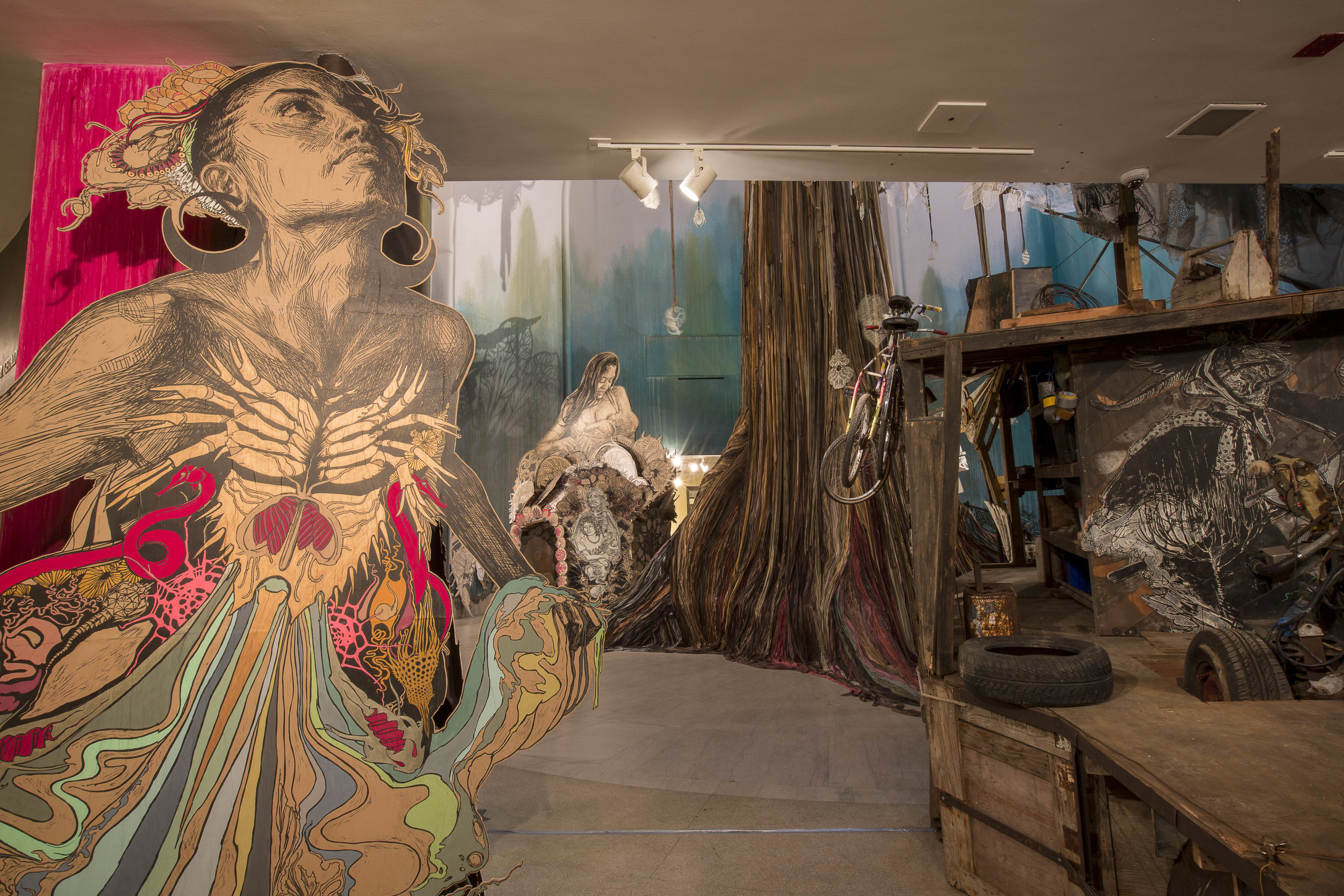
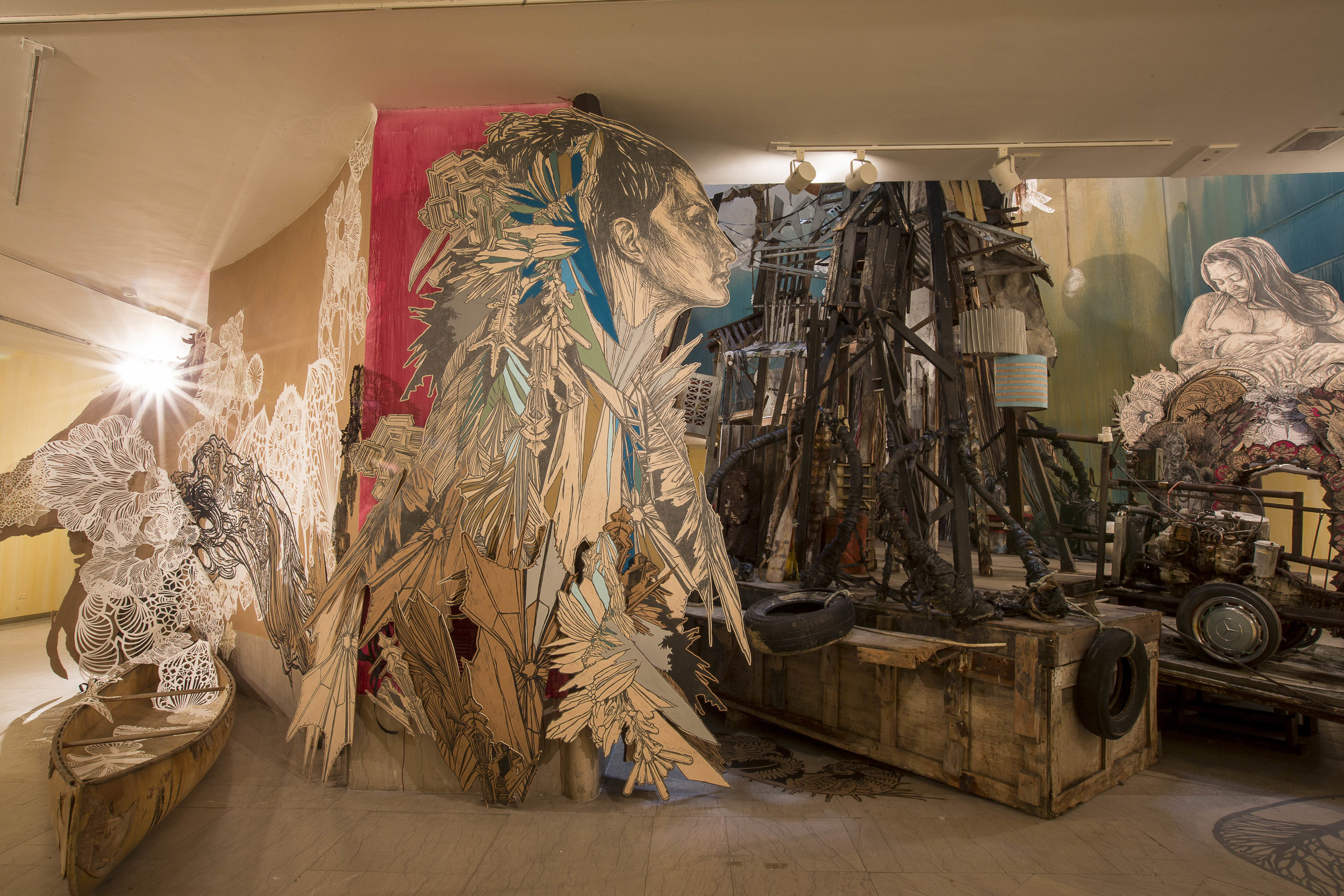
The Metropolis Lights is a site-specific exhibition unfolding across the labyrinthine cellar galleries of the five-story museum. Curry responds to the maze-like compages of the historic building with carefully placed portraits and papercuts that reply to the theatrical quality of the infinite, a human-scale version of a shadow box or toy theater. She addresses themes of passage and initiation, , making connections between the feelings of discovery that occur when exploring the physically subterranean, to the youthful experience of becoming aware of underground subcultures.
The City Lights was the countdown exhibition of the Millennium Iconoclast Museum of Art, which also featured installations by MOMO, Maya Hayuk and Faile. Equally artists who primarily piece of work on in the public sphere and on metropolis streets, this group exemplified the museum'due south founding mission to reach new publics through cut edge gimmicky art, called "culture ii.0."
The City Lights Creative person Interview with Caledonia Curry.
Dawn and Gemma
Wynwood Walls Art of Collaboration Program, Miami, FL
Opening Reception Dec 4 - seven, 2014
Dawn and Gemma is a public mural featuring a central image of a mother breast-feeding her child, flanked by mirrored Memento Mori portraits of Back-scratch'southward mother created shortly before her decease. At 12 feet tall, Dawn and Gemma is one of Curry's largest cake prints. The mural celebrates intergenerational bonds and the wheel of life and expiry. Inspired by an encounter with a babyhood friend while her mother was dying, Curry diameter witness to Dawn'southward deeply nurturing relationship with her children. Existence nowadays to this life-giving force gave Curry condolement at a time when she was grieving both the loss of her mother, and the effects of trauma and addiction on her babyhood, which created obstacles to maintaining a nurturing relationship with her mother throughout her life. The revelation that motherhood could exist and so elementally nurturing was a powerful catalyst in Curry'southward life and creative practise, leading her to confront these themes and nautical chart a path to healing through her work.
Memento Mori
Museo de Arte Contemporáneo Oaxaca, Oaxaca, Mexico
July v - July 31, 2013
Curated past Pedro Alonzo
Memento Mori was a site-specific installation that included both an indoor installation in the Museo de Arte Contemporáneo's celebrated, Castilian colonial edifice, too as outdoor, clandestine art installations on the streets of Oaxaca. Back-scratch created this installation equally office of Hecho en Mexico, a major group exhibition curated by Pedro Alonzo (ICA Boston), that brought the most important international Street Artists to present their piece of work to a Mexican audition.
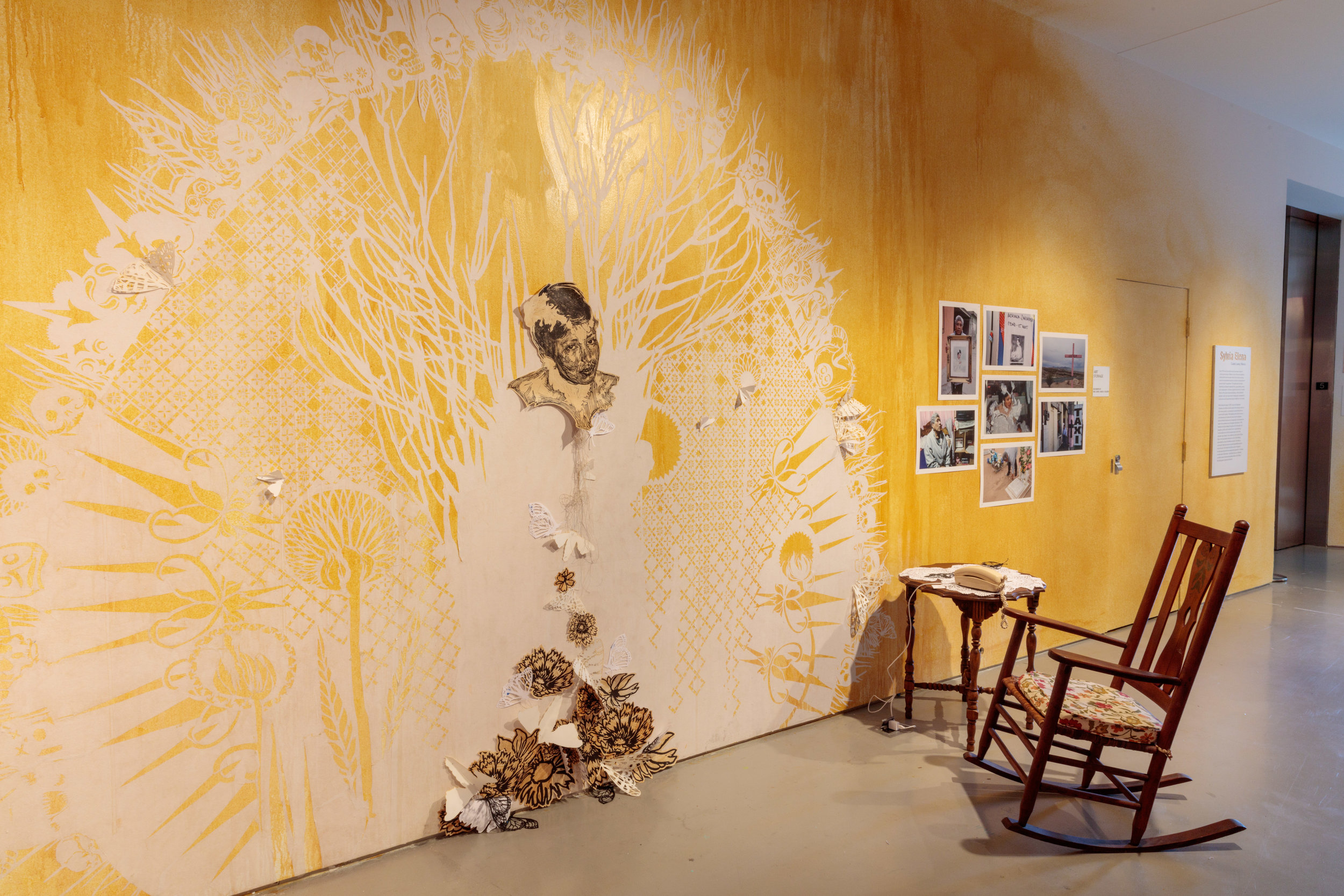
The indoor installation responds to the architectural components of the gallery to create an altar-like installation centered around Memento Mori, a portrait of her mother created shortly subsequently her decease. The sacred, life-giving nature of blood is a key theme, represented past the deep carmine walls throughout the installation. The outdoor interventions take up similar themes of birth and death on the personal and global scale. These portraits include Kamayura, a young indigenous activist in Brazil who has protested the devastation to her ancestral land caused by the structure of the Belo Monte Dam; Street Sweeper, a portrait of a human being cleaning the street in United mexican states City; and Silvia Elena, a portrait of a woman who was killed in Juarez, Mexico, one of over 400 victims of femicide in Juarez alone in the 1990s and early on 2000s.
Petrichor
Manatee-Sarasota Fine art Gallery, State College of Florida, Brandenton, FL,
March i - Apr three, 2013.
"Petrichor" is the aroma of the beginning pelting upon the globe afterward a long dry spell. Swoon's Petrichor was made to gloat the subconscious worlds that become visible through the practise of looking and sensing deeply. Curry learned the importance of attunement from her father, who was an avid gardener. She attributes the time spent with him, carefully observing nature, equally the genesis of her path to condign an artist.
In the gallery, earthen-colored gallery walls are layered with newspaper cut patterns of natural motifs created from Curry's own observations alongside block impress portraits of friends and family. 2 portraits of Curry's male parent, Milton Curry Jr., who lived close to the college, are included in the exhibition. Elevating these everyday encounters highlight the importance of personal relationships, and the fluidity between art and life that recurs throughout Back-scratch'south work.
Motherlands
Galerie LJ, Paris, France
November 30 - January xv, 2013
Motherlands is a site specific installation unfolding over two floors, taking on generational narratives of origin and death on both the personal and global scale. Created shortly after her ain mother'southward death in 2013, Motherlands is one of the first installations where Back-scratch directly takes on her personal history. This interest would eventually develop into multi-year community appointment projects that address intergenerational trauma and addiction.
The installation begins in the upper gallery with bright, three-dimensional installations of her iconic block-impress portraits. The cellar underneath the gallery, Curry responds to the , maze-like compages of passageways, arches and caverns, to connect the interior experience of grief with the concrete transition between life and expiry every bit a sacred passage. Memento Mori, a block print that features multiple images of her mother as a immature woman, and before long before her death, is suspended in one of the cellar archways, encircled past altar-like light. Created in the classical memento mori tradition, this piece serves as the anchor to the Motherlands exhibition, and a reminder of life's impermanence.
Honeycomb
Snowfall Contemporary, Tokyo, Japan.
Apr iv - May xx, 2012
Honeycomb is an contemplative installation that honors the sacred importance of the bee. In 2012, we were just start to hear almost the effects of human-acquired climate alter on bees, who were dying in massive numbers. All life on earth depends on the work of bees as pollinators, and their loss has tremendous ecological impact. Honeycomb makes connections between the loss of bees and other, large-scale, ecology catastrophes, including the 2011 seismic sea wave in Japan, that irrevocably change the landscape and our relationships with information technology.
The installation is imagined equally an altar-like space, providing comfort and solace in a time of mourning. The walls are painted aureate and illuminated by candlelight. Flowing across the space are intricate cake-print portraits linked by abstracted honeycomb motifs. In this space, Curry honors the beauty in all life, and the inseparable bonds between humans and nature.
Murmuration
Black Rat Projects, London, England,
Dec 1 - Dec 24, 2011
"Murmuration" refers to the flocking germination of starlings in flying. Working to capture the feeling of awe that reveals itself through careful observation of nature, Curry responds to the sweeping curves of a cavernous withal intimate former railroad train tunnel. Sculptures appear to rise out of the floor and cake-print portraits layered on found wood create mysterious nooks and passageways through the gallery. Embedded within are peepholes with miniature installations, evoking the sense of mystery and wonder that accompanies a peek into hugger-mugger worlds and hidden terrains.
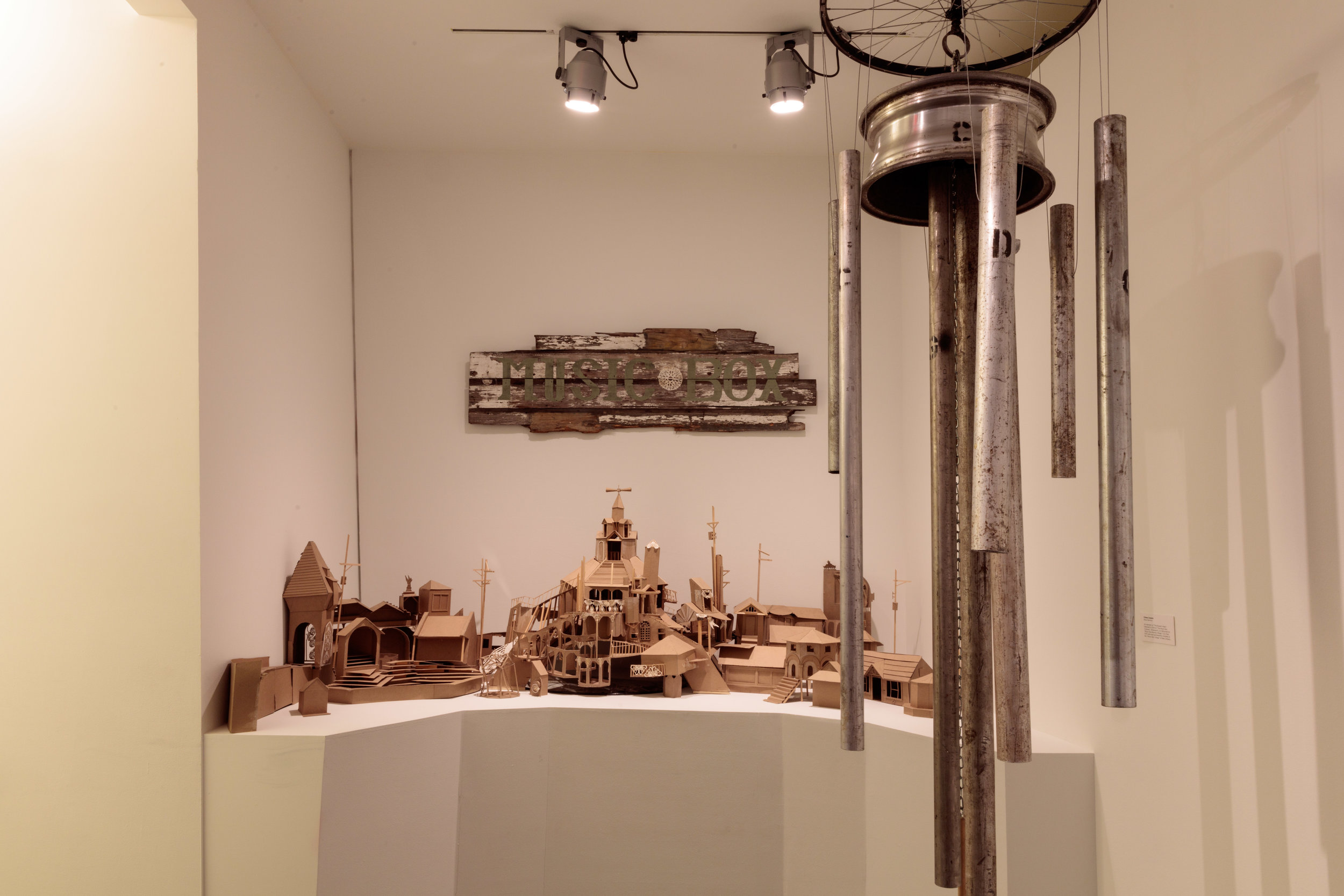
Swoon'southward Murmuration features many of Curry'southward most ambitious cake prints, including three-dimensional versions of Thalassa, Mrs. Bennett and Water ice Queen, which all stand over 12 feet tall. The translation of her portraits into sculptures is an approach she would return to throughout her work, developing the architectural relationships of her work in both her series of miniatures, every bit well as in the immersive environments she creates for stop-motility animation.
Fine art in the Streets
Museum of Contemporary Art, Los Angeles, California
April 17, 2011 – August 8, 2011
Curated past Jeffrey Deitch, Roger Gastman and Aaron Rose
Art in the Streets is the starting time major U.S. museum survey of graffiti and street fine art, exhibited at the Museum of Contemporary Fine art in Los Angeles in 2011. Curated by MOCA Director Jeffrey Deitch and Acquaintance Curators Roger Gastman and Aaron Rose, the exhibition traces the development of graffiti and street art from the 1970s to the global movement it has get today, concentrating on cardinal cities such as New York, Los Angeles, San Francisco, London, and Sao Paulo, where a unique visual language or attitude has evolved.
Swoon's architectural-scale installation features a triptych portrait of the Ice Queen, Curry's grandmother, atop a 20ft structure of textile and intricately cutting newspaper. In this portrait, Curry looks back with compassion and understanding on the conditions of duress that fabricated it difficult to develop a relationship with her grandmother. This personal narrative merges with the sense of expansion and awe when i ventures out across the family unit and home, and into the world. Illuminated from within, Ice Queen projects patterned shadows on a cavern-like enclosure of draped textile forms. These were inspired past the shadows cast past Hickory, a raft that sailed with the Pond Cities of Serenissima, as it passed under the bridges on the Grand Culvert. Back-scratch'due south contribution highlights the influence of the city itself on her studio practice, which draws inspiration from architectural forms and the everyday people who make their mark on the cities they inhabit.
Back-scratch's Ice Queen installation is exhibited alongside works by 50 of the most important international graffiti and street artists. The exhibition is accompanied by a comprehensive timeline illustrated with artwork, photos, video, and ephemera providing a historical context for the piece of work, likewise equally a printed catalogue.
DROWN YOUR BOATS
New Image Art Gallery, Los Angeles, California
Feb sixteen- April 19, 2008
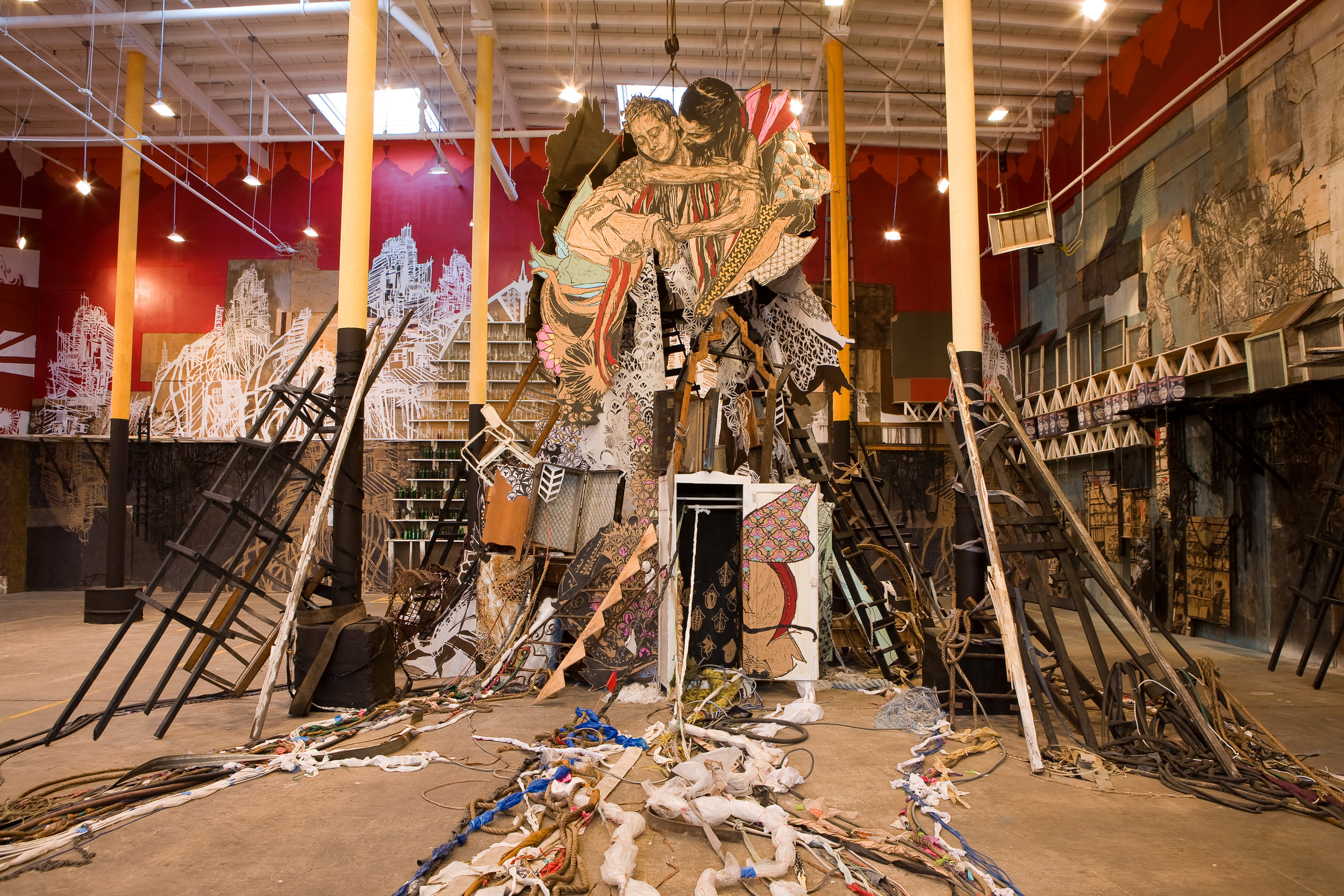
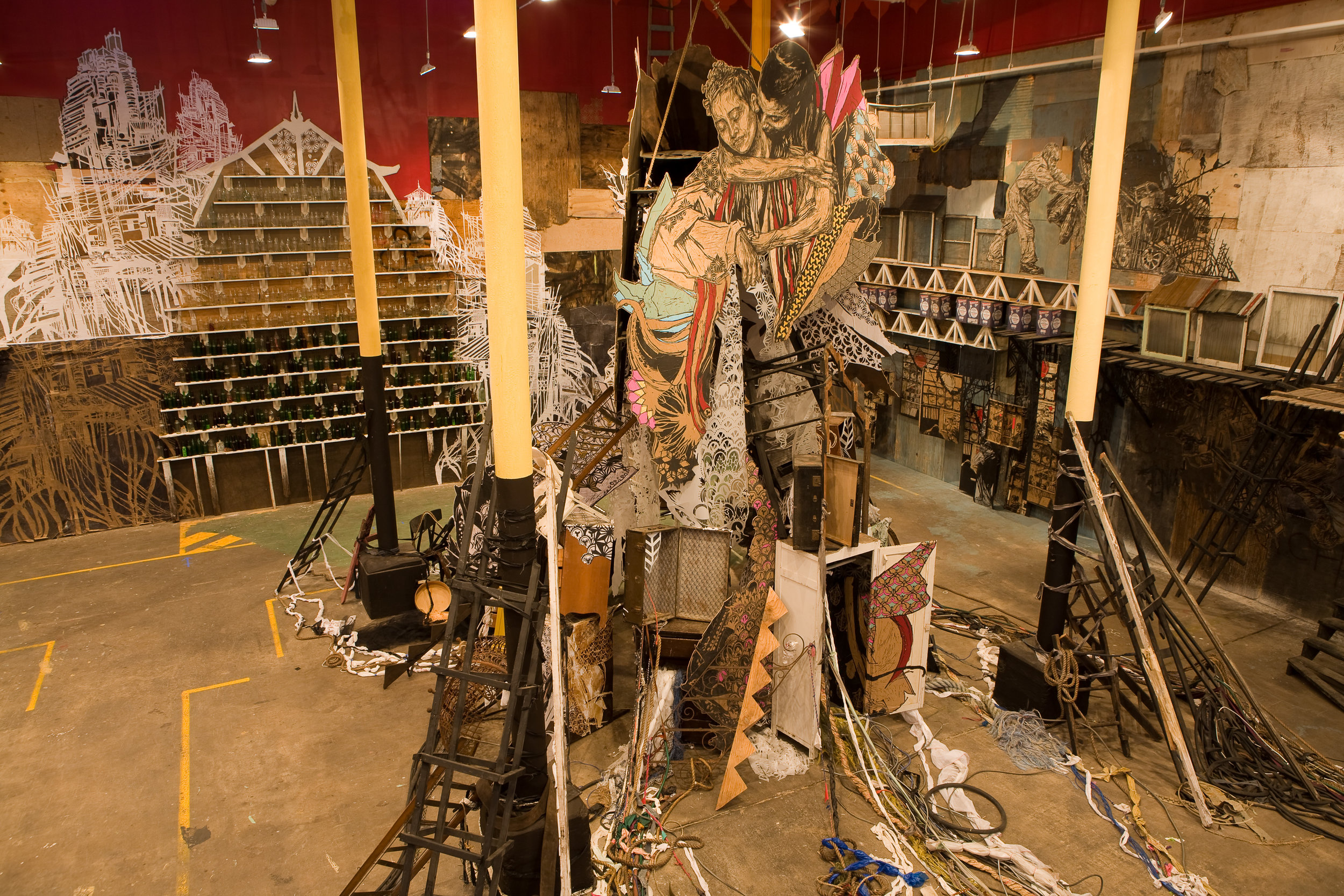
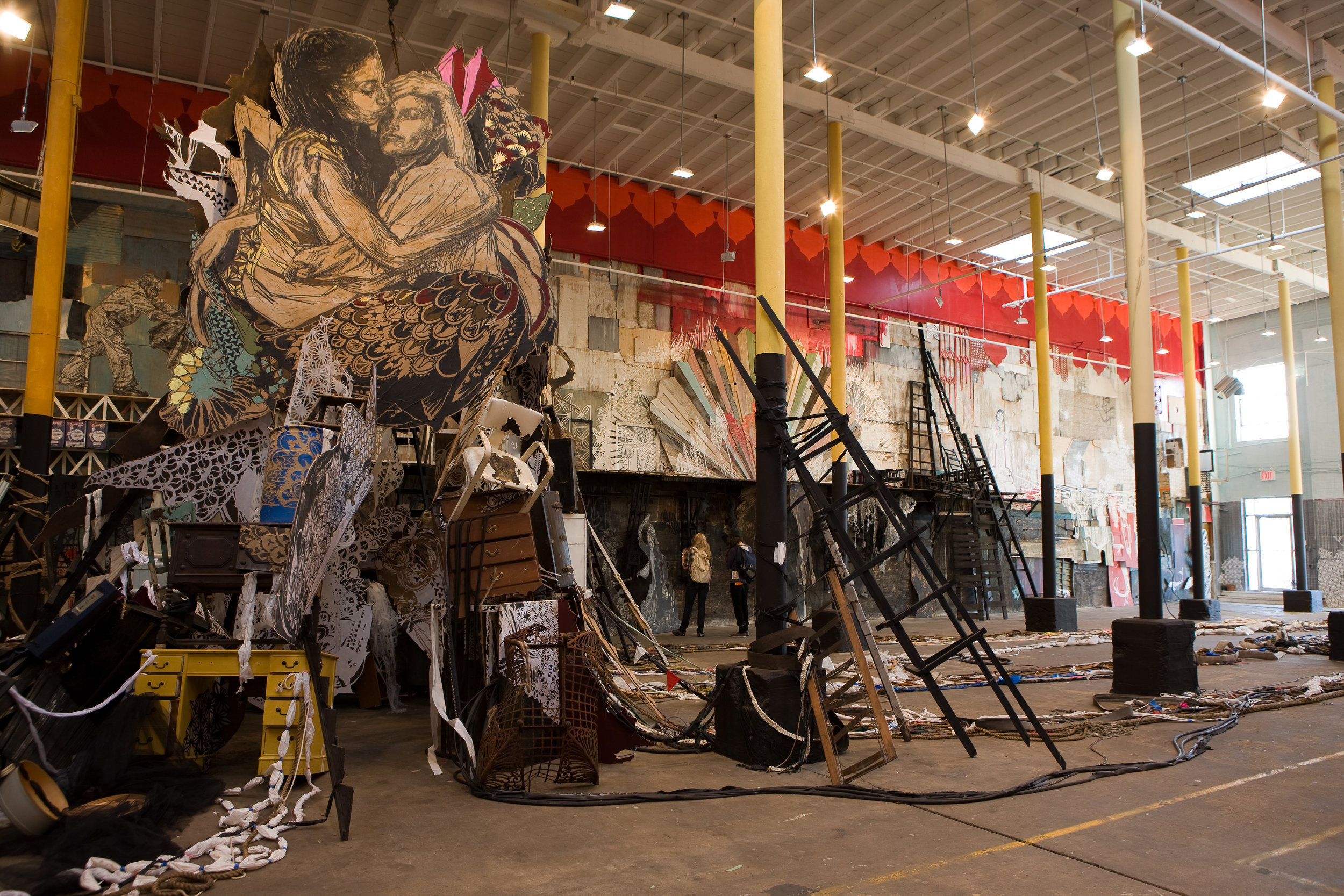
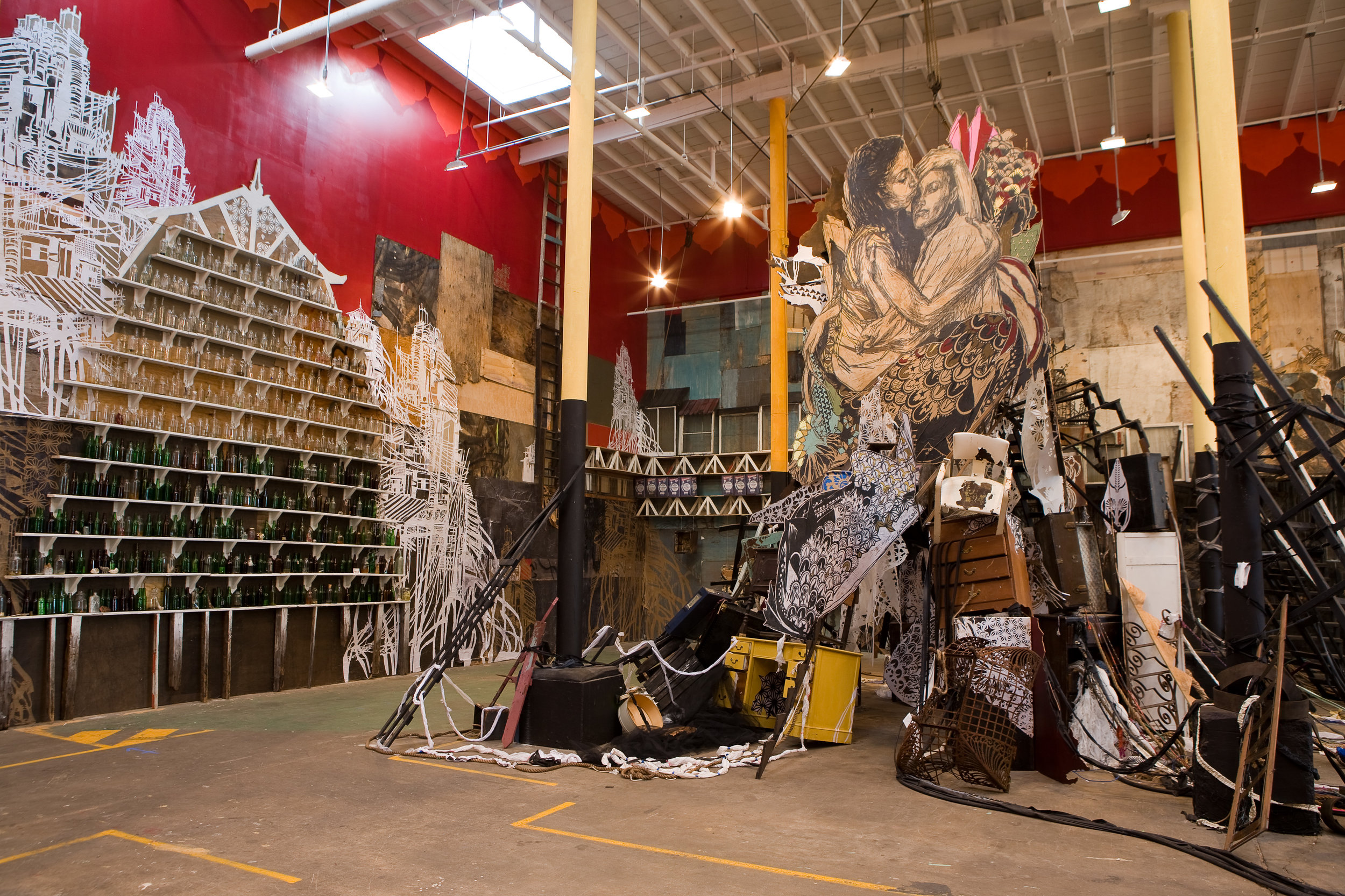
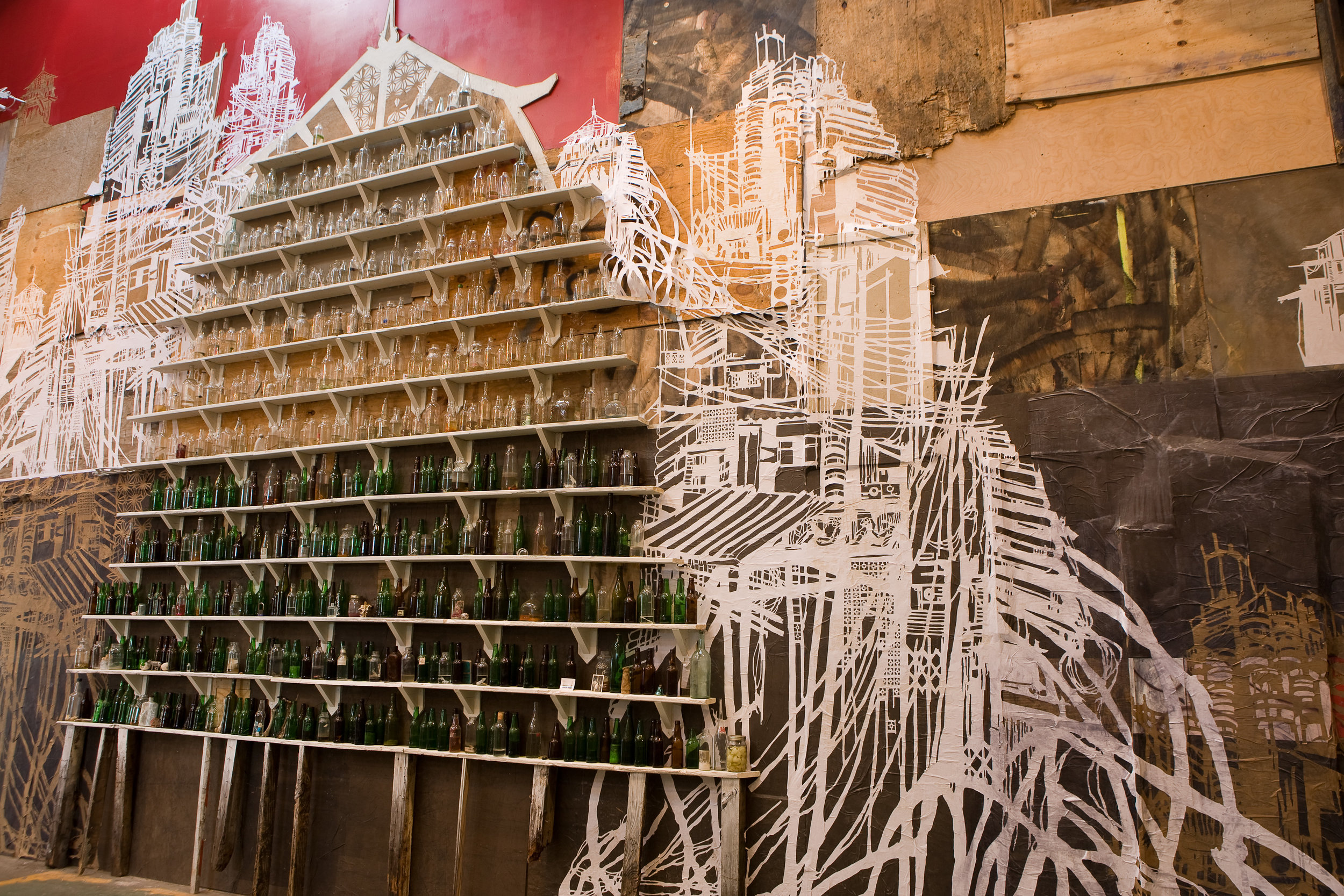
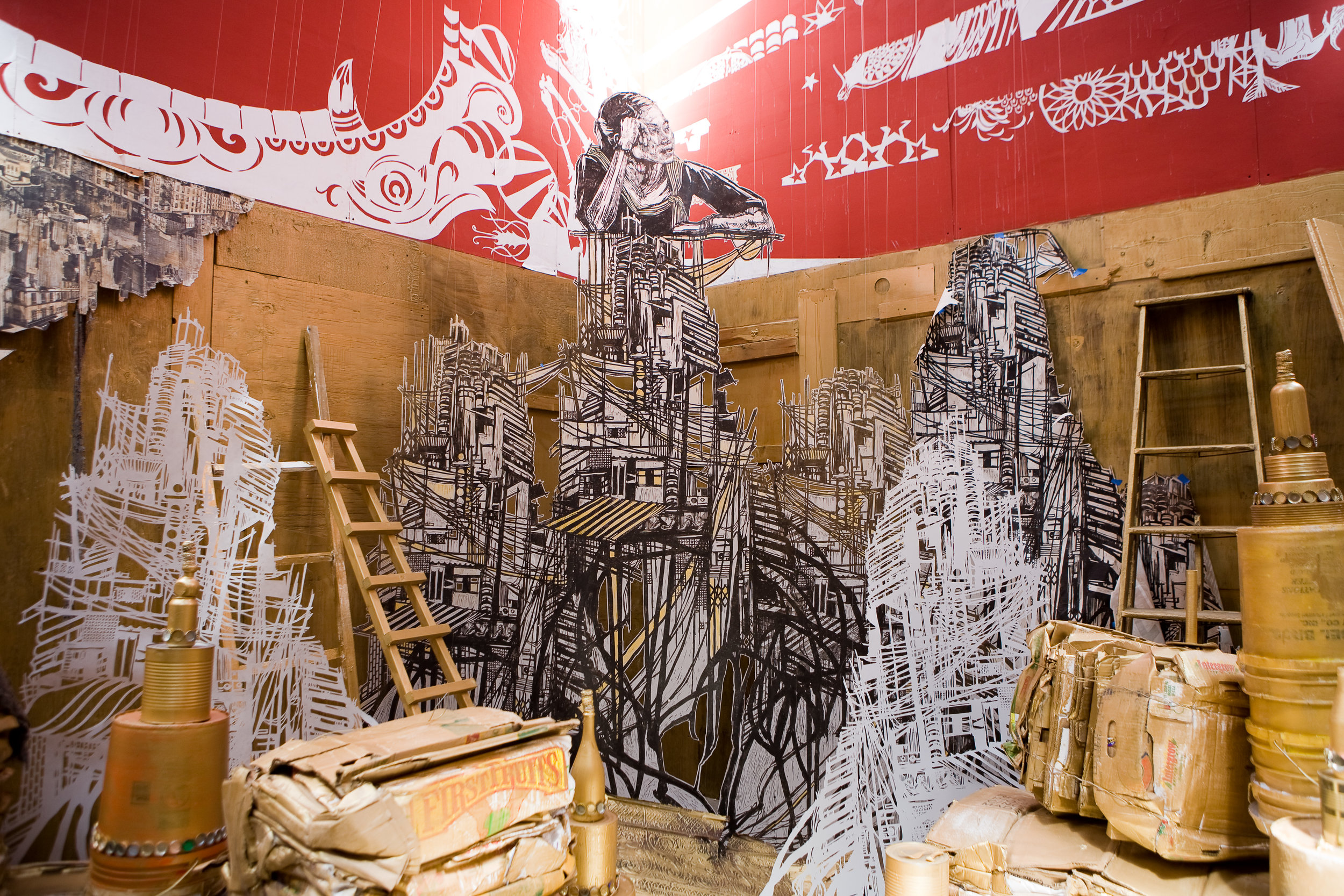
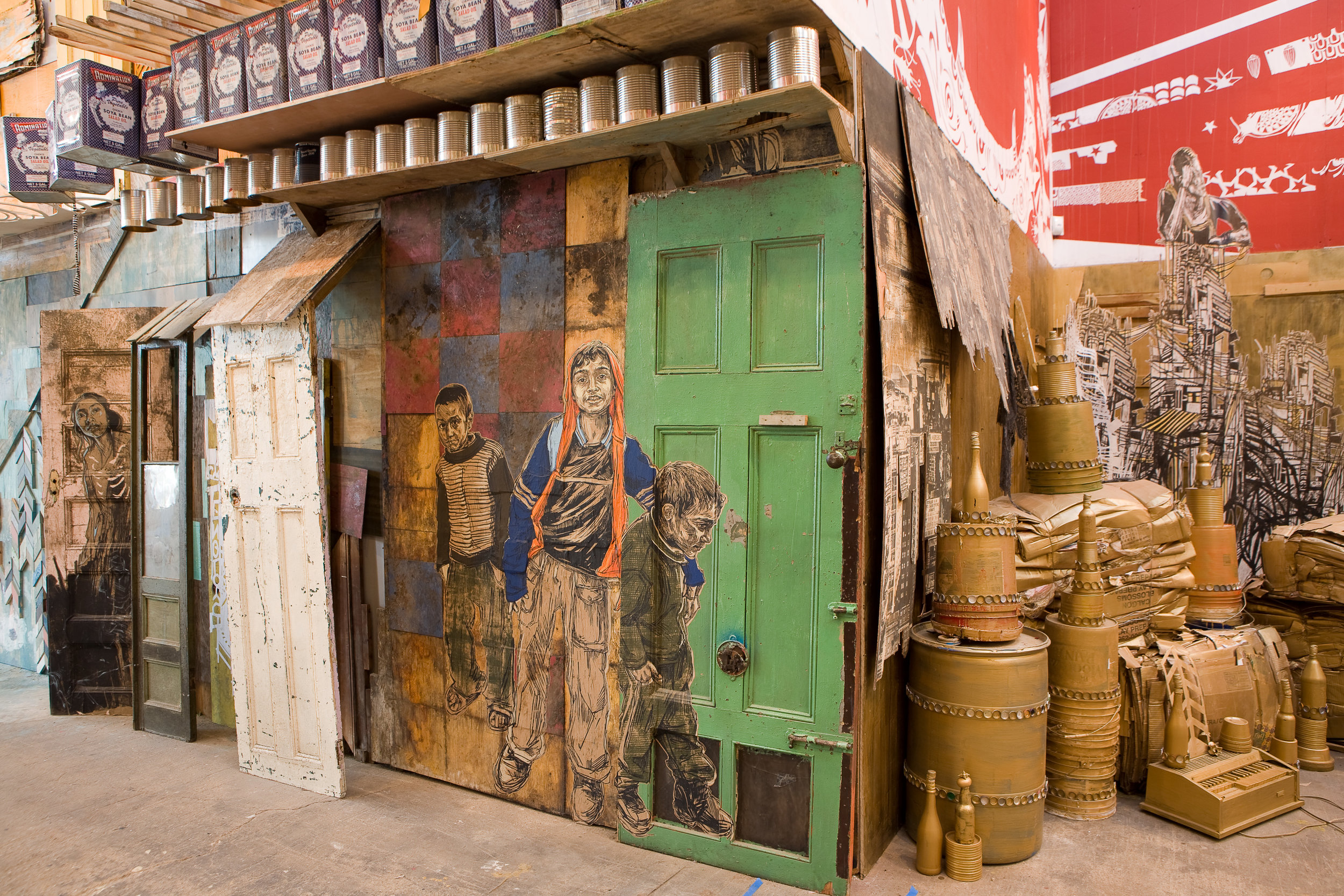
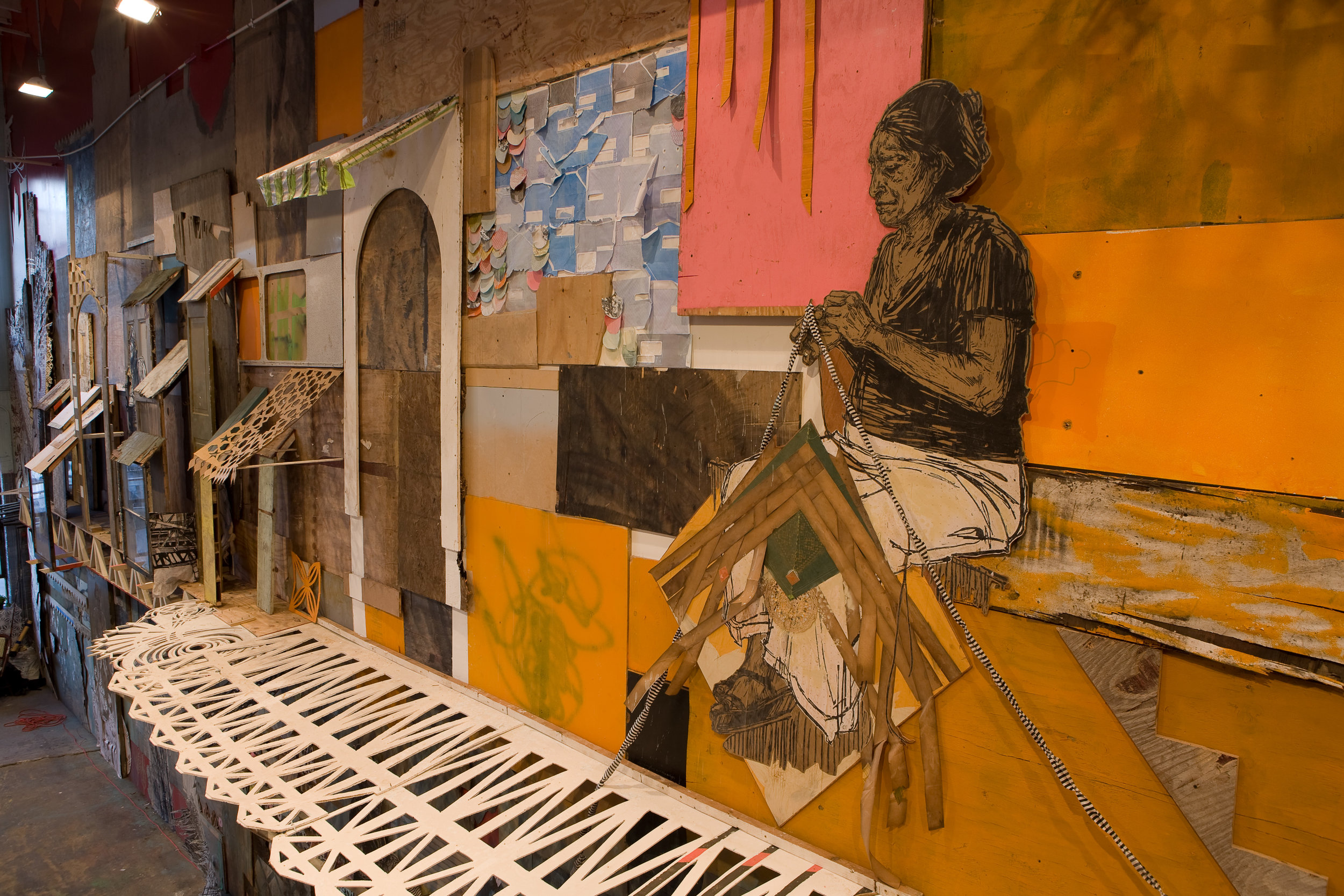
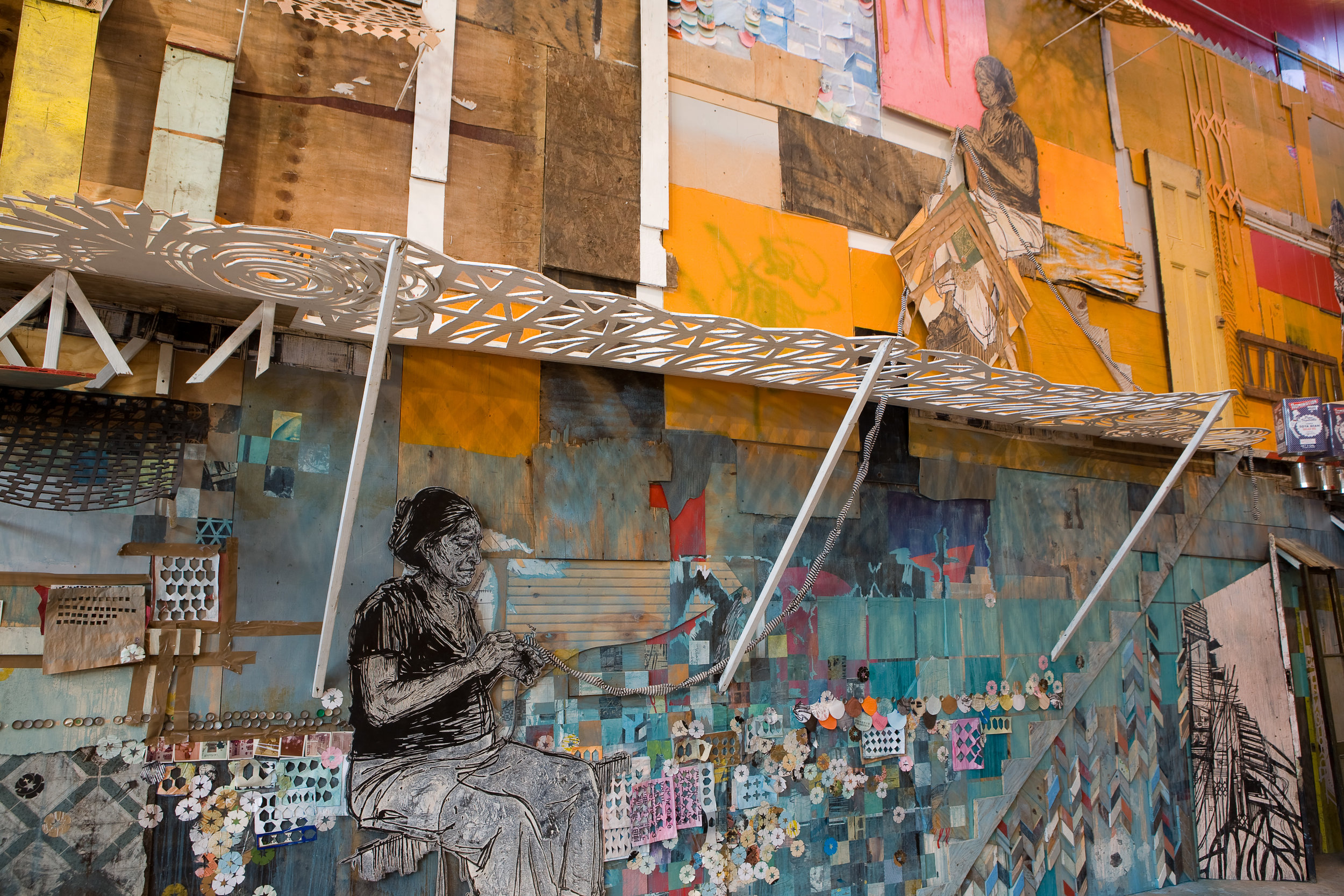
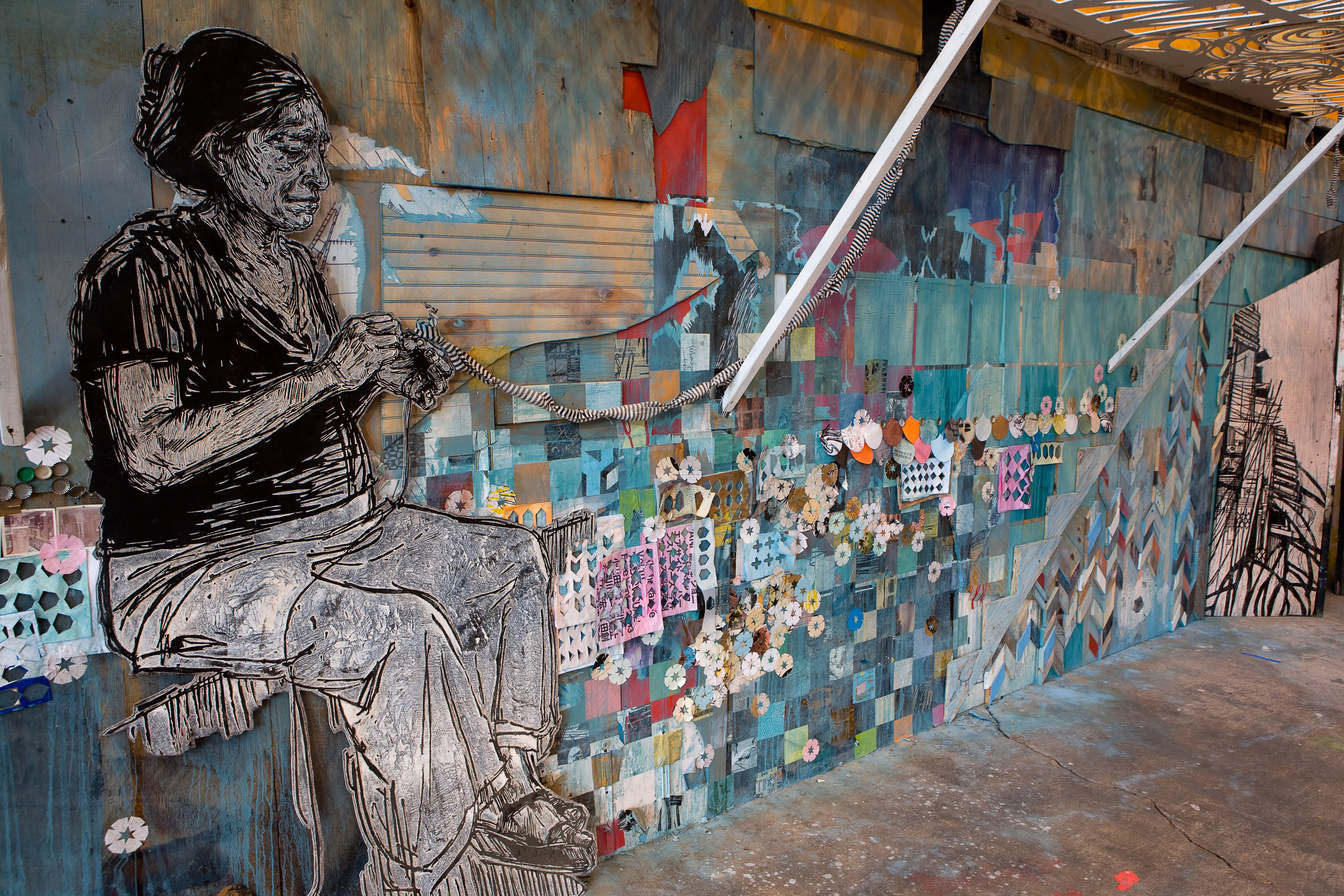
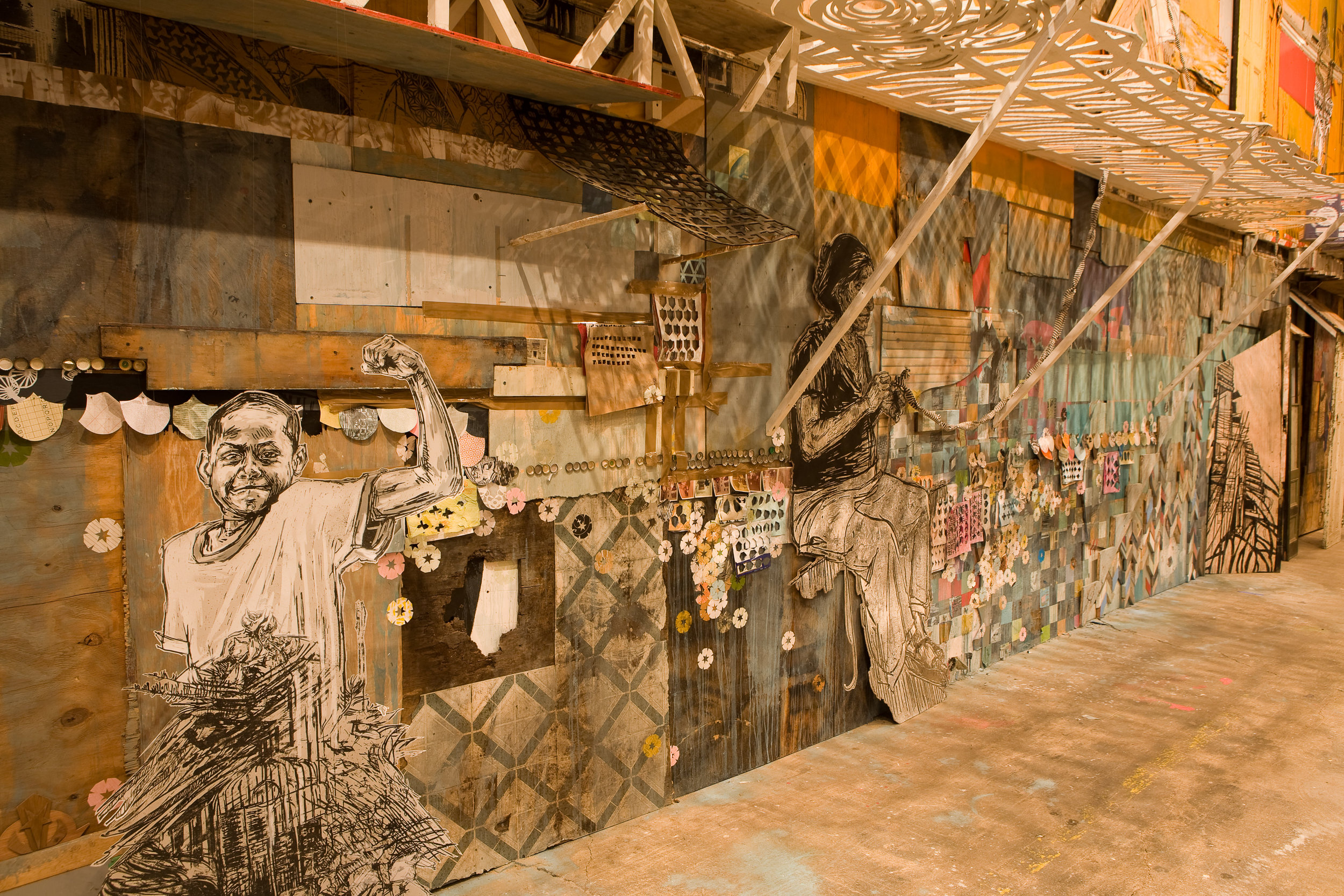
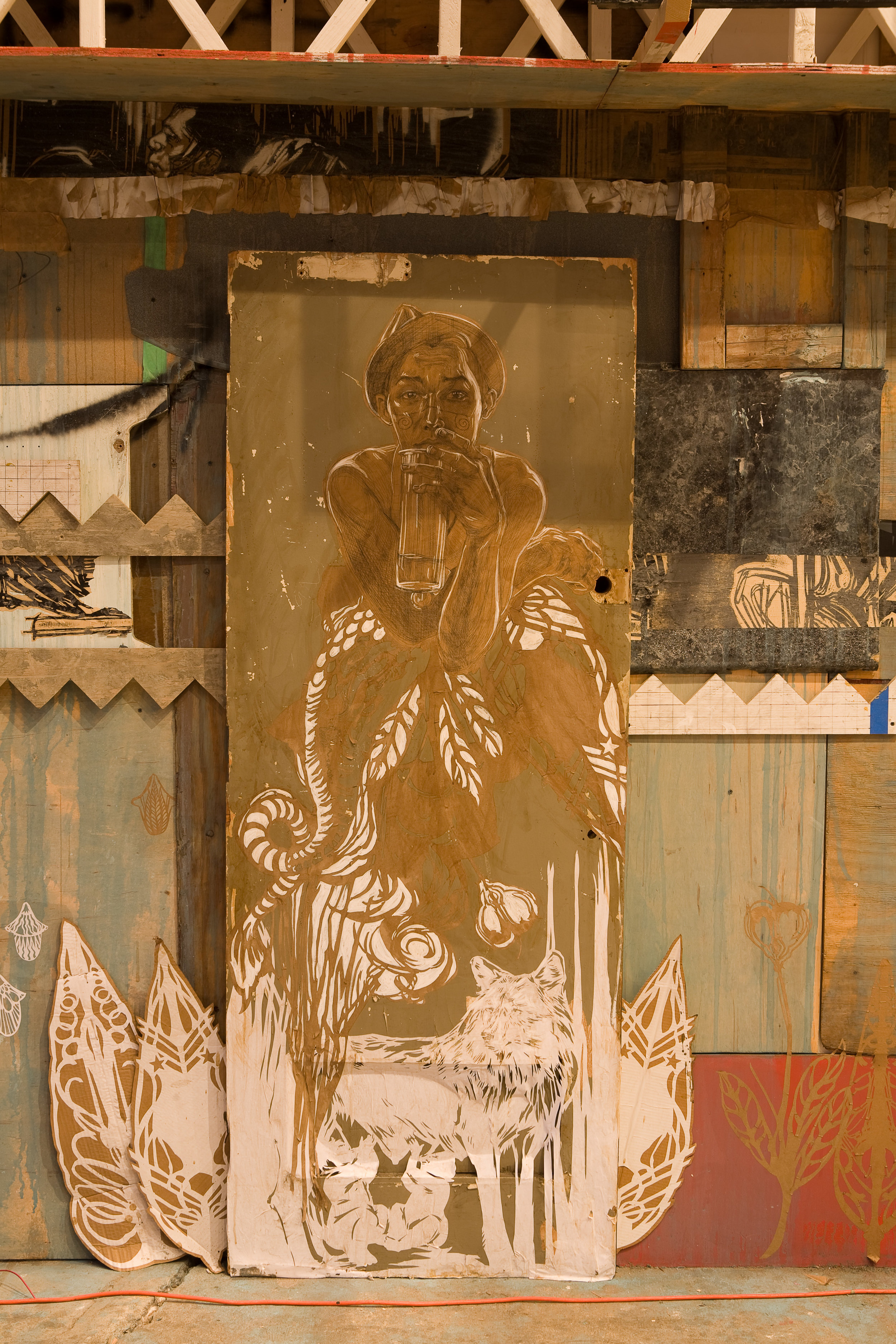
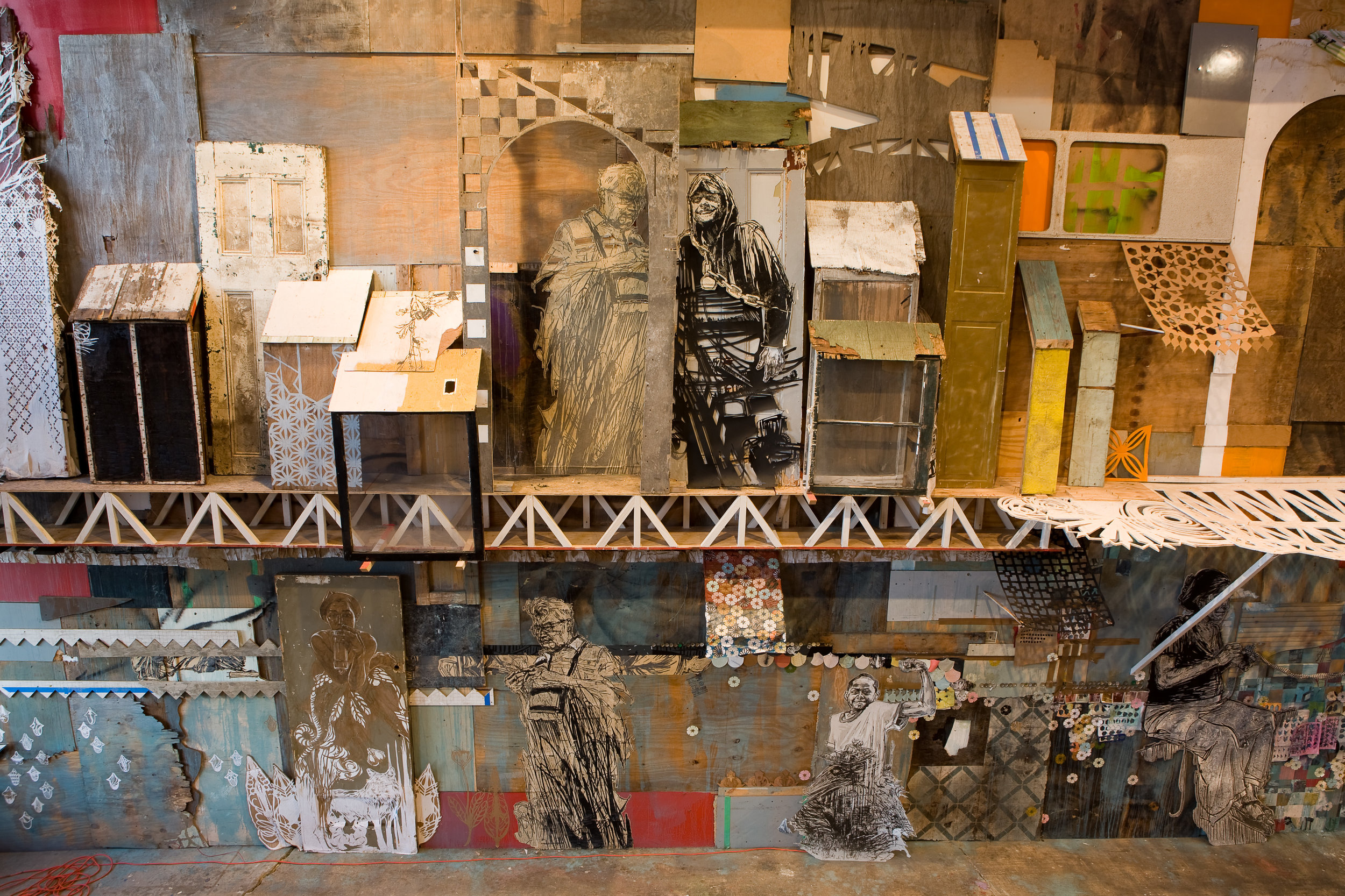
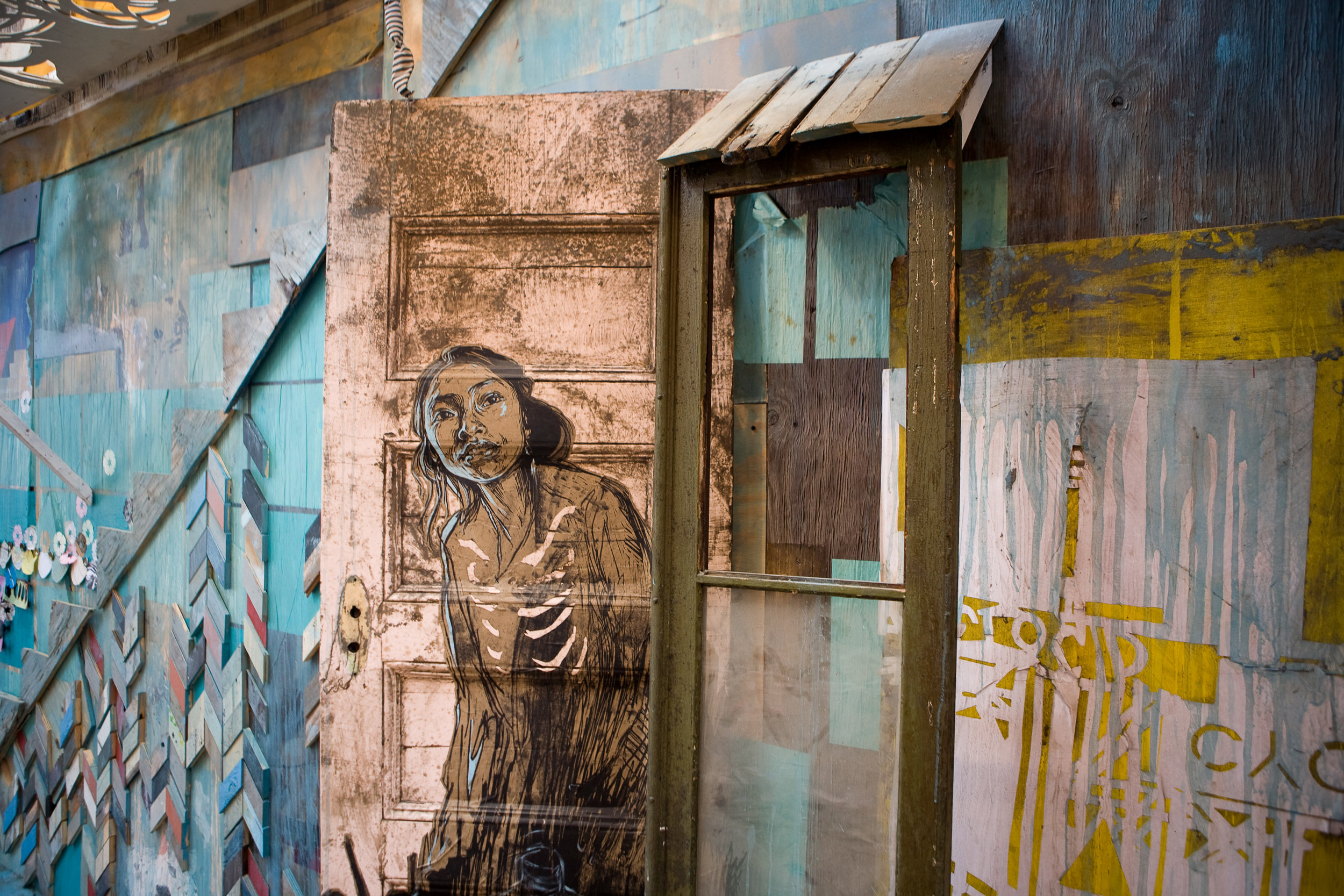
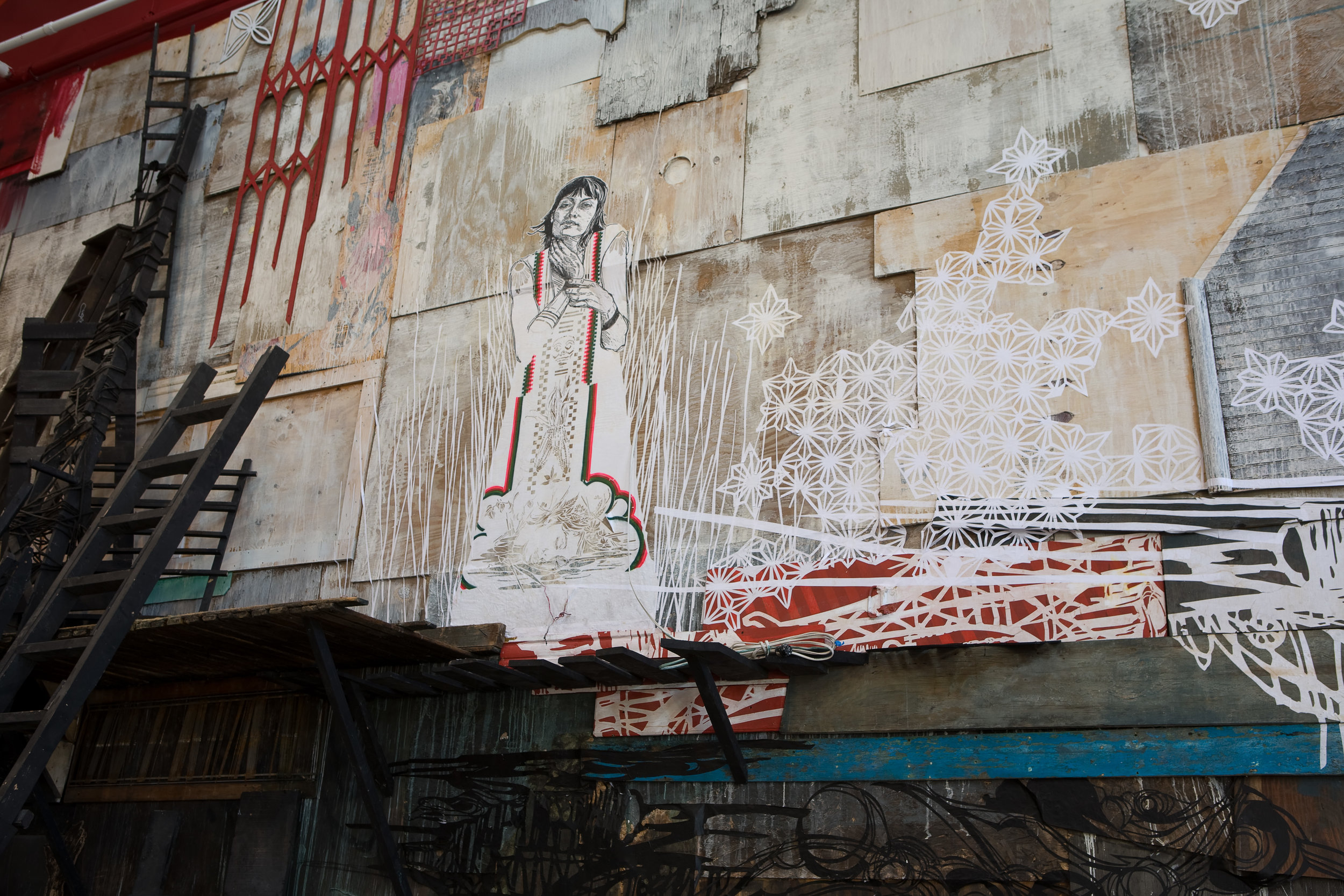
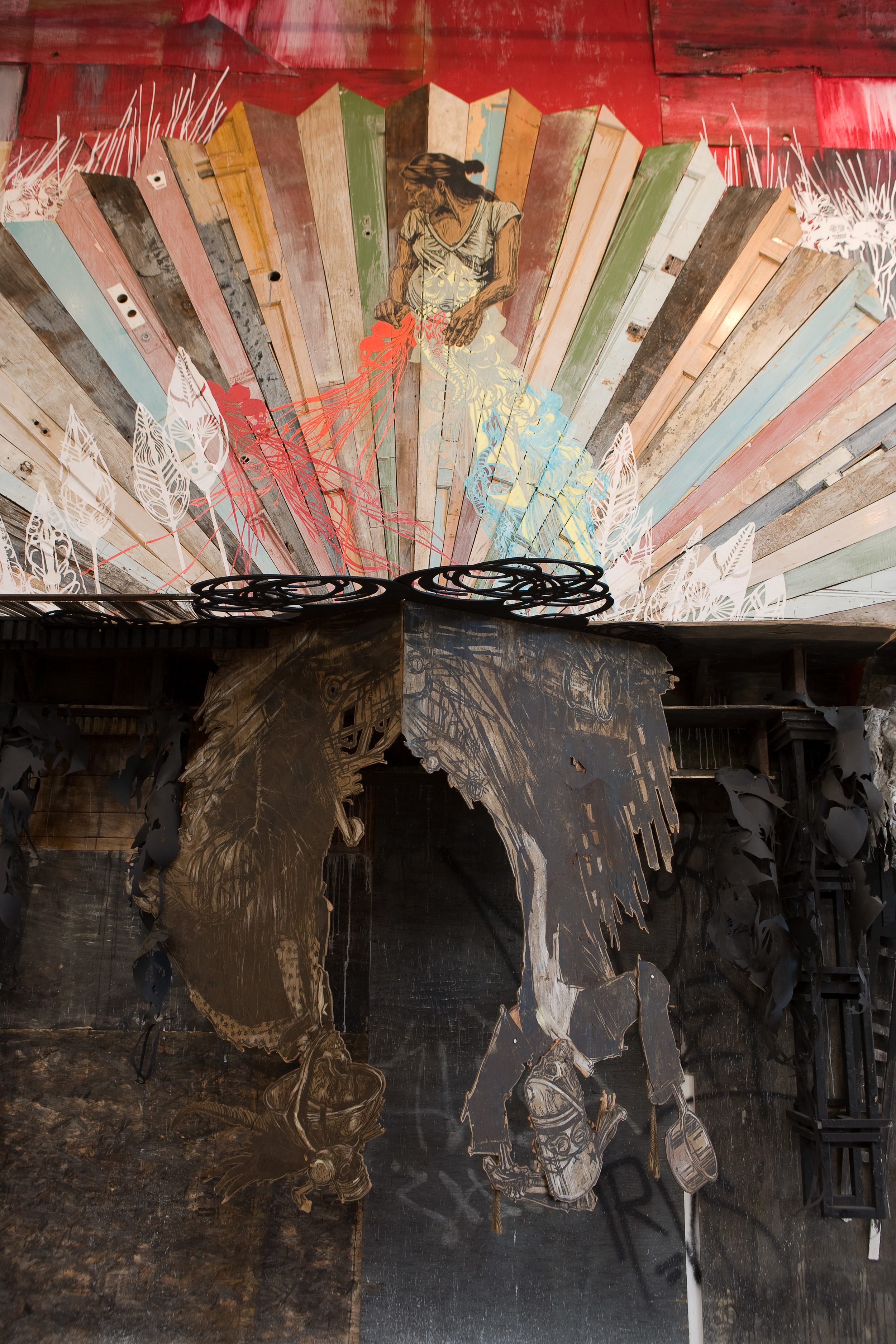
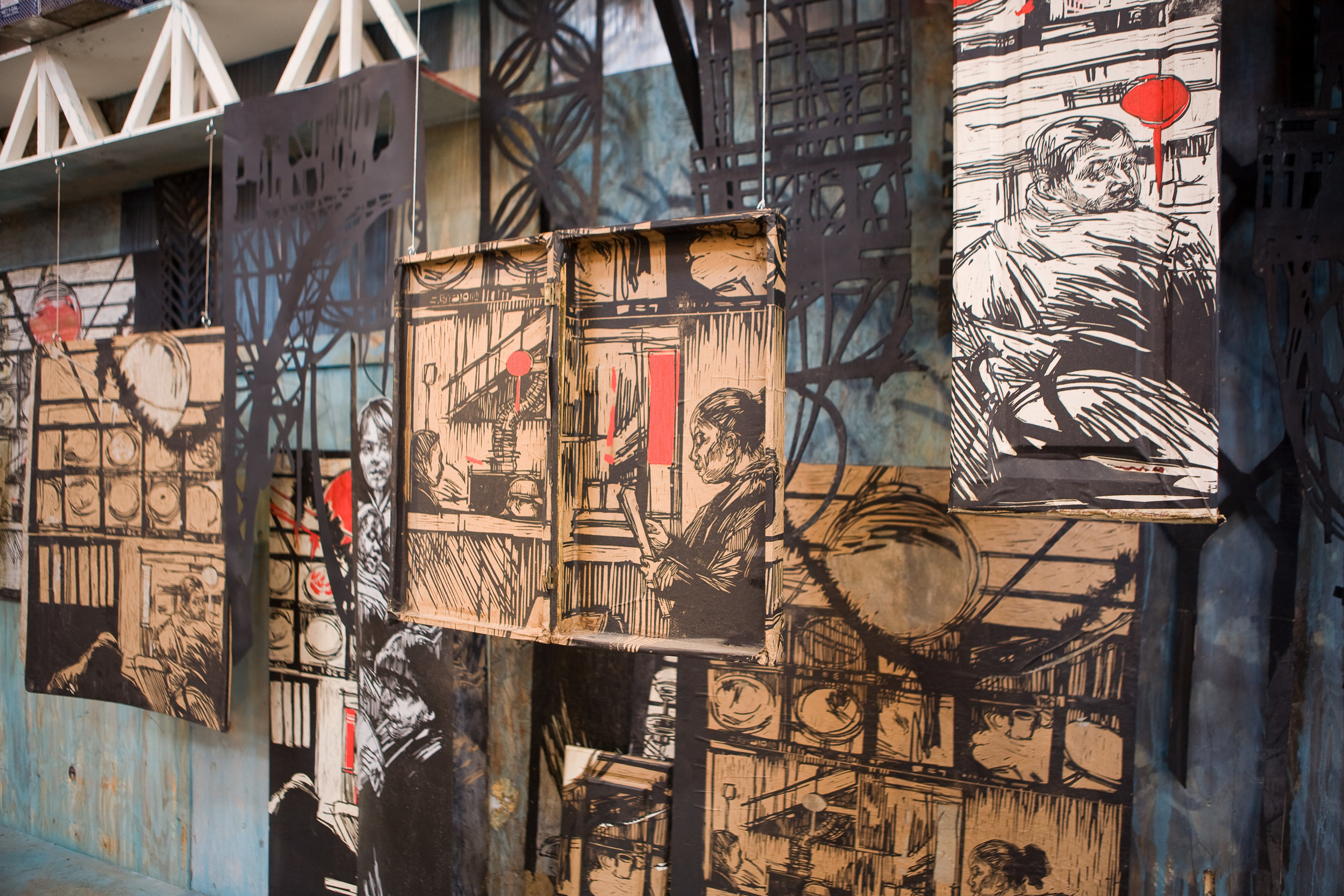
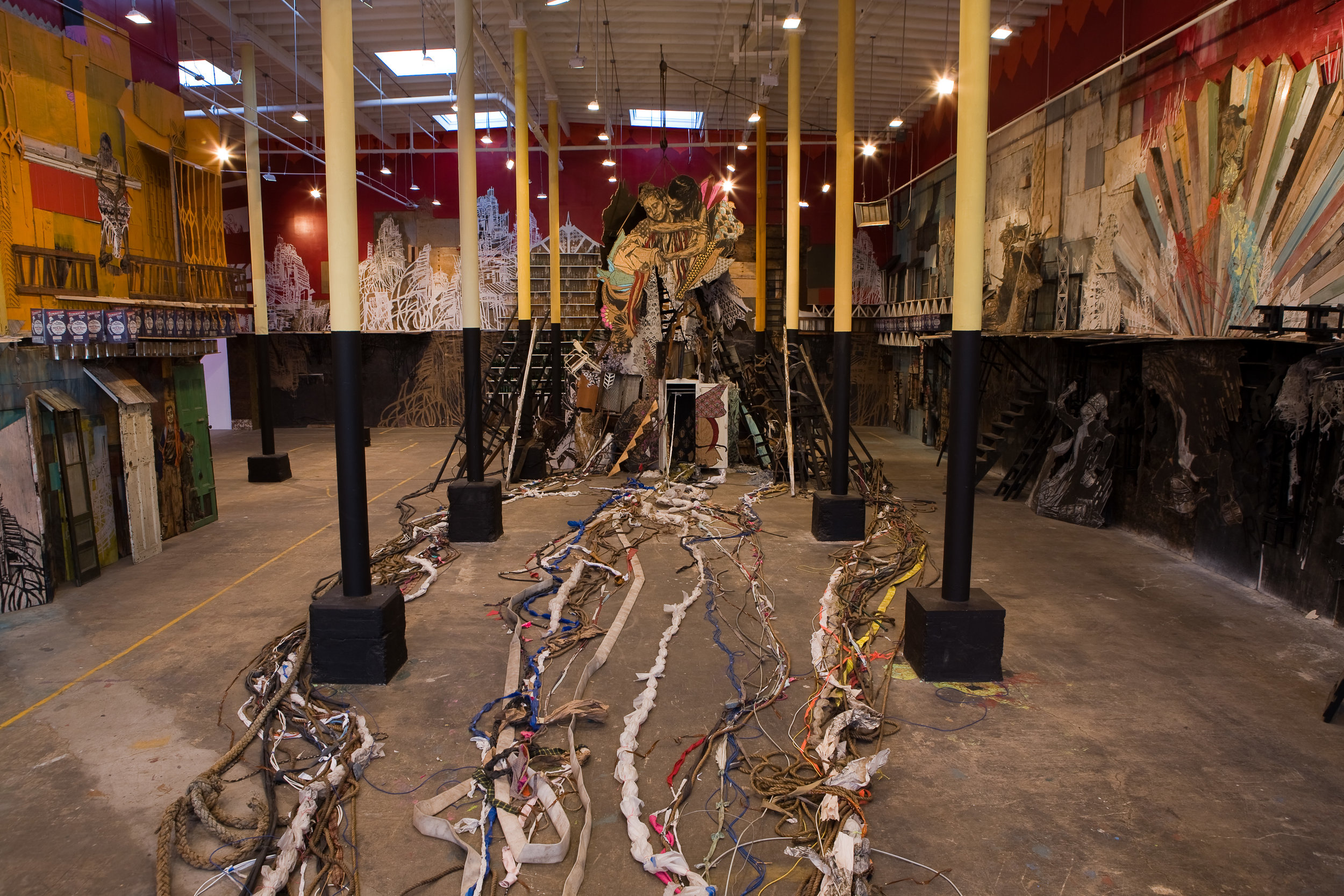
Drown Your Boats was Curry'due south first Los Angeles solo exhibition. The immersive installation was inspired by the Siren and the Crone, mythological representations of women that incite fear, equally well as Angela Carter's collection of short stories "Burning Your Boats," which feature darkly feminist fiction about the subversive potential of desire.
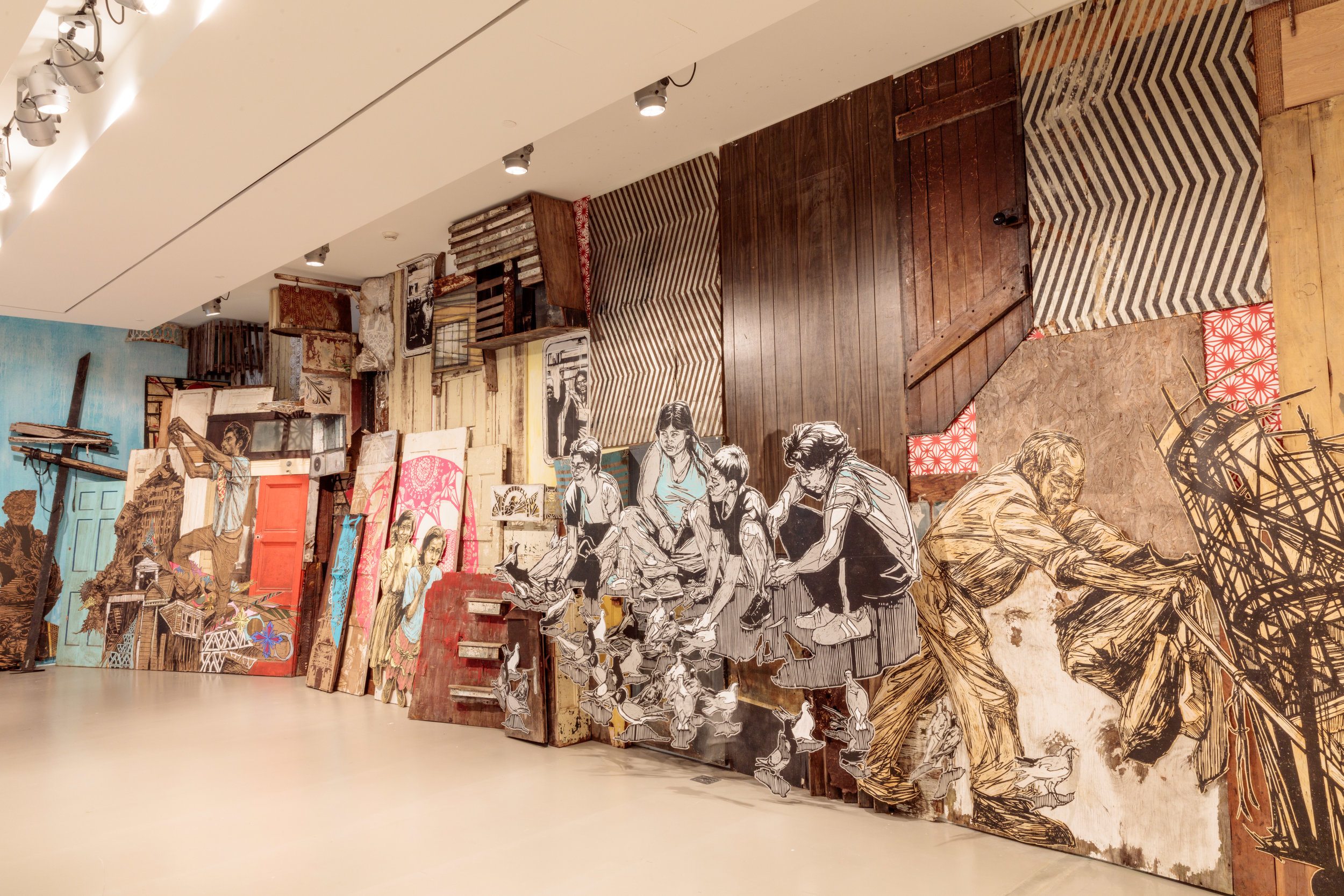
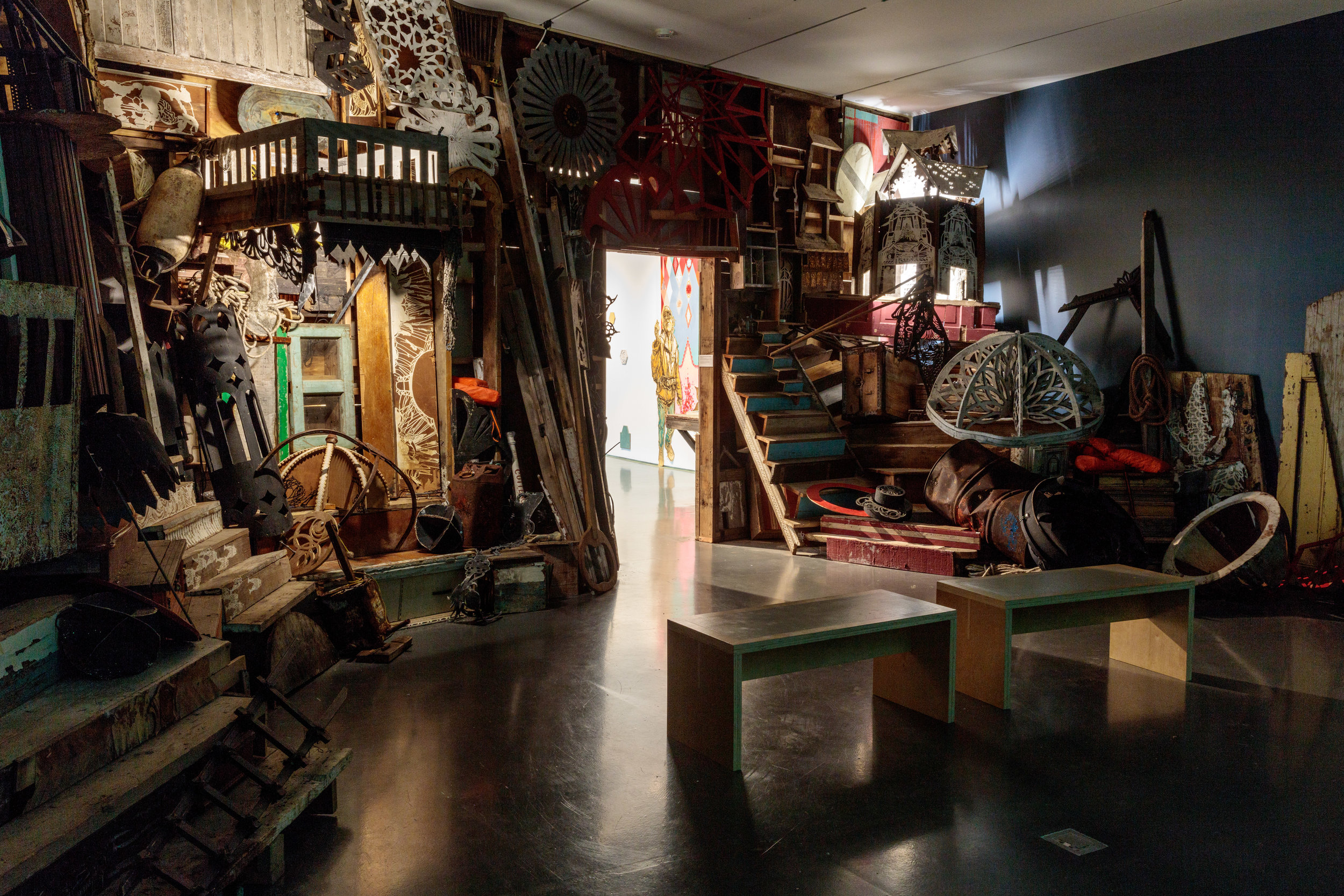
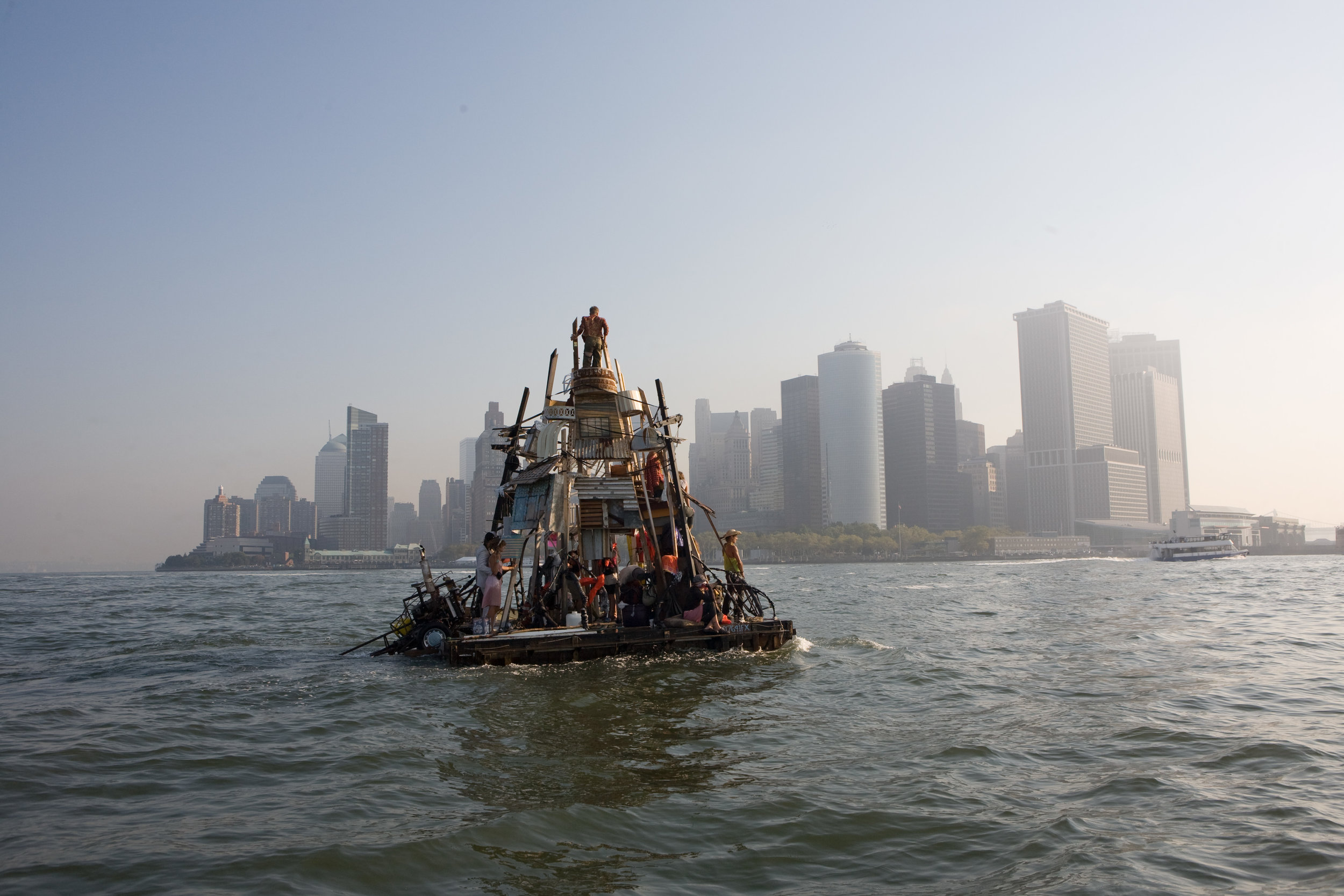
Drown Your Boats transforms New Image Gallery with densely layered sculptural forms, created from reclaimed materials and establish objects overlaid with block-print portraits originally pasted on city streets. It uses the DIY junk boat aesthetic adult by Curry and her collaborators while building their own vessels to navigate the Mississippi and Hudson rivers to manifest an underworld cityscape of the imagination. The centerpiece of the exhibition is a modified canoe that would eventually become office of the river-based performances during Pond Cities of Switchback Body of water.
Curry'due south approach to materials combines the ornate grit of the punk civilisation she was role of with a resourcefulness that originates from deep concern for the ecological touch on of materials and the desire to minimize waste. This exhibition brings together 2 threads that recur in her work about how our struggles for survival are interrelated: within the speculative frameworks of DIY culture, we run into how our vision of commonage living is inseparable from the environment we inhabit.
SWOON
Deitch Projects, New York, NY
July 7 - August 13, 2005
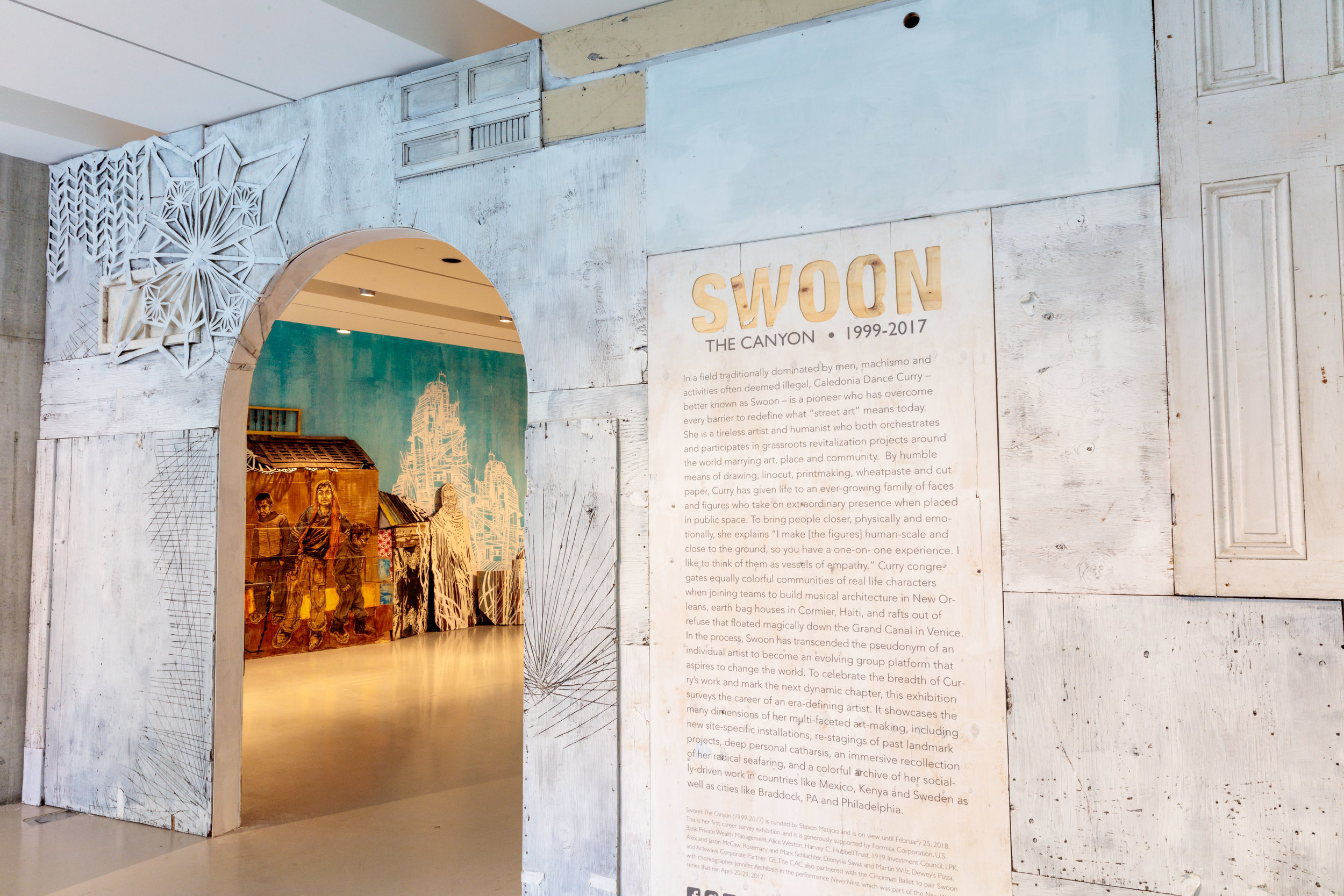
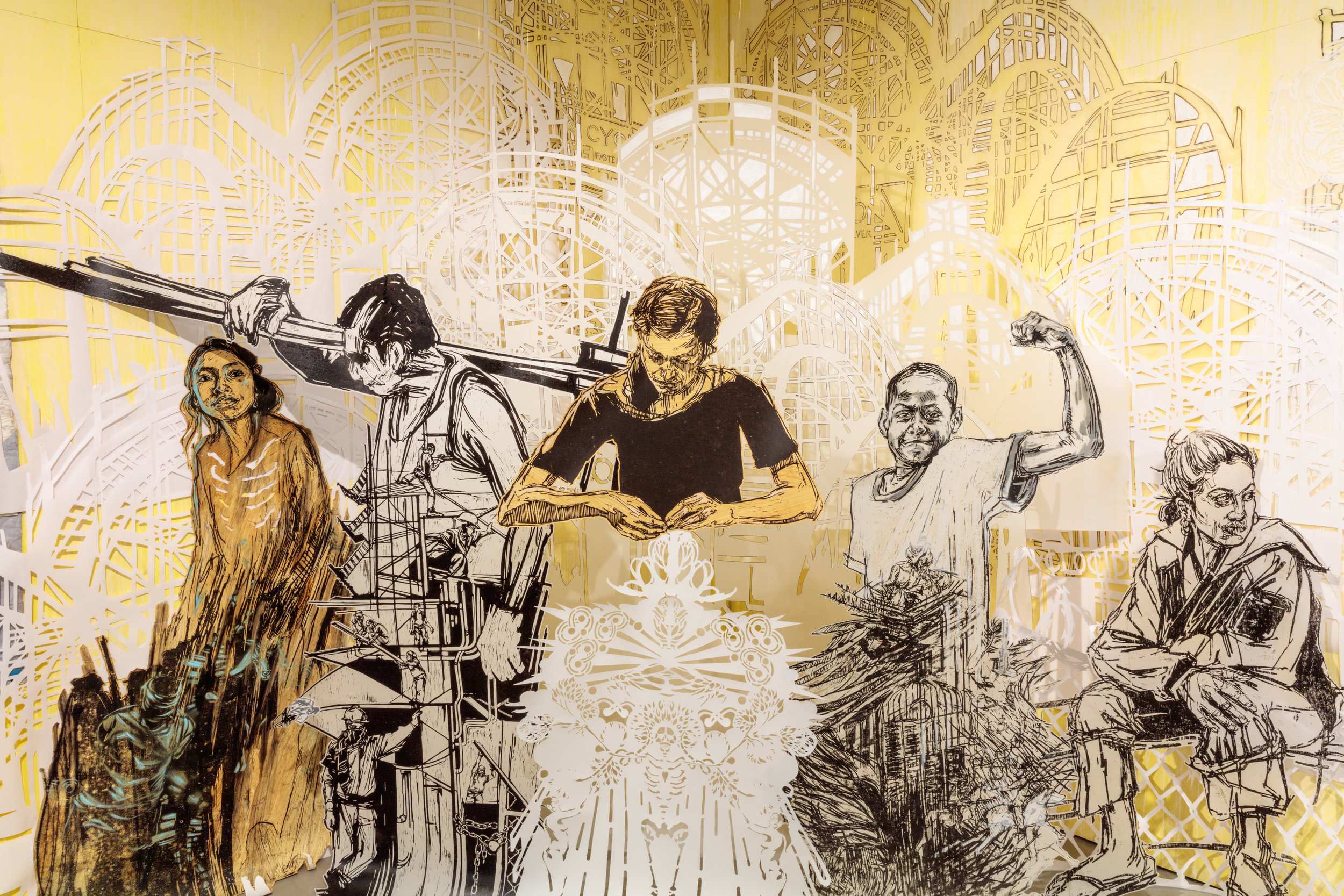
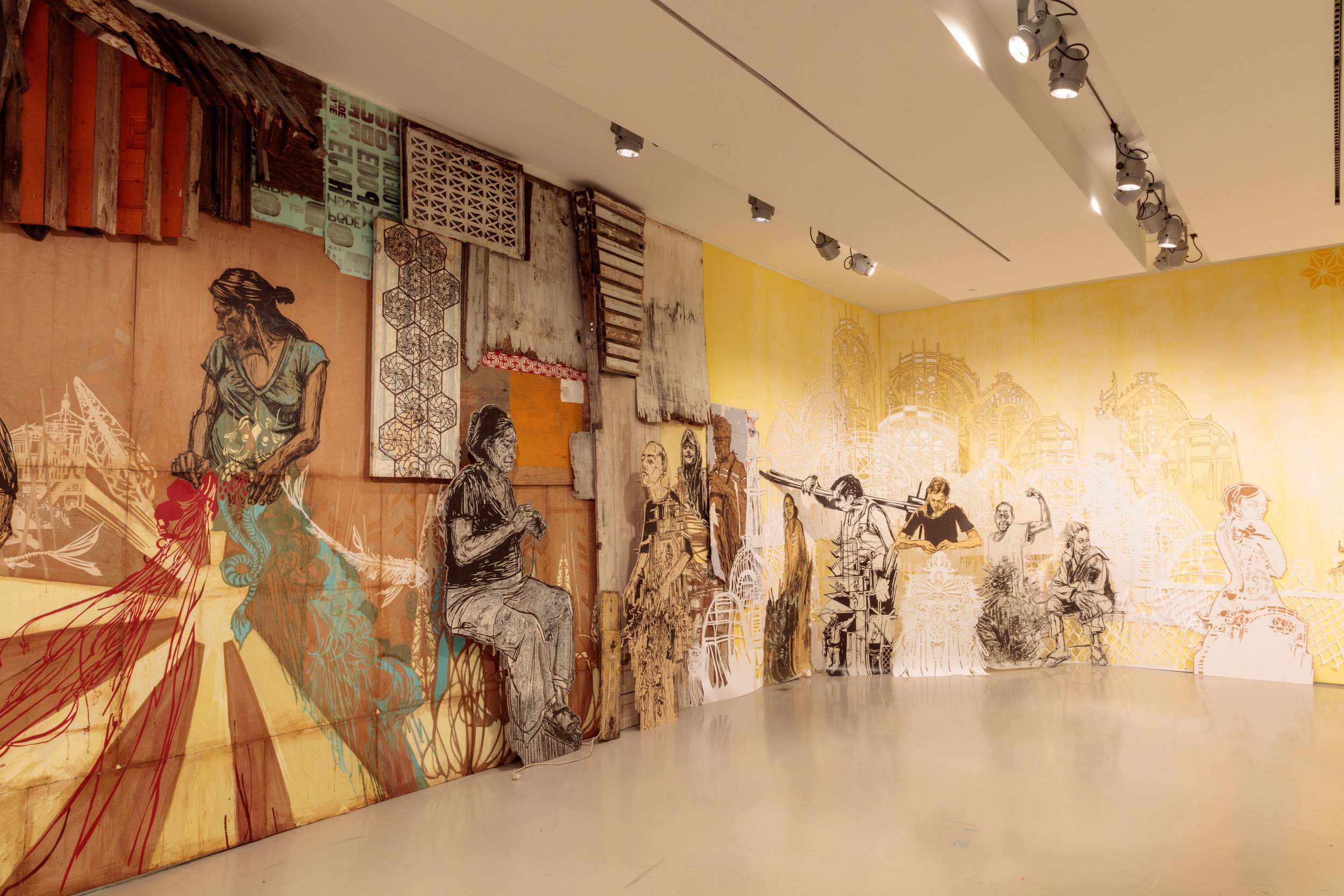
In 2005, the Deitch Projects, founded by Jeffrey Deitch, presented Curry's beginning New York solo exhibition: Swoon. The interior of the gallery was transformed into a cityscape populated past intricate cut out figures and block-prints set within sculptural elements referencing truss-work, ability-lines and elevated trains. Drawing on Kowloon Walled City as the creative signal of departure, Curry hoped to evoke the spontaneous, unregulated, and cocky congenital development that took identify in the autonomous Hong Kong neighborhood earlier it was bulldozed in 1993. She connects the ingenuity and complexity of Kolwoon Walled Urban center, across cultures, to other built environments that ascend from necessity. These include the portraits Curry captures from life as it is lived in public, on the streets of New York City. This early on exhibition introduces many of the themes that volition recur throughout her work, including her focus on urban architecture, activism and liberation movements.
At the opening, guests were greeted by the surprise arrival of the ring Japanther, which played from the back of a Penske box-truck to a street crowded with over ane,000 people. Swoon was seen crowd-surfing downwardly Yard Street, a moment which encapsulates the youth-driven free energy behind the Street Art movement in the early 2000s, and its fluidity with music and popular civilization. Curry discusses this experience in a documentary film by Fredric King, Swoon: fearless (2017).
Watch the Documentary Swoon: fearless, by Frederic King
Source: https://swoonstudio.org/

Post a Comment for "Meaningful Street Art About Water Drawings of Dead Trees"